What It's Really Like to Work as a Flight Attendant
The job is part safety role, part service role: emergency drills, reserve call-outs, overnight layovers and a seniority system that shapes almost everything.
Quick answer
- Typical entry-level education is a high school diploma or equivalent (U.S. Bureau of Labor Statistics, 2025).
- Median annual wage was $63,580 in May 2025 (U.S. Bureau of Labor Statistics).
- Employment is projected to grow 9 percent from 2025 to 2035 (U.S. Bureau of Labor Statistics).
Working as a flight attendant means being trained and federally certified for emergencies first, and serving passengers second. The typical entry-level education is a high school diploma or equivalent (U.S. Bureau of Labor Statistics, 2025), airlines train you themselves for several weeks to a few months, and the median annual wage was $63,580 in May 2025 (U.S. Bureau of Labor Statistics).
The tradeoffs are real: on-duty days run from 4 to 18 hours or longer, almost everyone starts on reserve status, and the occupation has one of the highest injury and illness rates of any job (U.S. Bureau of Labor Statistics, 2025).
What This Job Involves Day to Day
There is no standard day. On-duty shifts run from 4 to 18 hours or longer, with the long end usually belonging to international flying (U.S. Bureau of Labor Statistics, 2025). Here is one realistic domestic duty day.
The night before, you check the trip in your airline's crew scheduling system — ONET lists calendar and scheduling software such as AD OPT Altitude among the technology flight attendants use (National Center for ONET Development) — and skim company bulletins in Microsoft Outlook for aircraft swaps or security notices.
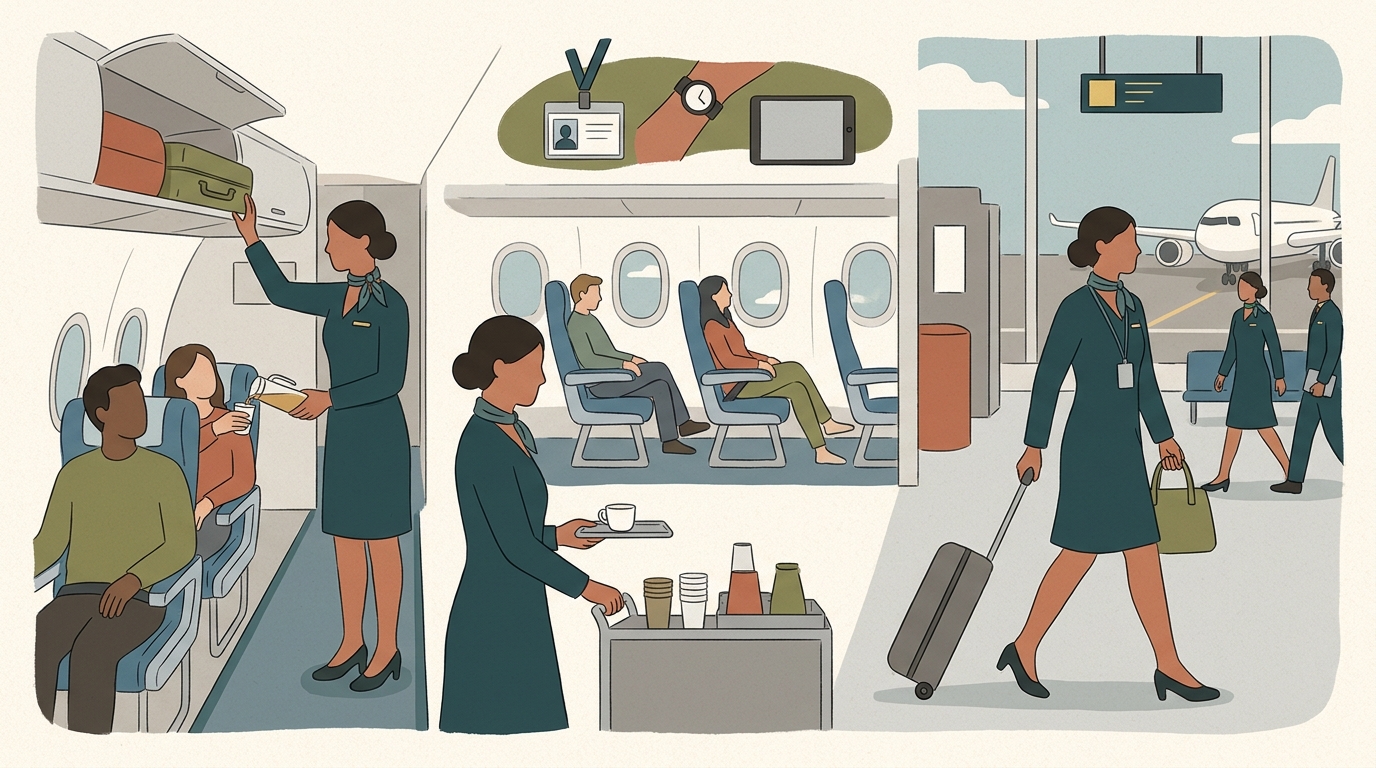
5:50 a.m. report time at the crew room. You sign in, confirm the sequence hasn't been rerouted, and walk to the gate with the rest of the crew.
6:05 a.m. preflight briefing with the pilots: flight time, expected turbulence, door assignments, how an evacuation would be run on this aircraft type. Then the preflight inspection of emergency equipment — extinguishers, oxygen bottles, first aid and medical kits, flashlights, slide indicators — checking each is aboard, in date and in its assigned place.
6:40 a.m. boarding: greeting passengers, watching carry-on sizes, noting who is seated in an exit row and whether they can perform the required functions. 7:10 a.m. doors closed, safety demonstration, seatbelt and tray table check, then your jumpseat for takeoff.
In cruise you run the cabin service, take onboard payments on the airline's handheld device, answer call bells and keep an eye on the cabin. If someone faints or a passenger becomes disruptive, you are the first responder and the person writing the report afterwards.
Then you do it again. A domestic day often has two to four legs with 35- to 60-minute turns between them: secure the cabin, tidy, board, demo. Around 9 p.m. the last flight lands at an outstation, you ride the crew van to a hotel and set an alarm for a 6 a.m. lobby time. Days off are bid by seniority, not chosen freely.
The physical cost is not theoretical. Flight attendants have one of the highest rates of injuries and illnesses of all occupations, including sprains, strains and bruises (U.S. Bureau of Labor Statistics, 2025).
Common Tasks and Responsibilities
- Participate in preflight briefings with the pilots covering flight time, weather, turbulence and emergency procedures for that aircraft (U.S. Bureau of Labor Statistics, 2025).
- Conduct preflight inspections of emergency equipment, confirming extinguishers, oxygen, medical kits and escape slides are present and serviceable (U.S. Bureau of Labor Statistics, 2025).
- Demonstrate the use of safety equipment — seatbelts, oxygen masks, life vests and exits — before every departure (U.S. Bureau of Labor Statistics, 2025).
- Brief passengers seated in exit rows and reseat anyone who cannot perform the required functions.
- Secure the cabin for takeoff, turbulence and landing, stowing galley carts and latching overhead bins.
- Administer first aid from the onboard medical kit and coordinate with ground-based medical advice when a passenger falls ill in flight.
- Manage disruptive passengers, escalate to the captain and file the incident report after landing.
- Bid monthly schedules, trade trips and track legality limits in crew scheduling software such as AD OPT Altitude (National Center for O*NET Development).
Salary and Job Outlook by Experience Level
Flight attendant pay is not a straight salary. Most airlines pay an hourly flight-hour rate that starts when the aircraft door closes, plus a per diem for every hour away from base and premiums for purser or language-qualified positions. The rate climbs on a published longevity scale tied to years at that airline, so changing carriers usually means restarting at first-year rates.
The national median annual wage was $63,580 in May 2025 (U.S. Bureau of Labor Statistics). The same release shows the median in nonscheduled air transportation — charter and corporate flying — was higher than in scheduled air transportation.
| Career stage | Typical years of experience | Where pay usually sits |
|---|---|---|
| Entry-level (reserve) | 0-2 years | Below the national median of $63,580 (BLS, May 2025); check the published lowest 10 percent figure |
| Mid-career (line holder) | 3-10 years | Around the national median of $63,580 (BLS, May 2025), with more credited flight hours |
| Experienced / senior | 10+ years | Above the national median of $63,580 (BLS, May 2025); BLS also publishes a highest 10 percent figure |
Pay figures: U.S. Bureau of Labor Statistics, Occupational Employment and Wage Statistics and Occupational Outlook Handbook, May 2025. These are national figures; pay varies by airline, contract and base, so check the current BLS release and the applicable union contract rather than one number.
Outlook: employment of flight attendants is projected to grow 9 percent from 2025 to 2035, much faster than the average for all occupations (U.S. Bureau of Labor Statistics, 2025).
Skills and Traits That Fit This Work
- Calm under pressure. When a passenger stops breathing at altitude, you open the medical kit and direct the other crew while the aircraft is still two hours from a diversion airport.
- Memorised procedure recall. Door operation, evacuation commands and decompression drills have to come out under stress, which is why recurrent training is required every year to maintain FAA certification (U.S. Bureau of Labor Statistics, 2025).
- Service experience that holds up. Airlines typically expect 1 or 2 years in a service occupation first (U.S. Bureau of Labor Statistics, 2025), because de-escalating an angry passenger in row 14 is the same skill as de-escalating one at a hotel desk.
- Physical stamina. You push carts, lift bags overhead and stand through turbulence; sprains, strains and bruises are common enough that the occupation has one of the highest injury rates of any job (U.S. Bureau of Labor Statistics, 2025).
- Tolerance for an unpredictable schedule. Reserve means answering the phone and reaching the airport inside a set call-out window, sometimes for a trip that keeps you away four days.
- Attention to small detail. A broken seal on an extinguisher is a delay if you catch it on preflight and a serious problem if you don't.
- Administrative follow-through. Missing a bid deadline in scheduling software such as AD OPT Altitude can cost you a month of good trips (National Center for O*NET Development).
How to Get Started
- Finish a high school diploma or equivalent. That is the typical entry-level education for the occupation (U.S. Bureau of Labor Statistics, 2025). A GED or state equivalency credential usually takes a few months of study and meets the same bar; a degree is not required, though some airlines prefer one.
- Spend 1 or 2 years in a customer-facing service job. Flight attendants typically need that much experience in a service occupation before being hired (U.S. Bureau of Labor Statistics, 2025). Hospitality, retail, restaurant, hotel front desk or cruise work all count as documented experience handling the public.
- Clear the baseline requirements before you apply. Applicants must meet a minimum age, typically 18 or 21; be eligible to work in the U.S.; hold a valid passport; pass a background check and a drug test; and have vision correctable to at least 20/40 (U.S. Bureau of Labor Statistics, 2025). Start the passport early — no airline will hold a class date for it.
- Apply through airline careers portals. Carriers recruit directly on their own sites, usually with a recorded video interview, then a group assessment day, then a conditional offer pending the background check and drug screen. Include charter and corporate operators: nonscheduled air transportation had a higher median wage than scheduled air transportation in May 2025 (U.S. Bureau of Labor Statistics).
- Complete initial training and earn FAA certification. After hire, the airline runs initial training at its flight training center, typically several weeks to a few months, and it is required for FAA certification (U.S. Bureau of Labor Statistics, 2025). Pass and you receive the FAA Certificate of Demonstrated Proficiency. Expect to start on reserve status, as almost all new hires do, and to return for recurrent training every year.
Frequently asked questions
Do I need a college degree to become a flight attendant?
No. The typical entry-level education is a high school diploma or equivalent (U.S. Bureau of Labor Statistics, 2025). What airlines screen hardest for is service experience, usually 1 or 2 years, plus the ability to pass a background check, a drug test and the vision standard. Some carriers prefer a degree, but it is not a stated requirement across the occupation.
How does pay progress over a career?
Most carriers use an hourly flight-hour rate on a longevity scale, so earnings rise with years at that specific airline rather than years in the industry. Reserve years sit at the bottom of the scale with fewer credited hours. The national median annual wage was $63,580 in May 2025 (U.S. Bureau of Labor Statistics); check the current release and the applicable contract.
What are the schedule and physical demands really like?
On-duty shifts vary from 4 to 18 hours or longer, with international trips at the long end (U.S. Bureau of Labor Statistics, 2025). Almost all new hires work on call, known as reserve status, meaning days spent available rather than scheduled. The occupation also has one of the highest rates of injuries and illnesses of any job, including sprains, strains and bruises.
How long does airline training take, and what do I get at the end?
After you are hired, the airline provides initial training at its flight training center, typically lasting several weeks to a few months, and it is required for FAA certification (U.S. Bureau of Labor Statistics, 2025). Graduates receive the FAA Certificate of Demonstrated Proficiency. The certificate is not permanent on its own; you must complete recurrent training each year to keep it valid.
Is this occupation growing?
Yes, by the most recent federal projection. Employment of flight attendants is projected to grow 9 percent from 2025 to 2035, much faster than the average for all occupations (U.S. Bureau of Labor Statistics, 2025). Growth does not mean every applicant is hired; hiring at individual carriers moves with fleet plans and retirements, so timing and willingness to relocate to a base matter.
Sources
- U.S. Bureau of Labor Statistics — Flight Attendants : Occupational Outlook Handbook (2025-05)
- National Center for O*NET Development — 53-2031.00 - Flight Attendants

Written by
Priya tracks wages, layoffs, and the slow shifts in what counts as a stable job. She writes for readers trying to make sense of numbers that rarely match their own experience.