
How to Switch Careers to Physical Therapy Assisting
The assistant role itself carries a hard degree requirement, but the aide job beside it does not — here is how people move from one into the other.
Quick answer
- A degree is genuinely required to work as a physical therapist assistant — all states require an associate's degree from an accredited program plus licensure or certification (U.S. Bureau of Labor Statistics, 2025).
- The no-degree entry point is the physical therapist aide job, reachable in roughly 4 to 8 months through an aide training program (TradeCareerPath, undated), with the PTA degree taking about 2 years on top (PhysicalTherapistAssistantEdu.org, undated).
- Hands-on caregiving backgrounds such as nursing assistant, personal training and emergency medical work transfer well, because aides spend their day moving patients, preparing treatment areas and handling clerical tasks (U.S. Career Institute, undated).
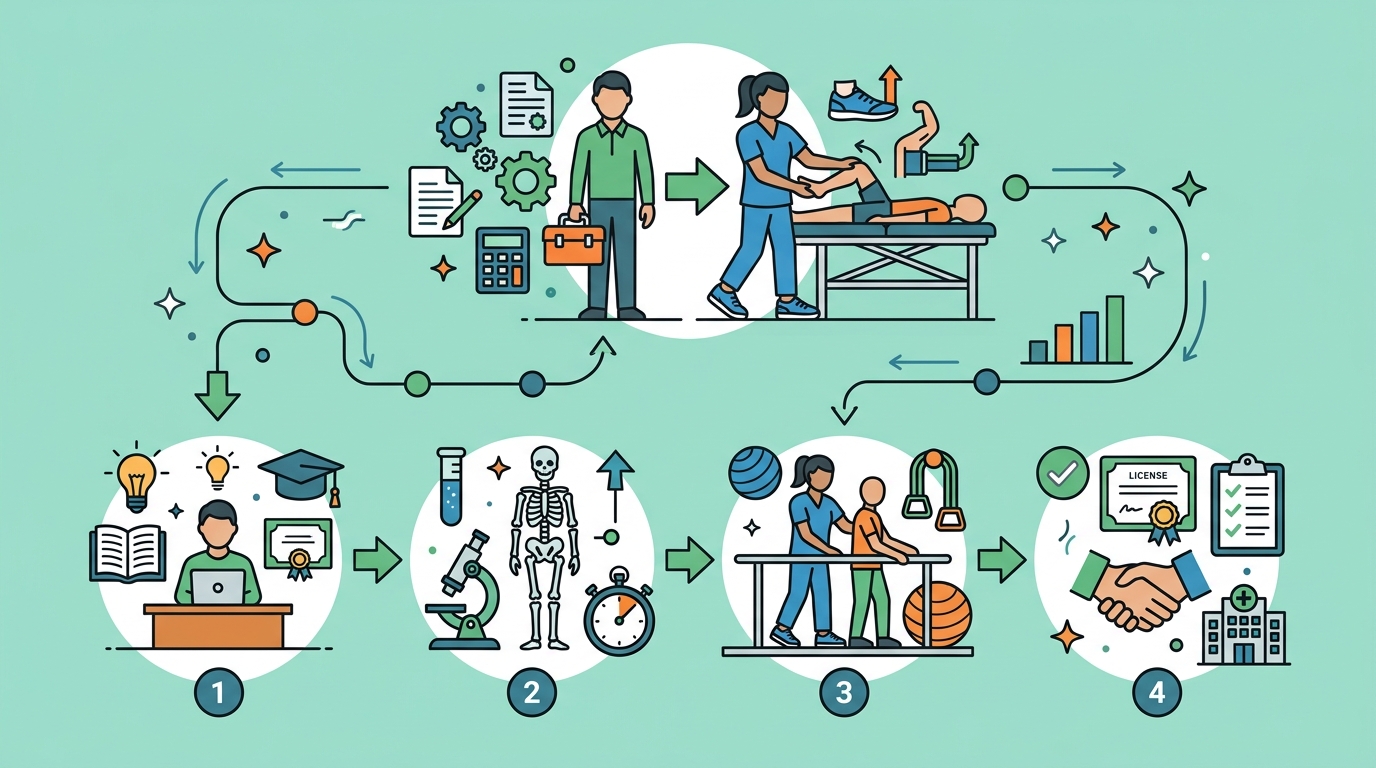
There is no no-degree route to working as a physical therapist assistant. All states require PTAs to hold an associate's degree from an accredited program and to be licensed or certified, which normally means graduating from a CAPTE-accredited program and passing a qualifying exam (U.S. Bureau of Labor Statistics, 2025).
What does exist is a no-degree entry point beside it: the physical therapist aide role, which usually needs only a high school diploma or equivalent plus on-the-job training and is not licensed by states (U.S. Bureau of Labor Statistics, 2025). Many career changers start there, earn while they confirm the work suits them, and then enter a CAPTE-accredited associate degree program.
Who Successfully Makes This Transition
Three backgrounds come up again and again in physical therapy clinics, and they transfer because the aide role is defined by patient handling and room turnover rather than by classroom credentials. Aides prepare treatment rooms, move patients and do clerical work, and they are not required to hold a degree, while PTAs treat patients and must hold an associate degree plus state licensure or certification (U.S. Career Institute, undated).
Certified nursing assistants and home care aides. You already transfer patients safely, document what you did and work under a licensed clinician's direction. A clinic manager can put you on the floor quickly because the physical skills — gait belts, wheelchair transfers, positioning, infection control — are the same ones the aide job needs on day one, and the role requires only a high school diploma or equivalent plus on-the-job training (U.S. Bureau of Labor Statistics, 2025).
Personal trainers, group fitness instructors and athletic coaches. You can cue a movement, count repetitions, spot poor form and keep someone motivated through a boring set. Outpatient orthopedic clinics value that because much of an aide's day is supervising exercise set-ups that the physical therapist has already prescribed.
EMTs, military medics and medical office staff. Emergency and clinical backgrounds bring vital-sign familiarity, medical terminology and comfort with charting. Physical therapist assistants may also hold CPR, basic life support (BLS) or other first-aid certifications (U.S. Bureau of Labor Statistics, 2025), so a current BLS card from an emergency background is an immediate, checkable asset.
All three groups also sit well with PTA program admissions committees later, because documented patient-contact hours and a reference from a licensed physical therapist make an application concrete.
Traditional Path vs. Alternative Path
The traditional path enrolls directly in a CAPTE-accredited associate degree program. The alternative path enters as an aide first and adds the degree afterwards, usually while working.
| Path | Time to Entry | Upfront Cost | Credential Required | Typical Starting Pay |
|---|---|---|---|---|
| Direct PTA associate degree | About 2 years on average (PhysicalTherapistAssistantEdu.org, undated); at least one CAPTE-accredited program is advertised at 18 months including 4 months of clinicals, with no prerequisites (Fox College, undated) | Driven by in-district versus out-of-district community college tuition, public versus private school, plus lab fees, textbooks, background check and immunizations — check each school's published tuition and net price calculator, and find accredited programs through CAPTE | Associate's degree from a CAPTE-accredited program and state licensure or certification, which requires passing the NPTE (U.S. Bureau of Labor Statistics, 2025; FSBPT, undated) | PTA median annual wage was $68,380 in May 2025, with the lowest 10 percent under $47,750 and the highest 10 percent above $89,510 (U.S. Bureau of Labor Statistics, 2025) |
| Aide first, degree later | 4 to 8 months for a physical therapy aide training program (TradeCareerPath, undated), then about 2 more years for the PTA degree | Aide program tuition plus a BLS class of two to three hours and the optional PTTC exam fee — check current fees with AMCA and with the training provider | High school diploma, GED or equivalent is the minimum; PTTC certification is optional, and most states do not license aides (Nurse.org, undated; U.S. Bureau of Labor Statistics, 2025) | Aide median annual wage was $35,240 in May 2025, with the lowest 10 percent under $25,360 (U.S. Bureau of Labor Statistics, 2025) |
The pay gap between the two rows is the whole argument for finishing the degree rather than staying an aide.
Step-by-Step Alternative Path
- Get the minimum paperwork in order. Confirm you hold a high school diploma, GED or equivalent, which is the minimum requirement to work as a physical therapy aide (Nurse.org, undated). Then book a Basic Life Support class — usually a two- or three-hour hands-on session, with recertification every two years — because many states and employers expect aides to hold BLS (Nurse.org, undated).
- Complete a physical therapy aide training program. These typically run 4 to 8 months and cover medical terminology, anatomy and therapy techniques (TradeCareerPath, undated). Add the Physical Therapy Aide/Technician Certification (PTTC) offered by AMCA, which is optional but gives a hiring manager something verifiable (TradeCareerPath, undated; Nurse.org, undated).
- Take an aide job in a setting that uses PTAs. Outpatient orthopedic clinics, hospital rehabilitation departments, skilled nursing facilities and home health agencies all employ aides alongside licensed staff. Ask in interviews whether PTAs are on the team, since you want daily exposure to the job you are aiming at.
- Build a documented clinical record while you work. Keep a dated log of patient-contact hours, transfer and modality set-up tasks, and observation hours spent shadowing a licensed physical therapist. Ask your supervising PT early whether they will write you a reference for a degree application.
- Apply to a CAPTE-accredited associate degree program. Accreditation is not optional — nearly 350 associate's degree programs for physical therapist assistants were accredited by the Commission on Accreditation in Physical Therapy Education as of 2017 (U.S. Bureau of Labor Statistics, 2017), and all states require a degree from an accredited program (U.S. Bureau of Labor Statistics, 2025). Some programs list no prerequisites (Fox College, undated); others want anatomy and physiology first, so check each program's admission page.
- Finish the degree and its clinical rotations. Expect about 2 years on average, with clinical placements built in (PhysicalTherapistAssistantEdu.org, undated). Many community college programs schedule classes so aides can keep part-time shifts during the didactic terms.
- Sit the NPTE-PTA and apply for your state credential. The National Physical Therapy Examination is administered by FSBPT and must be passed to work as a PTA in the United States (American Physical Therapy Association, undated). You must be at least 18 and have met the education requirement through a CAPTE-accredited program or education judged substantially equivalent by a recognized credentialing agency, and the exam is offered four times a year (FSBPT, undated; Mometrix, undated). Apply to your state's physical therapy licensing board for the licence or certificate it issues.
What to Have Ready Instead of a Degree
These items get you hired as an aide and make the later degree application stronger. None of them replace the associate's degree for the PTA title itself — all states require it (U.S. Bureau of Labor Statistics, 2025).
- High school diploma, GED or equivalent transcript, the stated minimum for aide work (Nurse.org, undated).
- A current BLS card, renewed every two years (Nurse.org, undated), plus CPR and First Aid if your employer asks for them separately.
- PTTC certification from AMCA, the common optional credential for aides and technicians (TradeCareerPath, undated).
- A completed aide training certificate covering medical terminology, anatomy and therapy techniques (TradeCareerPath, undated).
- A patient-handling log: dated entries showing wheelchair and bed transfers, gait belt use, modality set-up such as hot and cold packs, and treatment-area turnover.
- Observation hours signed by a licensed physical therapist, listed by setting — outpatient, inpatient rehab, skilled nursing, home health — since PTA programs often ask for these.
- Two references, ideally one licensed physical therapist or PTA who has supervised you and one clinic or department manager.
- Clearances most clinics require before your first shift: criminal background check, immunization and TB screening records, and HIPAA training confirmation.
- A shortlist of CAPTE-accredited programs within commuting distance, with admission prerequisites and start dates noted, so you can apply the moment you are ready.
Frequently asked questions
Can I ever work as a PTA without an associate's degree?
No. Every state requires physical therapist assistants to hold an associate's degree from an accredited program and to be licensed or certified (U.S. Bureau of Labor Statistics, 2025). Eligibility for the qualifying exam runs through CAPTE-accredited education or education ruled substantially equivalent by a recognized credentialing agency (FSBPT, undated), so there is no portfolio or experience substitute.
Do employers look down on someone who came in through the aide role?
The opposite is more common — clinic managers know what an experienced aide can already do unsupervised, and a reference from a licensed physical therapist carries weight in PTA program admissions. The roles are distinct, with aides doing room preparation, patient movement and clerical work while PTAs deliver treatment (U.S. Career Institute, undated). Be clear in interviews about which tasks you performed, because scope of practice matters to employers.
How much does my pay actually change once I finish the degree?
The two occupations sit far apart in the federal wage data: physical therapist aides had a median annual wage of $35,240 in May 2025, while physical therapist assistants had a median of $68,380 in the same month (U.S. Bureau of Labor Statistics, 2025). Where you land inside those ranges turns on setting, state and years in the role. Check the Bureau of Labor Statistics occupational wage pages for your state before you commit to a program.
Is the aide detour worth the extra months, or should I enroll directly?
If you can afford full-time study now, enrolling directly in a CAPTE-accredited program is the shorter road. The detour pays off if you need income immediately, are unsure the work suits you, or want patient-contact hours and a clinical reference behind your application. O*NET places physical therapist assistants in Job Zone Three, medium preparation, where vocational training and related on-the-job experience are normal routes into the field (O*NET OnLine, undated).
How often can I take the licensing exam if I need a second attempt?
The National Physical Therapy Examination is administered by FSBPT and offered four times a year (Mometrix, undated), so a retake means waiting for the next administration window. Candidates must be at least 18 and have met the education requirement before sitting it (Mometrix, undated). Your state board sets its own limits on attempts, so confirm the rules with the board where you plan to work.
Sources
- U.S. Bureau of Labor Statistics — Physical Therapist Assistants and Aides : Occupational Outlook Handbook (2025)
- U.S. Bureau of Labor Statistics — Physical Therapist Assistants and Aides : Occupational Outlook Handbook (2017)

Written by
Wyatt covers work outside the office: construction, logistics, repair, and the people who keep things running. He's skeptical of career advice that assumes everyone sits at a desk.