What Does a Physical Therapist Assistant Do? Duties, Skills, and Salary Explained
A look at the treatments PTAs carry out under a physical therapist's supervision, the license every state requires, and what the work asks of your body.
Quick answer
- Entry requires an associate's degree from a CAPTE-accredited program, about two years, plus state licensure.
- Median annual wage $65,510 (O*NET OnLine, from U.S. Bureau of Labor Statistics wage data, 2025).
- Demand growing: 17 percent projected growth, 2025–2035 (U.S. Bureau of Labor Statistics, 2025).
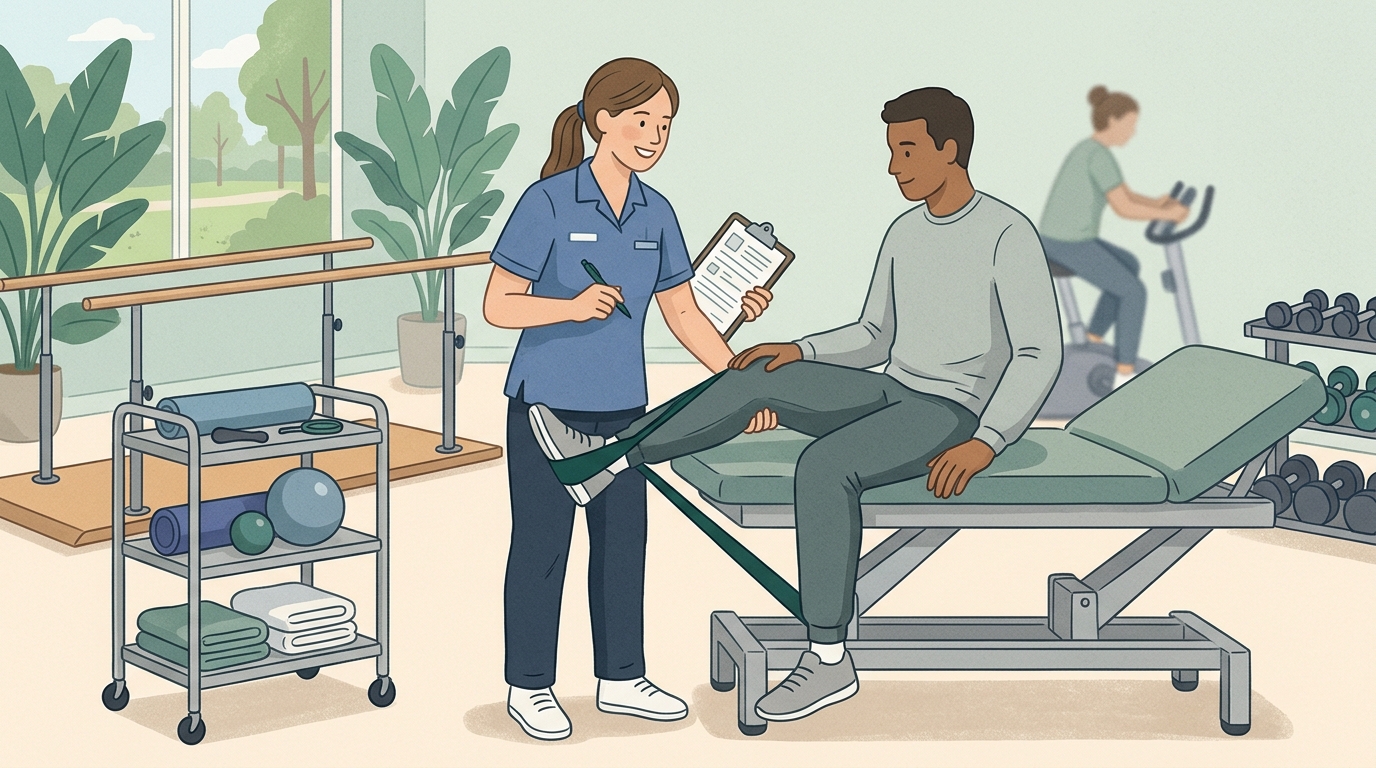
A physical therapist assistant (PTA) delivers hands-on treatment — exercise, massage, stretching, and gait and balance training — under the direction and supervision of a physical therapist, and records how each patient responds (U.S. Bureau of Labor Statistics, 2025). Most PTAs work in physical therapists' offices or hospitals and are on their feet for much of the day setting up equipment and helping patients move (U.S. Bureau of Labor Statistics, 2025).
Entry takes an associate's degree from an accredited program plus a state license or certification, and demand is strong: employment of physical therapist assistants and aides is projected to grow 17 percent from 2025 to 2035 (U.S. Bureau of Labor Statistics, 2025).
What This Job Involves Day to Day
Picture an outpatient orthopedic clinic. You clock in at 7 a.m., read the physical therapist's plan of care for each patient on your schedule, and set up the first treatment area — resistance bands anchored to the wall rack, a treatment table wiped down, hot packs in the hydrocollator, cold packs ready.
Your 7:30 patient is six weeks out from a knee replacement. You fit a gait belt around their waist, walk them to the parallel bars, and cue each step while you watch for compensation in the hips. You take range-of-motion measurements with a goniometer, compare them with last week's numbers, and move the patient through the exercise progression the therapist wrote. Between sets, you use massage and stretching to loosen the surrounding tissue.
Mid-morning shifts to a patient relearning stairs with a walker. You guard from behind, correct hand placement, and explain to the daughter who came along exactly what to practice at home. Documentation goes into the clinic's electronic health record between visits — progress notes, objective measures, patient-reported pain.
After lunch you may confer with the supervising physical therapist about a patient whose shoulder is not tolerating the current load, so the plan can be modified. Afternoons often run back-to-back until the last visit around 5 or 6 p.m. In hospitals and skilled nursing settings the rhythm changes — bedside mobility work, transfers, and coordination with nursing — and some employers schedule evenings or weekends. You will finish most days having spent very little of it sitting down.
Common Tasks and Responsibilities
- Instruct and motivate patients through prescribed exercises and functional activities, guarding them against falls or re-injury (O*NET OnLine, U.S. Department of Labor).
- Treat patients with hands-on techniques such as massage and stretching within the plan of care set by the supervising physical therapist (U.S. Bureau of Labor Statistics, 2025).
- Carry out gait and balance training, including walking practice with walkers, crutches, canes, and parallel bars (U.S. Bureau of Labor Statistics, 2025).
- Observe patients during treatment and evaluate their responses and progress, reporting anything unexpected to the physical therapist (O*NET OnLine, U.S. Department of Labor).
- Secure patients into or onto therapy equipment safely before and during treatment (O*NET OnLine, U.S. Department of Labor).
- Teach body mechanics and functional mobility, including aquatic exercise where the facility has a pool (O*NET OnLine, U.S. Department of Labor).
- Document progress notes and objective measures for each visit so the record supports the plan of care (O*NET OnLine, U.S. Department of Labor).
- Educate patients and family members on what to do after treatment, including home exercise and safe transfers (U.S. Bureau of Labor Statistics, 2025).
- Confer with physical therapy staff to plan or modify a patient's treatment when progress stalls or symptoms change (O*NET OnLine, U.S. Department of Labor).
Salary and Job Outlook by Experience Level
Pay for PTAs is usually an hourly rate or an annual salary, sometimes with per-visit productivity bonuses in outpatient clinics or shift differentials in hospitals. Where you land in the range depends heavily on setting, state, and metro area.
| Career stage | Typical years of experience | Where pay usually sits in the national range |
|---|---|---|
| Entry-level | New graduate, first year or two after licensure | Toward the lower end — the bottom 10 percent of PTAs earn $46,020 or less annually |
| Mid-career | Several years of full caseload experience | Around the national median of $65,510 annually |
| Experienced/senior | Long-tenured, often in lead, home health, or hard-to-staff settings | The top 10 percent earn $87,630 or more annually |
Footnote: wage distribution figures are the national figures for Physical Therapist Assistants published by O*NET OnLine, sourced from U.S. Bureau of Labor Statistics wage data. The U.S. Bureau of Labor Statistics also published a median annual wage for physical therapist assistants in May 2025; for the broader occupational therapy and physical therapist assistants and aides group the median was $63,030, and for physical therapist aides specifically it was $35,240 (U.S. Bureau of Labor Statistics, May 2025). Percentiles are national and do not map exactly to years of experience; state and local pay varies, so check the BLS Occupational Employment and Wage Statistics pages for your state and metro area, and your state's job postings, for current rates.
Outlook: employment of physical therapist assistants and aides is projected to grow 17 percent from 2025 to 2035, much faster than the average for all occupations, with about 24,900 openings projected each year on average over the decade (U.S. Bureau of Labor Statistics, 2025).
Skills and Traits That Fit This Work
- Physical stamina. You will frequently kneel, stoop, bend, and stand for long periods (U.S. Bureau of Labor Statistics, 2025) — guarding a patient on stairs means being low and braced, not seated at a desk.
- Dexterity. Hands-on techniques such as massage and stretching, and fitting a gait belt or adjusting a walker to the right height, call for controlled, precise hands (U.S. Bureau of Labor Statistics, 2025).
- Attention to detail. You follow the physical therapist's plan of care exactly and record what happened, so a repetition count or a reported pain level does not get lost between visits (U.S. Bureau of Labor Statistics, 2025).
- Compassion. Patients are often in pain or frustrated by slow progress, and the job is largely about keeping them working through that (U.S. Bureau of Labor Statistics, 2025).
- Interpersonal skills. You explain a home exercise program to a patient's spouse in plain language, then switch to clinical shorthand when conferring with the supervising therapist (U.S. Bureau of Labor Statistics, 2025).
- Comfort working under supervision. PTAs treat under the direction and supervision of a physical therapist (U.S. Bureau of Labor Statistics, 2025), so evaluating patients and setting the plan of care is not yours to do — that limit frustrates some people and suits others.
- Observation. Spotting that a patient's knee is drifting inward on the tenth repetition, and flagging it, is a core task (O*NET OnLine, U.S. Department of Labor).
How to Get Started
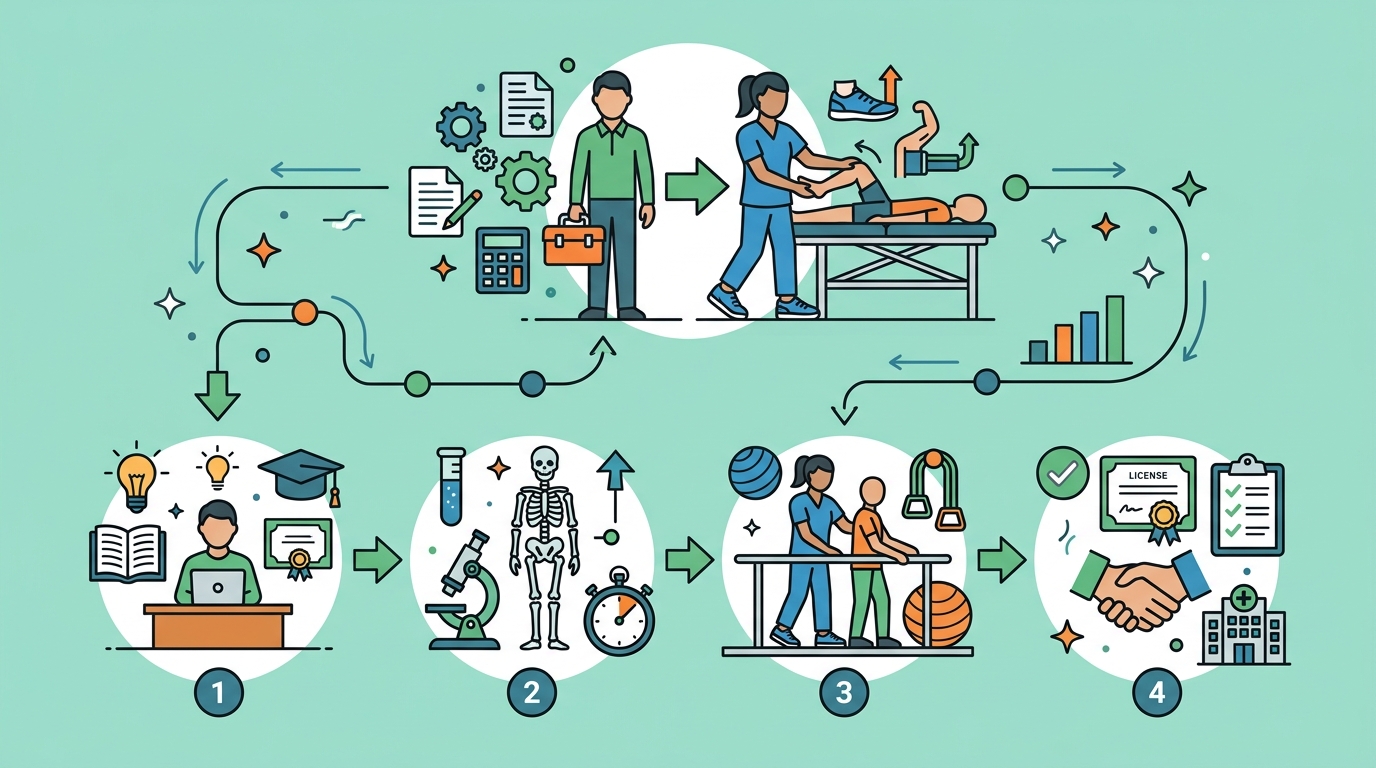
- Finish an associate's degree from a CAPTE-accredited physical therapist assistant program. All states require it, and programs typically last about two years, covering anatomy, physiology, and kinesiology alongside supervised clinical work (U.S. Bureau of Labor Statistics, 2025). The Commission on Accreditation in Physical Therapy Education (CAPTE) grants accreditation to qualifying entry-level PTA programs, and graduating from a CAPTE-accredited program is what makes you eligible to sit for the licensing exam.
- Pass the National Physical Therapy Examination (NPTE) for PTAs. The NPTE is administered by the Federation of State Boards of Physical Therapy and is required to become a licensed or certified physical therapist assistant in the United States (American Physical Therapy Association). The NPTE-PTA has 180 questions across four sections and takes about four hours.
- Apply for licensure through your state regulatory board. Licensure is managed by individual state boards and is required to work as a PTA (American Physical Therapy Association). Requirements, fees, and paperwork differ by state, so work from your own board's checklist — and if you plan to move, check the destination state's rules before you do.
- Add CPR and basic life support certification. PTAs commonly hold CPR, basic life support (BLS), or other first-aid certifications (U.S. Bureau of Labor Statistics, 2025), and many employers expect them on day one.
- Target first jobs where your clinical rotations were. Outpatient physical therapists' offices and hospitals employ most PTAs and aides (U.S. Bureau of Labor Statistics, 2025); apply through those employers' own careers portals and through your program's clinical-site network, since the therapists who supervised your rotations are the references hiring managers call.
Frequently asked questions
How does pay progress for a physical therapist assistant?
Progression is mostly through setting, location, and tenure rather than promotion rungs. New graduates often start near the bottom of the national range, where 10 percent of PTAs earn $46,020 or less, while the top 10 percent earn $87,630 or more and the median is $65,510 (O*NET OnLine, from U.S. Bureau of Labor Statistics wage data). Check current state and metro figures before negotiating.
How physically demanding is the work, and what are the hours?
Expect to be on your feet most of the shift, setting up equipment and helping care for patients, with frequent kneeling, stooping, and bending (U.S. Bureau of Labor Statistics, 2025). Transfers and guarding patients involve real lifting. Outpatient clinics often run early mornings through evenings to fit working patients; hospital and skilled nursing roles may include weekends. Schedules vary by employer.
What is the difference between a physical therapist assistant and a physical therapist aide?
PTAs are licensed clinicians who deliver treatment such as exercise, massage, and gait training under a physical therapist's supervision. Aides handle support tasks and do not require the same credential. The pay gap reflects that: the median annual wage for physical therapist aides was $35,240 in May 2025, against $65,510 for PTAs (U.S. Bureau of Labor Statistics and O*NET OnLine).
How long does it take to become licensed?
Plan on roughly two years for the associate's degree, since CAPTE-accredited PTA programs typically run about that long and include supervised clinical hours (U.S. Bureau of Labor Statistics, 2025). After graduation you sit the NPTE-PTA, a four-hour, 180-question exam administered by the Federation of State Boards of Physical Therapy, then apply to your state board. Board processing times differ by state.
Is the job market good for new PTAs?
Employment of physical therapist assistants and aides is projected to grow 17 percent from 2025 to 2035, much faster than the average for all occupations, with roughly 24,900 openings each year on average over the decade (U.S. Bureau of Labor Statistics, 2025). National projections do not guarantee openings in a specific town, so check hiring in your own area.
Can a PTA evaluate patients or set treatment plans?
No. PTAs work under the direction and supervision of a physical therapist, who performs the evaluation and sets the plan of care; the PTA carries out treatment, observes responses, documents progress, and confers with staff when a plan needs modifying (U.S. Bureau of Labor Statistics, 2025; O*NET OnLine). Supervision rules differ by state, so check your board's regulations.
Sources
- U.S. Bureau of Labor Statistics — Physical Therapist Assistants and Aides : Occupational Outlook Handbook (2025)
- O*NET OnLine (U.S. Department of Labor) — 31-2021.00 - Physical Therapist Assistants

Written by
Marisol steers Jobladderhq's coverage of hiring trends and the strange rituals of modern recruiting. She's drawn to the gap between what job ads promise and what the work actually feels like. Her editing hand favors clarity over jargon, always.