What Does a CNA Do? Duties, Skills, and Salary
A look at the hands-on care tasks, the state competency exam, the shift patterns and the physical demands that come with nursing assistant work.
Quick answer
- You typically need to finish a state-approved nurse aide program, pass your state's competency exam and appear on the state nurse aide registry to work in a nursing home (U.S. Bureau of Labor Statistics, 2025).
- Federal rules set a minimum amount of training for nurse aide certification programs, including at least 16 hours of supervised practical training (Long Term Care Community Coalition).
- Nursing assistants and orderlies have one of the highest rates of injuries and illnesses of all occupations, largely from lifting and moving people (U.S. Bureau of Labor Statistics, 2025).
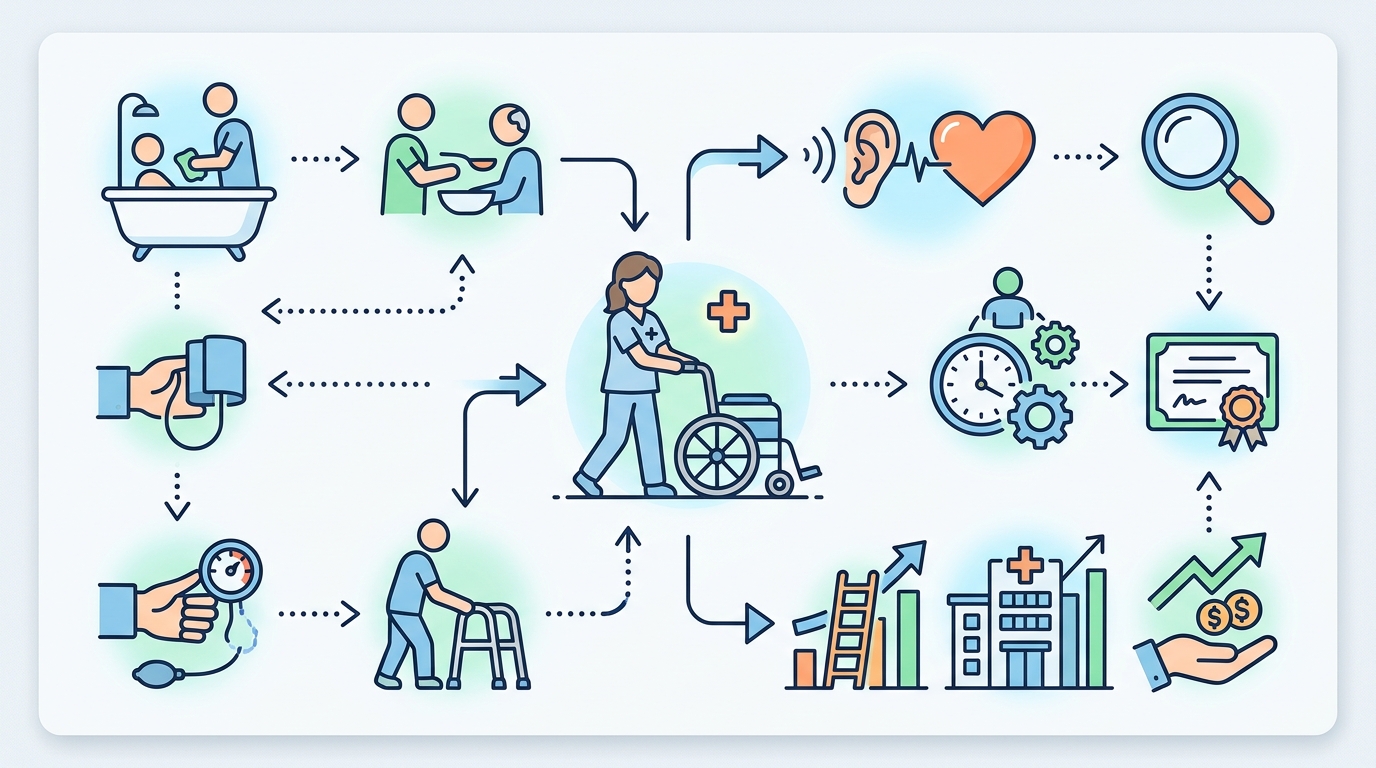
A certified nursing assistant (CNA) provides hands-on daily care to patients and residents under the supervision of a licensed nurse: bathing, toileting, feeding, moving people safely, taking vital signs and reporting changes. Most work in skilled nursing facilities, which the U.S. Bureau of Labor Statistics (2025) lists as the largest employer of nursing assistants, followed by hospitals.
Entry is faster than most healthcare careers — a state-approved training program and a state competency exam — but the work is physical and often runs on nights, weekends and holidays (U.S. Bureau of Labor Statistics, 2025).
What a CNA Does
A CNA does the hands-on, repetitive work of patient care that a licensed nurse delegates and supervises: helping people bathe, dress, use the toilet, eat and move between bed, wheelchair and bathroom, then recording what happened so the nurse can act on it.
You will find these jobs mainly in nursing care facilities, which the U.S. Bureau of Labor Statistics (2025) identifies as the largest employer category for nursing assistants, and in state, local and private hospitals, the second-largest. Assisted living and residential care communities, rehabilitation units, hospice and home health agencies also hire CNAs.
Core tasks listed by O*NET include turning or repositioning bedridden patients and measuring and recording food and liquid intake and urinary and fecal output. You also take vital signs, answer call lights, change linens, set up meal trays and report anything that looks different — a new bruise, a refusal to eat, confusion that was not there yesterday.
The title varies. Nursing assistants typically must complete a state-approved education program and pass a competency exam; in some states the credentialed worker is called a Certified Nursing Assistant, but titles differ from state to state (U.S. Bureau of Labor Statistics, 2025).
Entry-level CNAs usually start with basic daily-living care and vital signs on a fixed group of residents. Experienced CNAs take heavier assignments, precept new hires, and in some states add a Certified Medication Assistant credential that allows them to dispense medications (U.S. Bureau of Labor Statistics, 2025).
A Typical Day
Shifts are commonly eight or twelve hours, and because nursing and residential care facilities and hospitals provide care at all hours, you may work nights, weekends and holidays (U.S. Bureau of Labor Statistics, 2025).
- Takes handoff report from the outgoing aide and charge nurse, noting who needs two-person transfers, fall precautions or intake and output monitoring.
- Starts morning rounds: assists residents out of bed with a gait belt or mechanical lift, gives bed baths or showers, helps with dressing and oral care.
- Measures vital signs with a digital thermometer, blood pressure cuff and pulse oximeter, and records weights on the unit scale.
- Enters vitals, care tasks and intake and output into the electronic health record on a workstation or handheld tablet.
- Delivers and sets up meal trays, feeds residents who need help, and records how much of each meal and drink was taken.
- Answers call lights, assists with toileting and incontinence care, and repositions bedridden patients on the unit's turning schedule to prevent pressure injuries.
- Reports changes to the licensed nurse immediately — skin breakdown, a fall, shortness of breath, a sudden change in behavior.
- Strips and remakes beds, restocks linens and cleans equipment between residents following infection-control procedure.
- Gives end-of-shift report to the incoming aide, including anything the nurse is still following up on.
Salary and Job Outlook
Pay is hourly, with shift differentials for evenings, nights and weekends, overtime past 40 hours in most jobs, and sometimes extra for per diem or agency work. Rates vary by state, metro area and setting, and the figures change annually, so check the current numbers rather than relying on a page like this one.
| Level | How pay is set | Where to check the current figure |
|---|---|---|
| Entry (newly certified) | Hourly, often near the lower end of the state range; BLS (2025) publishes a 10th-percentile figure for the lowest-paid 10 percent of nursing assistants | BLS Occupational Outlook Handbook, nursing assistants and orderlies |
| Mid (1-3 years) | Hourly plus shift differentials and, in some states, a bump for a Certified Medication Assistant credential | BLS state and metro wage data (OEWS) for your area |
| Experienced (preceptor or specialty unit) | Hourly at the top of the employer's scale; BLS (2025) publishes a 90th-percentile figure for the highest-paid 10 percent | BLS Occupational Outlook Handbook |
| National median, all nursing assistants | A single national median annual wage published by the U.S. Bureau of Labor Statistics (2025); O*NET (2025) lists the same median hourly and annually | BLS Occupational Outlook Handbook and O*NET OnLine |
Employment of nursing assistants and orderlies is projected to grow about as fast as the average for all occupations over the 2025-35 decade, with a substantial number of openings projected each year, many from workers leaving the occupation (U.S. Bureau of Labor Statistics, 2025).
Skills and Qualifications
Hard requirements and skills
- Completion of a state-approved nurse aide education program (U.S. Bureau of Labor Statistics, 2025). Federal rules require a minimum amount of training, including at least 16 hours of supervised practical training (Long Term Care Community Coalition).
- A passing score on your state's competency exam. Most states use the National Nurse Aide Assessment Program (NNAAP), developed and administered by the National Council of State Boards of Nursing, with a written or oral portion and a hands-on skills portion.
- Placement on your state's nurse aide registry — required to work in a nursing home (U.S. Bureau of Labor Statistics, 2025).
- Basic Life Support / CPR certification, commonly required by employers.
- Optional in some states: the Certified Medication Assistant (CMA) credential, which allows you to dispense medications (U.S. Bureau of Labor Statistics, 2025).
- Physical ability to stand and walk for most of a shift and to transfer and reposition adults using a gait belt and mechanical lift. Nursing assistants and orderlies have one of the highest rates of injuries and illnesses of all occupations (U.S. Bureau of Labor Statistics, 2025).
- Accurate charting in an electronic health record, including intake and output measurement.
Soft skills
O*NET lists the essential skills for nursing assistants as Active Listening, Monitoring, Critical Thinking, Reading Comprehension and Speaking. In practice that means noticing a change in someone who cannot describe it, reading a care plan correctly, and giving a nurse a clear report under time pressure.
How to Get Started
- Check your state's requirements first. The credential title, program length and exam vary by state; your state health department or nurse aide registry is the authority on which programs it approves.
- Finish high school or an equivalent. Nursing assistants sit in ONET Job Zone Three, 'Medium Preparation Needed,' and a share of survey respondents reported that a new hire needs only a high school diploma or equivalent plus the required training (ONET OnLine).
- Enroll in a state-approved nurse aide training program, commonly offered by community colleges, vocational schools and some long-term care employers. Programs run from a few weeks to a few months; federal rules set a training minimum including at least 16 hours of supervised practical training (Long Term Care Community Coalition).
- Complete the clinical hours and drill the skills checklist, since the exam includes a hands-on skills demonstration scored by an evaluator.
- Apply for and pass your state's competency exam — in most states the NNAAP from the National Council of State Boards of Nursing — then confirm your name appears on the state nurse aide registry (U.S. Bureau of Labor Statistics, 2025).
- Clear the employer's background check, immunization record and drug screen, and add a current CPR card.
- Apply to skilled nursing facilities and hospitals first — the two largest employer categories (U.S. Bureau of Labor Statistics, 2025) — and state which shifts you can work. Night and weekend availability widens your options.
Frequently asked questions
How long does it take to become a CNA?
Most people finish a state-approved nurse aide program in a matter of weeks to a few months, then sit the state competency exam. Federal rules set a minimum program length that includes at least 16 hours of supervised practical training (Long Term Care Community Coalition), and individual states often require more. Scheduling and passing the exam, plus the background check, usually adds a few more weeks before you can start work.
Do you need a degree to be a CNA?
No. You need a state-approved training program and a passing score on your state's competency exam, not a college degree (U.S. Bureau of Labor Statistics, 2025). O*NET places nursing assistants in Job Zone Three, 'Medium Preparation Needed,' and survey respondents reported that a share of new hires need only a high school diploma or equivalent. Many CNAs later use the role as a step toward LPN or RN programs.
Is being a CNA physically hard?
Yes. Nursing assistants and orderlies have one of the highest rates of injuries and illnesses of all occupations (U.S. Bureau of Labor Statistics, 2025). The strain comes from lifting, transferring and repositioning adults, often many times a shift, plus standing and walking for most of an eight- or twelve-hour shift. Using gait belts, mechanical lifts and two-person transfers as trained is the main protection.
What shifts do CNAs work?
Because nursing and residential care facilities and hospitals provide care at all hours, CNAs may need to work nights, weekends and holidays (U.S. Bureau of Labor Statistics, 2025). Common patterns are three twelve-hour shifts or five eight-hour shifts, with day, evening and overnight rotations. Night and weekend hours often carry a shift differential on top of the base hourly rate.
Can a CNA give medications?
Not as a standard part of the role. In some states, nursing assistants may earn an additional credential called Certified Medication Assistant (CMA), which allows them to dispense medications (U.S. Bureau of Labor Statistics, 2025). Whether the credential exists, what training it requires and what it permits are set state by state, so check with your state's nurse aide registry or board of nursing.
Sources
- U.S. Bureau of Labor Statistics — Nursing Assistants and Orderlies : Occupational Outlook Handbook (2025)
- O*NET OnLine (U.S. Department of Labor) — 31-1131.00 - Nursing Assistants

Written by
Desmond writes about the mechanics of job searching: resumes, interviews, the long silence after applying. He's fascinated by how much of getting hired depends on luck dressed up as skill.