What Does a Bank Teller Do? A Day in the Life
A counter-level look at cash drawers, check verification, vault duties and the branch hours that shape the work before you apply for your first role.
Quick answer
- Typical entry requirement is a high school diploma, plus a background check at many employers, with training provided on the job (BLS, 2026-08-27).
- On-the-job training runs from a few days to one year depending on the employer (O*NET OnLine, U.S. Department of Labor).
- BLS projects employment of tellers to decline from 2025 to 2035, though openings are still projected each year as workers change jobs or leave the workforce (BLS, 2026-08-27).
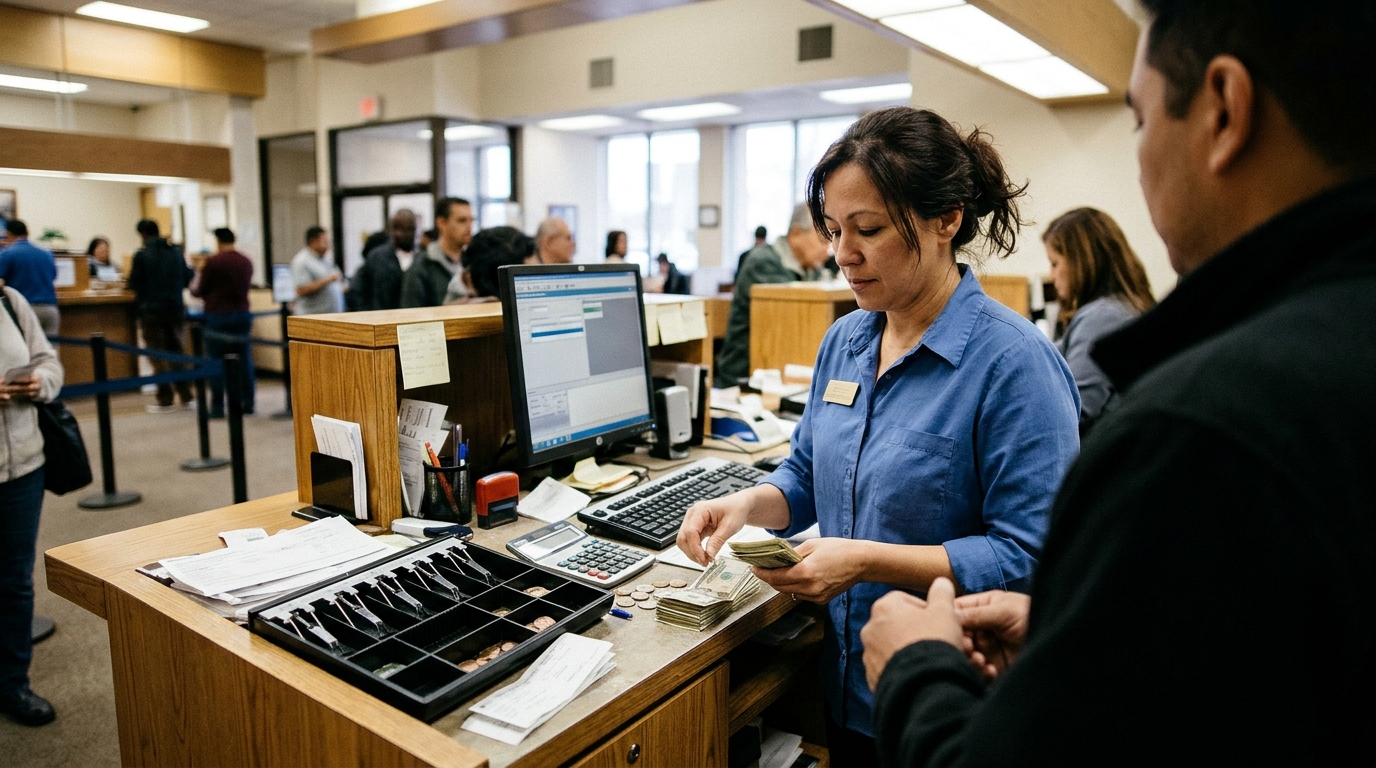
A bank teller handles routine money transactions at the counter of a bank or credit union — cashing checks, taking deposits, answering account questions and recording each transaction electronically (U.S. Bureau of Labor Statistics, 2026-08-27). The day is built around a cash drawer you count at the start of your shift and balance again before you leave.
Entry is open: BLS says tellers typically need a high school diploma, may need to pass a background check, and are trained on the job once hired. What varies most is the employer — credit unions, community banks and large national banks set different schedules and branch routines.
What a Bank Teller Does
A teller is the person at the counter who moves money in and out of customer accounts. The U.S. Bureau of Labor Statistics (2026-08-27) puts the core function simply: tellers process routine transactions, such as cashing checks and depositing money, at a bank or credit union.
Most tellers work in credit intermediation and related activities — retail bank branches and credit unions (BLS, 2026-08-27). That includes stand-alone branches, drive-up windows and branches inside larger stores. The setting shapes the job: a small credit union branch may have two tellers covering everything, while a large branch splits work between a teller line, a head teller and platform staff who open accounts.
BLS lists teller duties including counting the cash in your drawer at the start and end of a shift, accepting checks and cash, answering customers' account questions, preparing money orders, savings bonds and traveler's checks, exchanging foreign currency, ordering bank cards and checks, and recording transactions electronically (BLS, 2026-08-27).
Entry-level and experienced work differ. New tellers are trained by a head teller or another experienced teller to balance cash drawers, verify signatures and use the employer's computer software. Experienced tellers may take on vault monitoring and head teller duties, and can move into supervisory or managerial roles, or into occupations such as loan officer or sales positions (BLS, 2026-08-27).
A Typical Day
Exact routines are set by each employer's policies, but a branch shift usually runs in this order:
- Arrives before opening and counts the cash drawer, balancing currency, coin and checks on the teller system with a calculator or currency counter (O*NET OnLine, U.S. Department of Labor).
- Draws additional cash from the vault under the branch's dual-control procedure and logs it against the drawer limit.
- Opens the window and takes deposits — receiving checks and cash, verifying the amounts and issuing receipts from the teller terminal (O*NET OnLine).
- Cashes checks after verifying the signature and confirming the account holds sufficient funds (O*NET OnLine), applying any hold the employer's policy requires.
- Answers account questions at the counter — balances, cleared items, fees, statement entries — in the core banking system (BLS, 2026-08-27).
- Prepares money orders, savings bonds or traveler's checks, orders replacement bank cards and check stock, and exchanges foreign currency where the branch offers it (BLS, 2026-08-27).
- Refers customers who need a loan or a new account to the appropriate branch staff member, and records each transaction electronically as it happens (BLS, 2026-08-27).
- Counts down the drawer at the end of the shift, researches any difference and returns excess cash to the vault.
Salary and Job Outlook
Teller pay is usually an hourly rate for scheduled branch hours, and some employers add incentives for referrals to lending or account-opening staff. Rates vary by state, by metro area and by employer type. Look the current figures up at the source rather than relying on a quoted number.
| Level | How pay is usually set | Where to check the current figure |
|---|---|---|
| Entry (0-1 years) | Hourly rate at the branch's starting band; no credential premium, since training is on the job | BLS Occupational Outlook Handbook, Tellers, May 2025 wage data |
| Mid (1-3 years) | Hourly rate after review; may rise with vault or head-teller duties | O*NET OnLine median hourly and annual wage for Tellers, 2025 |
| Experienced / head teller | Higher band plus supervisory duties; the highest-paid 10 percent of tellers earned more than $49,680 a year (BLS, May 2025) | BLS state and metropolitan wage tables, May 2025 |
| National median, all tellers | A national median annual wage is published for the occupation | BLS Occupational Outlook Handbook, May 2025 |
BLS also publishes a separate median for tellers in credit intermediation and related activities, the industry where most tellers work (BLS, May 2025). On outlook, BLS projects employment of tellers to decline from 2025 to 2035 as routine transactions move to ATMs, mobile apps and online banking, though openings are still projected each year on average over the decade, mostly from workers transferring occupations or leaving the labor force (BLS, 2026-08-27).
Skills and Qualifications
Hard requirements and skills you can verify or obtain
- A high school diploma or equivalent — the typical entry-level education for the occupation (BLS, 2026-08-27).
- Ability to pass the employer's background check; many banks and credit unions require one before hire (BLS, 2026-08-27). Requirements differ by employer and by state.
- Accurate cash handling: counting currency and coin by hand, using a currency counter, and balancing a drawer to the cent against the system total (O*NET OnLine).
- Working arithmetic. BLS lists math skills among the important qualities for tellers (BLS, 2026-08-27).
- Computer skills for the employer's teller software, learned in on-the-job training from a head teller or experienced teller (BLS, 2026-08-27).
- Signature verification and ID checking against account records (O*NET OnLine).
- Physical tolerance for standing at a window for most of a shift and lifting coin bags.
Soft skills
- Communication and interpersonal skills, since the job is face-to-face with customers all shift (BLS, 2026-08-27).
- Customer-service skills for handling questions, complaints and declined transactions.
- Detail orientation and integrity, both listed by BLS, because you are personally accountable for the cash in your drawer.
- Active listening, speaking, critical thinking, monitoring and reading comprehension, which O*NET lists among essential skills for tellers.
How to Get Started
- Finish a high school diploma or equivalent, the typical entry-level education BLS reports for the occupation (BLS, 2026-08-27). No college degree is required to enter.
- Spend three to six months in a job that involves handling money and serving customers — cashier, retail sales, front desk — so you can point to cash accuracy on your resume.
- Practice the basics you will be tested on in week one: counting bills by hand, running a cash balance, and explaining a transaction clearly out loud.
- Search branch openings at banks and credit unions near you and read each posting for schedule requirements. Most tellers work full time during regular business hours, but some schedules include evenings or weekends (BLS, 2026-08-27).
- Ask the recruiter what the background check covers before you apply; the requirement differs by employer and by state.
- Apply with a resume that quantifies cash responsibility — drawer size, transactions per shift, balancing record — then expect on-the-job training from a head teller covering drawer balancing, signature verification and the employer's software (BLS, 2026-08-27). O*NET classifies the occupation as needing very little to some preparation, with training from a few days to one year.
Frequently asked questions
Do you need a degree to be a bank teller?
No. BLS reports that tellers typically need a high school diploma to enter the occupation, and that training is provided on the job after hire (BLS, 2026-08-27). Many employers also require a background check and prefer cash-handling or customer-service experience. Degree preferences vary by employer, so read individual postings.
Is being a bank teller stressful?
The pressure comes from specific sources: you are accountable for balancing your drawer to the cent at the end of each shift, you stand at a window for most of the day, and you deal directly with customers who may be unhappy about holds, fees or declined transactions. Branch queues create time pressure at lunch hours, paydays and month-end. How heavy it feels depends on branch traffic and staffing.
Is bank teller a dying job?
BLS projects employment of tellers to decline from 2025 to 2035, as routine transactions shift to ATMs, mobile apps and online banking (BLS, 2026-08-27). Openings are still projected each year on average over the decade, mostly because existing tellers transfer to other occupations or leave the labor force. Treat it as an entry point with a clear next step rather than a long-term plateau.
What hours do bank tellers work?
Most tellers work full time during regular business hours, though some schedules include evenings or weekends (BLS, 2026-08-27). Branches inside retail stores and those with Saturday hours are the most likely to need weekend coverage. Expect to arrive before the doors open to count your drawer and to stay after closing to balance it.
What can a bank teller do next?
Experienced tellers may advance to head teller or to other supervisory and managerial positions, and can move into occupations such as loan officer or sales roles (BLS, 2026-08-27). The usual route is to master drawer balancing and vault duties, then ask to be trained on account opening or lending referrals. Promotion paths vary by employer, so ask in the interview how that branch has promoted tellers before.
Sources
- U.S. Bureau of Labor Statistics — Tellers : Occupational Outlook Handbook (2026-08-27)
- O*NET OnLine (U.S. Department of Labor) — 43-3071.00 - Tellers - Summary Report (2025)

Written by
Priya tracks wages, layoffs, and the slow shifts in what counts as a stable job. She writes for readers trying to make sense of numbers that rarely match their own experience.