Web Developer vs. Software Developer: Which Career Fits You?
Both build things people use on a screen, but the entry routes, pay bands and the first hour of a shift diverge more than the shared word 'developer' suggests.
Quick answer
- Pay gap: the median annual wage was $92,650 for web developers and $134,040 for software developers, quality assurance analysts and testers (U.S. Bureau of Labor Statistics, May 2025).
- Education gap: web developer requirements run from a high school diploma to a bachelor's degree, and demonstrated prior work or projects can replace a credential; software developer roles typically require a bachelor's degree (U.S. Bureau of Labor Statistics, undated).
- Daily task gap: web developers write code for site layout and navigation and back up website files to local directories (O*NET OnLine, undated), while software developers design applications and programs and work from defect reports filed by quality assurance analysts (U.S. Bureau of Labor Statistics, undated).
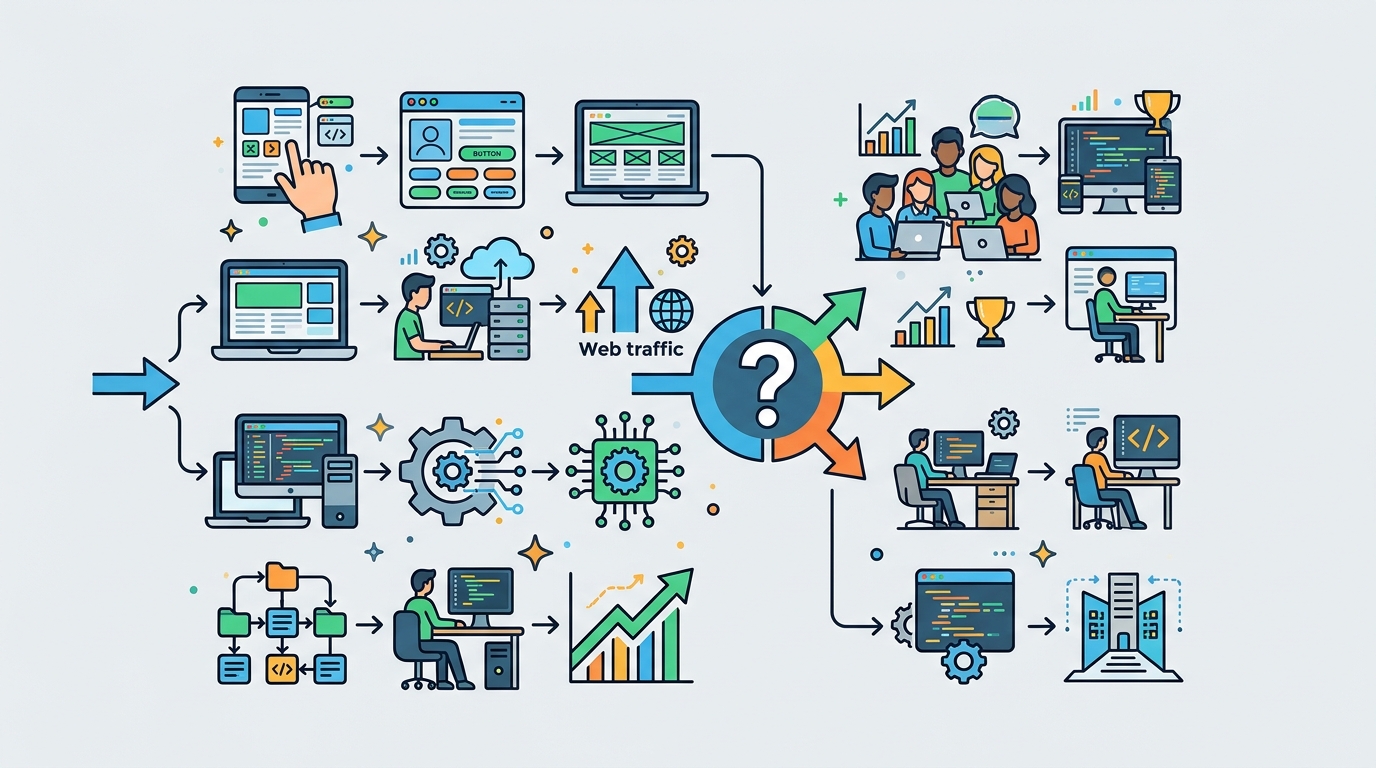
Web developers build and maintain websites — writing code in languages such as HTML or XML, creating and testing navigation menus, and integrating graphics, audio and video (U.S. Bureau of Labor Statistics, undated). Software developers design computer applications or programs, working further from the browser and closer to the system behind it (U.S. Bureau of Labor Statistics, undated).
The two paths differ most on the way in and on the pay band. Web developer requirements range from a high school diploma to a bachelor's degree, and prior work or projects can stand in for a credential, while software developers, quality assurance analysts and testers typically need a bachelor's degree (U.S. Bureau of Labor Statistics, undated).
Side-by-Side Comparison
The two occupations are counted separately by the U.S. Bureau of Labor Statistics, so the categories below use the same measures for each.
| Category | Web Developer | Software Developer |
|---|---|---|
| Median annual pay | $92,650 in May 2025 (U.S. Bureau of Labor Statistics, May 2025) | $134,040 in May 2025 for software developers, quality assurance analysts and testers (U.S. Bureau of Labor Statistics, May 2025) |
| Typical education | Ranges from a high school diploma to a bachelor's degree, and specific credentials may not be needed if ability is shown through prior work or projects; the BLS computer and information technology summary table lists a bachelor's degree as typical entry-level education (U.S. Bureau of Labor Statistics, undated and 2025) | Typically a bachelor's degree, with no equivalent portfolio substitute described by BLS (U.S. Bureau of Labor Statistics, undated) |
| Physical demands | Seated computer work; demands are visual and postural rather than lifting, standing or travel | Seated computer work; demands are visual and postural rather than lifting, standing or travel |
| Schedule type | Most work full time (U.S. Bureau of Labor Statistics, undated) | Most work full time (U.S. Bureau of Labor Statistics, undated) |
| Growth outlook | Employment of web developers and digital designers projected to grow 5 percent from 2025 to 2035, faster than the average for all occupations, with about 13,600 openings a year on average (U.S. Bureau of Labor Statistics, 2025) | Employment of software developers, quality assurance analysts and testers projected to grow 10 percent from 2025 to 2035 (U.S. Bureau of Labor Statistics, 2025) |
| Size of the occupation | Web developers held about 87,400 jobs in 2025; web and digital interface designers about 132,700 (U.S. Bureau of Labor Statistics, 2025) | Software quality assurance analysts and testers held about 187,600 jobs in 2025; the combined group is projected to move from 1,905,400 to 2,090,800 jobs by 2035 (U.S. Bureau of Labor Statistics, 2025) |
Pay for both varies by state, metropolitan area, industry and employer size, and contract or freelance web work is often billed by project rather than salaried. Check the current BLS Occupational Employment and Wage Statistics tables for your state before using a national median as a benchmark.
Day-to-Day Differences
The first hour of a shift separates the two jobs more clearly than the job titles do.
A web developer usually starts with something live. That can mean confirming the overnight backup of website files to local directories finished cleanly — O*NET lists that among standard web developer tasks — then opening a staging build in two or three browsers to see why a navigation menu collapses wrong at phone width. Fixes go straight into the markup and stylesheet; BLS lists creating and testing applications and navigation menus, writing code in languages such as HTML or XML, and integrating graphics, audio and video among typical duties. Client contact is built in, since BLS also lists meeting with clients to discuss website needs.
A software developer more often starts inside a ticket than a browser. You pull the branch, run the test suite and read a defect report — BLS describes quality assurance analysts and testers as identifying problems with applications and reporting defects — then step through the failing function in a debugger before writing anything new. Design takes a larger share of the week: designing computer applications or programs means deciding how data moves between parts of a system before code exists.
Entry-level and experienced work differ in both. Junior web developers implement layouts and content changes handed to them; experienced ones run the client conversation and the site architecture. Junior software developers close small, well-scoped tickets; experienced ones own the design decisions others build against.
Which Career Is Right for You
- Choose web development if you want to start without a four-year degree. BLS says requirements range from a high school diploma to a bachelor's degree, and that web developers and digital designers may not need specific education credentials if they can demonstrate their abilities through prior work experience or projects (U.S. Bureau of Labor Statistics, undated).
- Choose software development if the pay band is your deciding constraint. The median annual wage was $134,040 for software developers, quality assurance analysts and testers in May 2025, against $92,650 for web developers (U.S. Bureau of Labor Statistics, May 2025).
- Choose web development if you want visible output and direct client contact. Meeting with clients to discuss website needs and integrating graphics, audio and video are listed duties, so a day's work usually produces something a non-technical person can look at (U.S. Bureau of Labor Statistics, undated).
- Choose software development if you prefer longer design cycles to same-day fixes, spending more time on how a system is structured and less on how a page renders in one browser (U.S. Bureau of Labor Statistics, undated).
- Choose software development if you want the larger labor market. The combined group of software developers, quality assurance analysts and testers is projected to move from 1,905,400 to 2,090,800 jobs by 2035, while web developers held about 87,400 jobs in 2025 (U.S. Bureau of Labor Statistics, 2025).
- Choose either if you need full-time, predictable hours: most workers in both occupations work full time (U.S. Bureau of Labor Statistics, undated). Freelance and contract web work is the more common exception, so check how a specific employer in your state structures the role.
Frequently asked questions
Which pays more, web development or software development?
Software development, by a wide margin at the median. The median annual wage for software developers, quality assurance analysts and testers was $134,040 in May 2025, while web developers' median was $92,650 (U.S. Bureau of Labor Statistics, May 2025). Web and digital interface designers, a related role counted alongside web developers, had a median of $104,000 in the same period. Those are national figures, and your state and metropolitan area can sit well above or below them.
Can I get into either job without a bachelor's degree?
It is more plausible on the web side. BLS says educational requirements for web developers and digital designers range from a high school diploma to a bachelor's degree, and that workers may not need specific education credentials if they can demonstrate their abilities through prior work experience or projects (U.S. Bureau of Labor Statistics, undated). Software developers, quality assurance analysts and testers typically need a bachelor's degree (U.S. Bureau of Labor Statistics, undated). Employers set their own rules, so postings in your state are the practical test.
Which field is growing faster?
Software development. Employment of software developers, quality assurance analysts and testers is projected to grow 10 percent from 2025 to 2035, compared with 5 percent for web developers and digital designers over the same period (U.S. Bureau of Labor Statistics, 2025). The web side is still growing faster than the average for all occupations, with about 13,600 openings projected each year on average over the decade.
Is one job more stressful day to day?
The pressure comes from different places rather than being higher in one job overall. Web development involves meeting with clients to discuss website needs and fixing problems on sites that are already live, so interruptions and client deadlines drive the pace (U.S. Bureau of Labor Statistics, undated). Software development pressure tends to come from release schedules and defect reports filed by quality assurance analysts and testers, which concentrate workload before a launch. Both are mostly full-time, seated computer work, so the physical demands are similar.
Sources
- U.S. Bureau of Labor Statistics — Web Developers and Digital Designers : Occupational Outlook Handbook
- O*NET OnLine — 15-1254.00 - Web Developers

Written by
Noor writes personal essays and interviews about career changes, burnout, and starting over. She's interested in the stories people tell themselves about what a job is supposed to mean.