Top 20 CNA Interview Questions and How to Answer Them
What charge nurses and staffing coordinators in nursing homes, hospitals and home health actually ask CNAs — and how to build answers from your own shifts.
Quick answer
- Have your certification and state nurse aide registry status ready to confirm — the Bureau of Labor Statistics notes you must be on your state's registry to work in a nursing home (U.S. Bureau of Labor Statistics, 2025).
- Rehearse three STAR stories out loud: a resident who refused care, a change in condition you reported to the nurse, and a short-staffed shift where you prioritized.
- Practice narrating a skill step by step — gait belt transfer, hand hygiene, blood pressure — because some employers add a skills check resembling the NNAAP clinical skills demonstration (ICEV).
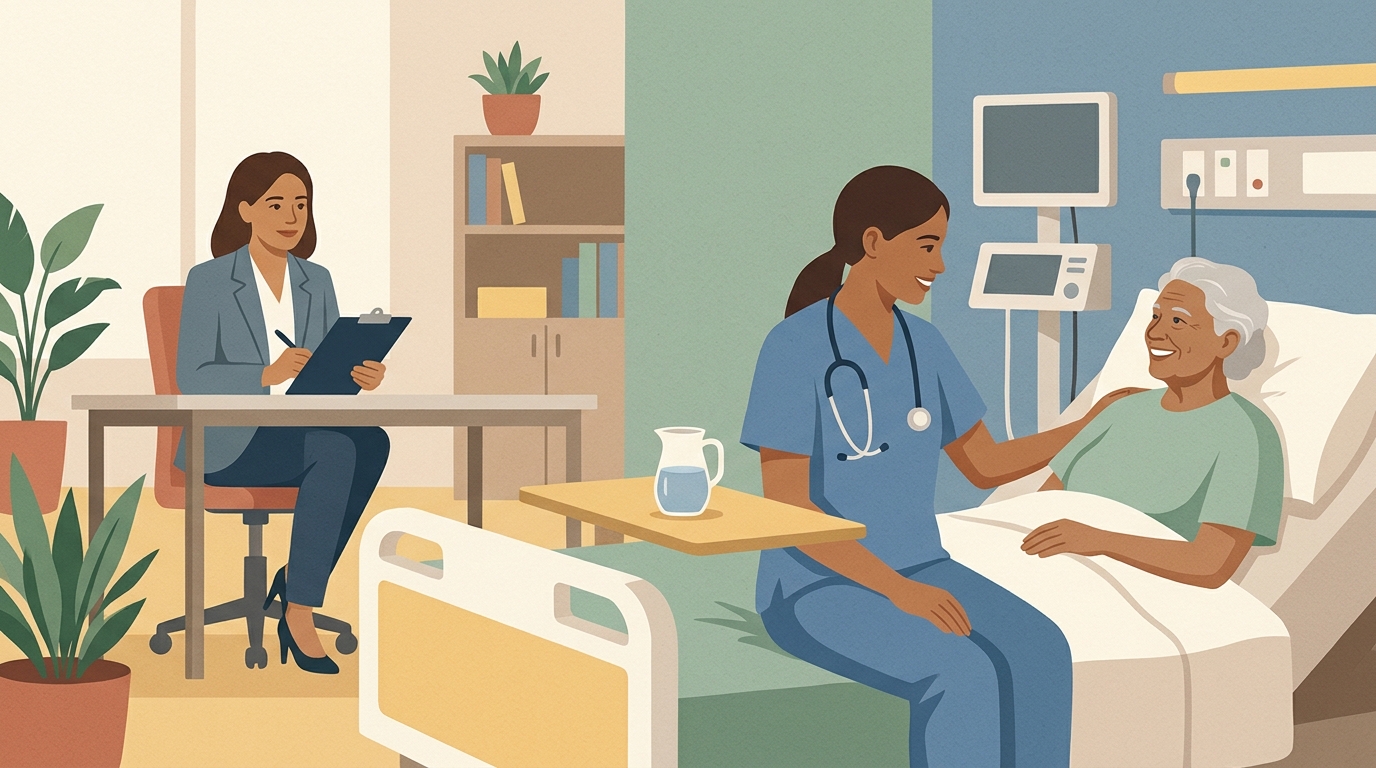
CNA interviews are short, practical and usually run by someone who works the floor. Expect a blend of clinical questions — transfers, vital signs, reporting a change in condition — and questions about handling residents, families and a shift that is down two aides; many CNA interview questions are designed to assess technical skills alongside interpersonal ability (Resume.co).
The sample answers below use the STAR structure (Situation, Task, Action, Result). Swap in your own residents, units and numbers before you use them.
What This Interview Usually Covers
Most CNA hiring runs in one or two rounds and moves fast. The first contact is often a phone screen from a recruiter or staffing coordinator who confirms you hold current certification and appear on your state's nurse aide registry; the Bureau of Labor Statistics states nursing assistants must pass a state competency exam and be on that registry to work in a nursing home (U.S. Bureau of Labor Statistics, 2025).
The main interview usually runs 20 to 45 minutes with a unit manager, director of nursing or charge nurse. In hospitals you may sit with two people at once — a nurse manager plus a senior aide or educator. Questions mix technical skills such as transfers and taking vital signs with interpersonal scenarios (Resume.co). Some employers add a short skills check — hand hygiene, a gait belt transfer, a blood pressure reading — drawn from the kind of list used in the NNAAP clinical skills demonstration (ICEV). Postings often ask about documentation and electronic medical records too (CareerOneStop, 2022).
Expect post-offer steps: background check, drug screen, TB test, immunization records. Some states add continuing education and criminal background check requirements, so check with your state certifying agency (U.S. Bureau of Labor Statistics, 2025).
Common Questions and Sample Answers
Why did you decide to become a CNA?
Sample answer
My grandmother spent four months in a skilled nursing facility after a hip fracture and I visited most evenings. I wanted to do the work I watched her aides do. I enrolled in a state-approved nurse aide program, finished the supervised clinical hours and passed the written and skills portions of the competency exam on the first attempt. I have since worked 14 months on a 32-bed long-term care unit, where I know which residents want coffee before care and which need quiet.
Tell me about a resident who refused care.
Sample answer
A resident on my hall refused her morning shower three days running and got loud when I brought the shower chair. My job was to keep her clean without forcing care. I switched to a bed bath that morning and spent two days tracking what set her off — she was cold and hated the overhead light. I started warming towels, closing the blinds and using the lamp. She accepted a shower by the fourth day and kept a twice-weekly schedule. I reported the pattern so the care plan was updated.
How do you respond when you notice a change in a resident's condition?
Sample answer
On a routine round, a resident who normally greeted me by name seemed confused about the day and her brief was saturated after months of continence. My task was to report, not diagnose. I took her vitals — temperature 100.8 — stayed with her and told the charge nurse within five minutes: confusion, incontinence, intake of about 200 mL at breakfast. The nurse ordered a urinalysis that came back positive for a UTI. Documenting observations and reporting them to the nurse is core to the role (O*NET OnLine).
Walk me through a safe bed-to-wheelchair transfer.
Sample answer
I had a resident who had fallen twice before I started, cleared for a one-person assist with a gait belt. I washed my hands, explained each step, raised the head of the bed, locked the wheelchair at a 45-degree angle, lowered the bed until her feet were flat, applied the belt snugly over clothing and had her push off on a count of three while I blocked her knees. She transferred without incident for six months. When her strength dropped, I asked the nurse for a two-person assist instead of trying alone.
How do you handle an upset family member?
Sample answer
A daughter arrived at 7 p.m. saying her father's call light had gone unanswered. My task was to hear her out without arguing or blaming staffing. I stepped into the hallway, repeated back what she told me, checked her father — dry, repositioned, water in reach — and told her exactly what I would do: round on him hourly that night and chart it. I passed it to the charge nurse so she could call the daughter back. The daughter asked for me by name on later visits.
You are short two aides with 14 residents. How do you prioritize?
Sample answer
Two call-offs on a Sunday day shift left me with six extra residents. My task was safety first, comfort second. I started with highest risk — two on thickened liquids who needed feeding assistance and one on a two-hour turning schedule — then clustered toileting and repositioning into one pass instead of walking the hall twice. I told the charge nurse which showers I was moving to evening shift rather than skipping them silently. No falls, no missed meals, and my handoff note listed everything deferred.
Tell me about a mistake you made.
Sample answer
In my first job I logged a resident's lunch intake as 75 percent when I had actually cleared another resident's tray. I caught it an hour later comparing my notes to the meal cards. I told the nurse immediately, corrected the entry in the electronic record using the facility's late-entry procedure, and started carrying a pocket sheet to record intake and output at the bedside. I have had no documentation corrections since, and the nurse asked me to show the sheet to two new aides.
Mistakes That Cost Candidates the Job
- Calling a resident "difficult" or "a feeder" instead of naming the behavior and what you changed — charge nurses hear that as how you will talk in front of families.
- Badmouthing a former facility's staffing when asked why you left, rather than saying what you want next.
- Answering a scenario question with what you would do in theory when you have a real shift to describe. Give the resident, the action and the outcome.
- Leaving the report step out. If your transfer, fall or change-in-condition story never mentions telling the nurse, it reads as working outside your scope.
- Saying you never need help with a heavy lift. The Bureau of Labor Statistics lists communication and patience alongside physical stamina as important qualities (U.S. Bureau of Labor Statistics, 2025), and interviewers listen for when you ask for a second person.
- Being vague about your certification, registry listing or CPR and basic life support cards.
- Saying you "catch up on charting at the end of the shift" — postings commonly ask for documentation and electronic medical records experience (CareerOneStop, 2022).
- Having no questions at the end. Ask about resident-to-aide ratios on the shift you are applying for, who you report to, and how call-offs are covered.
Frequently asked questions
What should I wear to a CNA interview?
Wear clean scrubs in a solid color, or plain slacks with a simple top, plus closed-toe non-slip shoes. Keep nails short, hair tied back and jewelry minimal. If the employer asks you to demonstrate a skill, scrubs let you do it without fighting your clothes.
What should I bring with me?
Bring your certification card or registry printout, CPR or basic life support card, photo ID, immunization and TB test records, and three references with phone numbers. The Bureau of Labor Statistics notes you must be on your state's nurse aide registry to work in a nursing home (U.S. Bureau of Labor Statistics, 2025).
How do I answer the pay question?
Give a range, not one number. Check the Bureau of Labor Statistics Occupational Outlook Handbook page for nursing assistants and orderlies, which publishes a median pay figure (U.S. Bureau of Labor Statistics, 2025), then use CareerOneStop's wage tool to filter by your state and metro. Ask separately about shift differentials and weekend rates.
When and how should I follow up?
Email the person who interviewed you within 24 hours, naming one specific thing you discussed, such as the unit's turning schedule. If you have heard nothing after five business days, call the staffing coordinator once and ask about the hiring timeline.
Sources
- U.S. Bureau of Labor Statistics — Nursing Assistants and Orderlies : Occupational Outlook Handbook (2025)
- O*NET OnLine (U.S. Department of Labor/Employment and Training Administration) — 31-1131.00 - Nursing Assistants

Written by
Priya tracks wages, layoffs, and the slow shifts in what counts as a stable job. She writes for readers trying to make sense of numbers that rarely match their own experience.