Switching Careers to Flight Attendant: What You Need to Know
A look at the hiring path, reserve schedules, unpaid training weeks and seniority rules before you hand in your notice at your current job.
Quick answer
- Plan for roughly 6 to 18 months from first application to a steady paycheck if you already have service experience, and 2 to 3 years if you need to build it first.
- Budget for an income gap — some airlines require unpaid training, such as the 6 weeks in Seattle described by Alaska Air Group, while Hawaiian Airlines runs 8 weeks of in-person training.
- No degree is required: the entry standard is a high school diploma or equivalent plus one or two years in a service job such as a restaurant, hotel or resort (U.S. Bureau of Labor Statistics, 2025).

Switching into flight attendant work later in your career is realistic: airlines hire on customer service experience rather than degrees, and training is provided after you are hired. The U.S. Bureau of Labor Statistics (2025) reports flight attendants typically need a high school diploma or equivalent plus one or two years of service work in restaurants, hotels or resorts, with initial airline training lasting several weeks to a few months.
The hard parts are financial and lifestyle, not academic. Expect a few months of applying and interviewing, several unpaid or low-paid training weeks, and a first year or two on reserve with unpredictable days away from home while your seniority builds.
What the Work Actually Involves
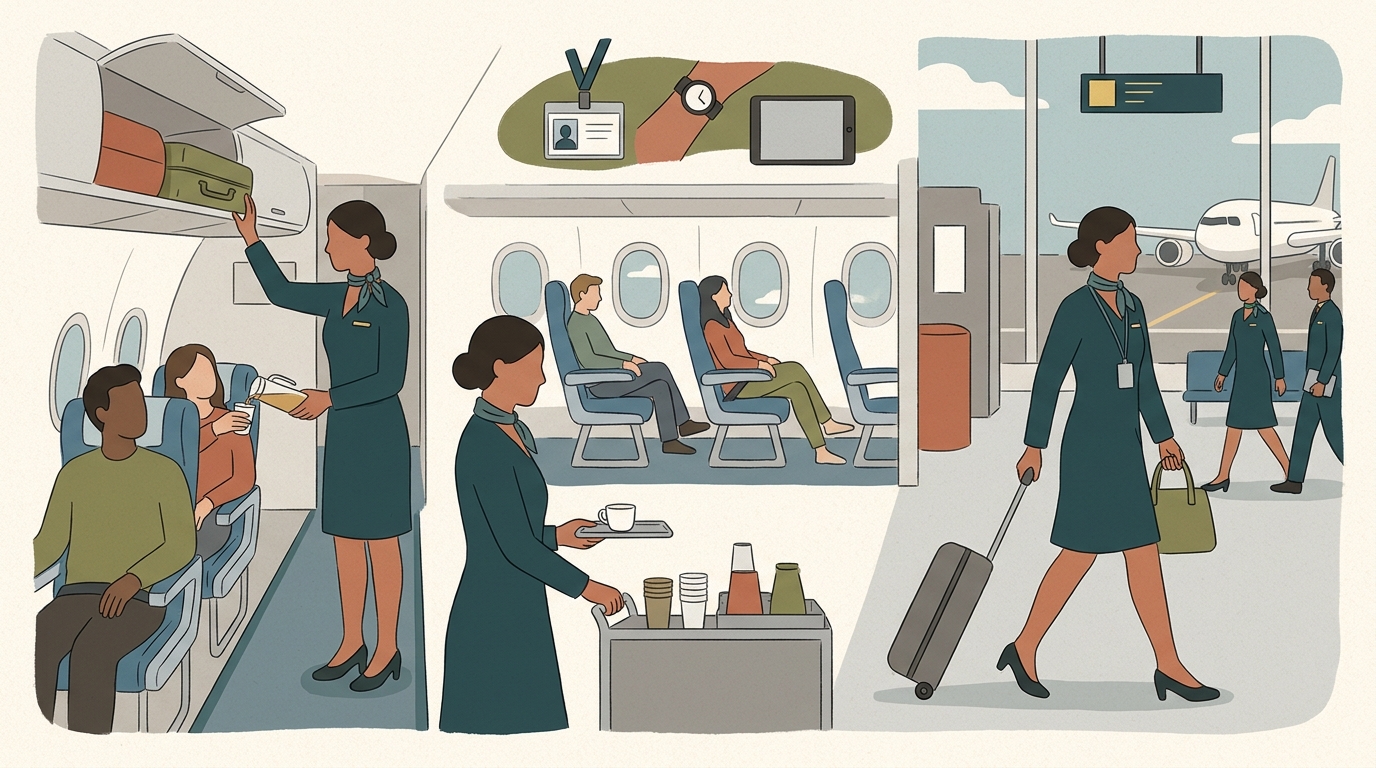
A duty day starts at the airport an hour or so before departure. You sign in, then spend 15 to 30 minutes in a preflight briefing with the pilots and cabin crew covering flight time, weather and door assignments.
Next is the preflight inspection of emergency equipment — oxygen bottles, extinguishers, slides, medical kit — roughly 15 to 20 minutes of methodical checking. Boarding is another 20 to 40 minutes standing in the aisle, helping with bags, counting heads and watching for anyone who should not be flying. Then the safety demonstration, door arming and takeoff.
On a two-hour domestic leg you get 45 to 60 minutes of actual service: beverages, snacks, payment handling, trash collection, then securing the cabin for landing. Turnarounds run 30 to 60 minutes before you do it again, often three or four times in a day. The U.S. Bureau of Labor Statistics (2025) lists the core duties as preflight briefings with pilots, emergency equipment inspections, safety demonstrations, serving beverages and meals, and directing passengers during emergency evacuations. The last one is why the job exists, even though most of your hours look like hospitality.
The people side is relentless. O*NET OnLine reports 89 percent of flight attendants say they have constant contact with others on the job, 87 percent say dealing with the public is extremely important, and 63 percent say they deal with unpleasant, angry or discourteous people every day. If you need quiet stretches to recharge during a shift, this will wear on you.
A week on reserve means being on call with your bags packed, waiting for crew scheduling to phone. A week on a held line means known trips, known layovers and known days off. Which one you get depends almost entirely on seniority at your airline.
Who This Career Change Suits
- Restaurant servers and bartenders — you already run timed service in a confined space for people who are hungry, impatient and sometimes drinking. The U.S. Bureau of Labor Statistics (2025) names restaurants specifically as the kind of prior experience airlines look for.
- Hotel front desk and guest services staff — check-in, upgrade requests, complaints and document checks use the same muscles as boarding and in-flight problem solving.
- Retail store managers — cash and card handling, de-escalating angry customers and following procedure under time pressure all transfer directly.
- Registered nurses, EMTs and CNAs — medical events at 35,000 feet are part of the job, and you are already calm when someone goes pale and sweaty.
- Elementary and secondary teachers — giving clear instructions to a room of people who are not listening is the safety demonstration, and the evacuation command, in miniature.
- Military veterans and former law enforcement officers — checklist discipline, chain of command and briefings before every operation map almost one to one onto crew culture.
- People whose home life is genuinely portable — no school run you must make, no dependent who needs you at a fixed hour. Reserve schedules punish rigid home commitments.
- Anyone over 45 who assumed they were too old — Aircraft Interiors International (2023) reported the average flight attendant was 49 years old, so a cabin crew of mid-career people is normal rather than unusual.
Transferable Skills That Carry Over
| Prior Career | Skill | How It Applies Here |
|---|---|---|
| Restaurant server | Timed service in tight aisles | Beverage and meal service on a short leg, with no second chance to return to the kitchen |
| Hotel front desk agent | Handling complaints without escalating them | Seat disputes, missed connections, and the 63 percent of days O*NET OnLine reports involve discourteous people |
| Retail manager | Cash handling, procedure compliance | Onboard payment systems, duty-free sales, documented safety checks |
| Registered nurse or EMT | Rapid assessment under medical pressure | Inflight medical events, oxygen administration, coordinating with ground-based medical advice |
| Teacher | Instructing a distracted audience | Safety demonstrations and evacuation commands that must land the first time |
| Military or law enforcement | Briefings, checklists, chain of command | Preflight briefings with pilots and the annual recurrent training the FAA certificate requires |
| Call center agent | Script discipline plus reading tone fast | Standardized announcements, and spotting the passenger about to become a problem |
How to Get Started
- Check the baseline requirements first. The U.S. Bureau of Labor Statistics (2025) lists a minimum age of typically 18 or 21 depending on the airline, eligibility to work in the United States, a valid passport, a background check and drug test, and vision correctable to at least 20/40. Airlines also set their own physical job-related requirements — reaching emergency equipment, operating aircraft doors, standing for long periods — and there is no single universal federal height rule.
- Renew your passport now if it is expired or expires within the next year. You cannot be scheduled on international routes without one, and some airlines screen for it at application.
- Build or document service experience. Airlines typically want one or two years in a service occupation such as restaurants, hotels or resorts (U.S. Bureau of Labor Statistics, 2025). If your background is office-based, a year of part-time front-of-house work gives recruiters the evidence they look for.
- Rewrite your resume around customer contact. Lead with public-facing duties, conflict resolution, cash handling and any safety or emergency responsibility, and strip the jargon from your old industry.
- Apply directly to airline career pages. Hiring runs through the airline, not through schools or agencies — you apply, pass the airline's screening, then complete airline-provided training (Assessment.com, undated). Set alerts for carriers with bases you could reach, and apply to several at once.
- Prepare for a multi-stage screening. Expect a recorded video interview, then a group assessment day with role-play and reach tests, then a conditional offer subject to background check and drug test. Practice two-minute answers about calming an angry customer.
- Arrange your finances before training starts, then pass it. Initial training runs several weeks to a few months at the airline's training center (U.S. Bureau of Labor Statistics, 2025); Alaska Air Group describes 6 weeks of unpaid training in Seattle, and 8 weeks of in-person training for Hawaiian Airlines flight attendants. On completion you receive the FAA Certificate of Demonstrated Proficiency for specific aircraft types, with new training for each additional type and recurrent training every year.
Costs and Time Commitment
Figures below are planning estimates for your own budget, not quoted prices. Costs vary by airline, base city and how far you travel.
| Item | Typical Cost | Typical Time |
|---|---|---|
| Passport (new or renewal) | Government fee set by the U.S. Department of State | 4 to 10 weeks; apply before interviewing |
| Building service experience, if you lack it | No tuition — it is paid work | 12 to 24 months, per the 1 to 2 years the Bureau of Labor Statistics (2025) describes |
| Interview clothes, grooming, travel to assessment days | A few hundred dollars across multiple airlines | Spread over 3 to 9 months of applying |
| Initial airline training and FAA certification | Provided by the airline; some is unpaid — Alaska Air Group describes 6 weeks unpaid, Hawaiian Airlines 8 weeks in person | 6 weeks to a few months (U.S. Bureau of Labor Statistics, 2025) |
| Income gap during training and reserve ramp-up | Budget 3 to 6 months of living expenses | 2 to 6 months before pay stabilizes |
| Crash pad or relocation near your assigned base | Monthly share of a crash pad, or a full move | Often 1 to 3 years, until seniority wins a preferred base |
The honest financial picture: the median flight attendant wage was $63,580 in May 2025, but the lowest 10 percent earned less than $35,110 (U.S. Bureau of Labor Statistics, 2025), and new hires start at the bottom. If you earn above that median now, plan on a pay cut in year one and a climb that depends on seniority. A realistic end-to-end transition is 6 to 18 months with service experience behind you, and 2 to 3 years if you need to build it first.
Frequently asked questions
Am I too old to start as a flight attendant at 45 or 50?
A 2023 study reported the average age of an airline flight attendant was 49 years old (Aircraft Interiors International, 2023), so a mid-career start is common rather than exceptional. Airlines set minimum ages — typically 18 or 21 (U.S. Bureau of Labor Statistics, 2025) — but no maximum. The practical concerns for applicants in their 40s and 50s are the physical requirements, such as operating aircraft doors and standing for long periods, and the willingness to be junior again on reserve.
How secure is the job market for new entrants?
The U.S. Bureau of Labor Statistics (2025) projects employment of flight attendants to grow 9 percent from 2025 to 2035, much faster than the average for all occupations, from a base of 133,700 jobs in 2025. It also projects about 18,500 openings a year on average over the decade, largely to replace people who transfer occupations or leave the labor force. That churn is why airlines run repeated hiring rounds, but competition within each round is heavy.
How long until I stop being on reserve and get a predictable schedule?
Advancement and schedule control are based on seniority (U.S. Bureau of Labor Statistics, 2025), so it depends on how many people your airline hires after you. Budget 1 to 3 years at most carriers before you reliably hold a line, and understand that moving to a different airline resets you to the bottom. Senior attendants on international routes may oversee other crew, and some move into recruiting, instructing or scheduling roles.
What happens to my pay if I leave a desk job to do this?
Expect a step down first. The median was $63,580 in May 2025, with the lowest 10 percent under $35,110 and the highest 10 percent above $136,430 (U.S. Bureau of Labor Statistics, 2025) — and that spread is largely seniority. Check your target airlines' current pay scales and the Bureau of Labor Statistics Occupational Outlook Handbook for up-to-date figures before you resign.
Sources
- U.S. Bureau of Labor Statistics — Flight Attendants : Occupational Outlook Handbook (2025)
- O*NET OnLine — 53-2031.00 - Flight Attendants

Written by
Wyatt covers work outside the office: construction, logistics, repair, and the people who keep things running. He's skeptical of career advice that assumes everyone sits at a desk.