Radiologic Technologist vs. Ultrasound Technician: Pay, Duties, and Day-to-Day Differences
One role works behind lead shielding with ionizing radiation; the other presses a probe by hand for 30 minutes straight — and that split shapes everything.
Quick answer
- The biggest practical difference: radiologic technologists shoot pre-set exposures using ionizing radiation and wear lead; sonographers hold a transducer and decide in real time which images prove or rule out the finding.
- Both list an associate degree as typical entry-level education (U.S. Bureau of Labor Statistics, 2025) — roughly two years full time — but radiography carries the longer licensing runway, since most states require licensure or certification and employers typically require or prefer certification (U.S. Bureau of Labor Statistics, 2025).
- Neither job is physically easy, and pay is national-median data you should check yourself: radiography means lifting, transfers and standing most of a shift, sonography concentrates strain in the scanning shoulder and wrist, and 2025 median figures from the Bureau of Labor Statistics and O*NET OnLine are national, so your state and metro will differ.
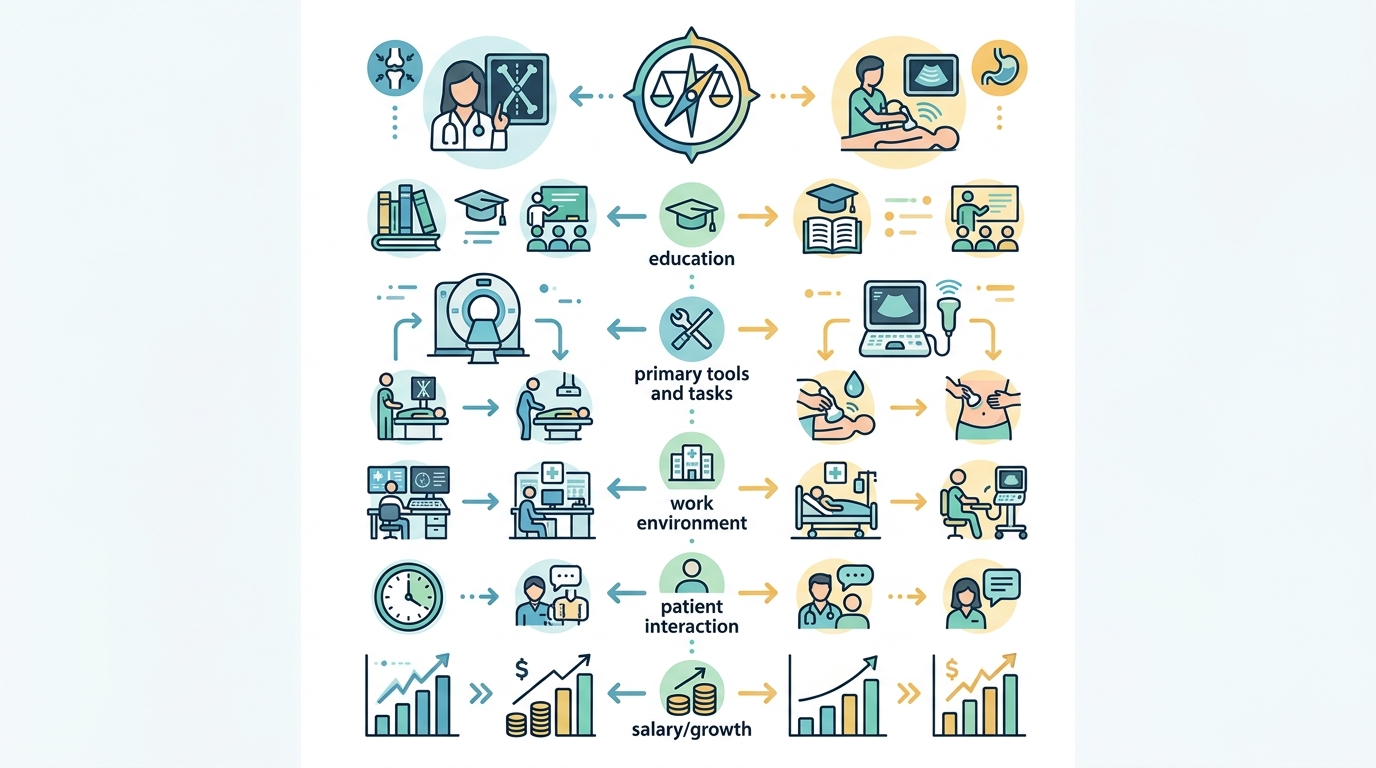
Radiologic technologists and ultrasound technicians (formally, diagnostic medical sonographers) both produce the images doctors read, but they use different physics, different body mechanics and often different schedules. Radiography is fast, protocol-driven and uses ionizing radiation; sonography is slower, hands-on and asks you to find the diagnostic image yourself while the patient lies in front of you.
Entry to both typically runs through an associate degree, but the certification and state licensure picture differs, and the physical costs of each job land on different parts of your body. This guide compares requirements, published pay and outlook sources, a typical Tuesday in each role, and who tends to last in each.
Head-to-Head Comparison
Four dimensions decide this choice for most people. The pay and outlook rows below point to the specific published sources rather than a single number, because these are updated annually and because national medians hide large state and metro differences.
| Dimension | Radiologic technologist | Ultrasound technician (diagnostic medical sonographer) |
|---|---|---|
| Typical entry requirement | An associate degree is the typical entry-level education (U.S. Bureau of Labor Statistics, 2025), usually about two years full time. Most states require licensure or certification, and employers typically require or prefer certification (U.S. Bureau of Labor Statistics, 2025). ARRT certification rests on education, ethics and examination requirements, and you must apply within three years of finishing an ARRT-recognized program — the Three-Year Rule (American Registry of Radiologic Technologists policy summary). | An associate degree is listed as the entry-level education (U.S. Bureau of Labor Statistics, 2025), again around two years. ARDMS certification requires meeting one prerequisite pathway (education and/or clinical experience) and then passing two exams: the Sonography Principles & Instrumentation (SPI) exam and a specialty exam (ARDMS policy summary). State requirements vary — check your state health department or medical board. |
| Median pay | The Bureau of Labor Statistics publishes a 2025 median annual wage for radiologic technologists and technicians, and a separate 2025 median pay figure for the combined radiologic and MRI technologist group; ONET OnLine publishes 2025 median wages for occupation 29-2034.00. Look up the current numbers on the BLS Occupational Outlook Handbook and ONET pages — both are national. | The Bureau of Labor Statistics publishes a 2025 median pay figure for diagnostic medical sonographers, and O*NET OnLine publishes 2025 median wages for occupation 29-2032.00. Check both sources directly, and compare against your own state, since hospital, outpatient-imaging and physician-office settings pay differently within the same metro. |
| Physical and schedule demands | Most radiologic and MRI technologists work full time (U.S. Bureau of Labor Statistics, 2025). Hospital radiography covers nights, weekends and holidays, often with on-call rotations for trauma. Expect standing for most of a shift, transferring patients onto tables, pushing portable units, and wearing a lead apron and dosimetry badge. | Scanning is quieter but harder on the upper body: sustained transducer pressure, reaching across a bed, and a repeated forward-and-twisted posture. Outpatient clinics often run weekday daytime hours; hospital and OB sonographers may carry evening, weekend or call coverage. Emotionally heavy scans, including obstetric ones, come with the job. |
| Five-year outlook | The Bureau of Labor Statistics publishes a 2025–35 job outlook for radiologic and MRI technologists, and O*NET OnLine publishes a 2025–2035 projected employment growth figure for radiologic technologists and technicians (29-2034.00). Both published windows are ten years, so a five-year horizon is roughly half of that projection. | The Bureau of Labor Statistics publishes outlook data for diagnostic medical sonographers, and O*NET OnLine publishes a 2025–2035 projected employment growth figure for occupation 29-2032.00. Again the published window is ten years; use it as a direction of travel, not a guarantee for any one city. |
Two things the table cannot show. First, upkeep differs: certified radiologic technologists must complete continuing education, meet continuing qualification requirements every ten years, and renew certification annually (summary of ARRT policy), while ARDMS certification is maintained with continuing medical education credits every three years (summary of ARDMS policy). Second, O*NET OnLine also reports the education level actually held by people working as radiologic technologists and technicians (2025), which is worth checking if you are weighing an associate degree against a longer program.
Day-to-Day Differences
Picture the same Tuesday in a mid-size hospital.
The radiologic technologist clocks in at 6:45 a.m. for a day shift and picks up a worklist of chest films from overnight admissions. The first two hours are portable exams: pushing a mobile X-ray unit into ICU rooms, clearing lines and leads out of the field, positioning a cassette behind a patient who cannot sit up, calling the exposure, and clearing the room. Back in the department, it is a hand series, a lumbar spine, and a swallow study where the tech runs fluoroscopy while the radiologist drives the exam. Through all of it, the tech sets technical factors — kilovoltage and milliamperage — to balance image quality against dose, wears a lead apron for fluoroscopy, and carries a dosimetry badge that gets read on a schedule. At 2 p.m. the ED calls a trauma: a pelvis and chest film at the bedside in minutes, around a crowded resuscitation bay. A sonographer never sets exposure factors, never wears lead for their own modality, and never carries a radiation badge, because ultrasound uses sound waves, not ionizing radiation.
The ultrasound technician starts at 8 a.m. with a scheduled list: an abdominal study, a renal, two OB exams and a vascular follow-up, usually 30 to 60 minutes each. The abdominal patient fasted overnight; the tech dims the room, applies gel, and works systematically through the liver, gallbladder, pancreas, kidneys and aorta, adjusting depth, gain and focus as they go, holding the probe steady while the patient holds a breath. When a gallbladder wall looks thickened, the tech does not simply complete the protocol — they add views, take measurements, check for a sonographic Murphy's sign, and document the finding in a technical worksheet the radiologist will read alongside the images. That is the task radiography never involves: the sonographer effectively has to recognize the abnormality in real time, because once the patient leaves, the image cannot be re-created from stored data. The physical cost shows up by mid-afternoon as shoulder and wrist fatigue from sustained pressure, not from lifting.
The contrast in a sentence: a radiographer's skill is positioning and exposure under time pressure, often with patients who are acutely unwell; a sonographer's skill is sustained hand-eye searching with a patient who is usually stable but sometimes receiving bad news in the room.
Who Thrives in Each Path
Radiologic technology suits you if:
- You have worked in an emergency department, as an EMT, or as a patient care tech, and you are already comfortable positioning someone with a fractured hip without making the injury worse.
- You like protocol work with a clear endpoint — a defined series of views, done correctly, then the next patient — rather than open-ended searching.
- You are willing to carry the regulatory load: most states require licensure or certification (U.S. Bureau of Labor Statistics, 2025), and ARRT certification must be renewed annually with continuing education and continuing qualification requirements every ten years (ARRT policy summary).
- Night, weekend and on-call shifts fit your life, since most radiologic and MRI technologists work full time (U.S. Bureau of Labor Statistics, 2025) and hospital imaging runs around the clock.
Sonography suits you if:
- You have strong spatial reasoning — the kind that lets you hold a 3D anatomy map in your head while looking at a 2D slice on screen — and you enjoy manipulating an image until it answers the question.
- You can stay with one patient for 45 minutes, manage small talk during a quiet OB scan, and keep your face neutral when the images are not good news.
- You have prior clinical employment you can leverage: one ARDMS prerequisite pathway requires employment as an ultrasound or vascular sonographer in a clinical setting for at least 12 months and at least 1,680 hours (ARDMS policy summary), which matters if you are entering through on-the-job experience rather than a degree program alone.
- You will take ergonomics seriously, including table height, bed rails down, and arm support, because repetitive scanning strain is the most common reason sonographers leave the chairside.
Frequently asked questions
Which path takes longer before I can start working?
They are close. Both list an associate degree as typical entry-level education (U.S. Bureau of Labor Statistics, 2025), roughly two years full time. Radiography usually adds more regulatory steps afterward: most states require licensure or certification (U.S. Bureau of Labor Statistics, 2025), and ARRT certification must be applied for within three years of finishing an ARRT-recognized program under the Three-Year Rule.
I am already a radiologic technologist. How do I move into ultrasound mid-career?
Two concrete routes. ARRT's post-primary eligibility pathway can be met by technologists already certified by ARRT, the Nuclear Medicine Technology Certification Board, or ARDMS, which gives a credentialing bridge between the radiography and sonography registries. Alternatively, pursue ARDMS certification by meeting a prerequisite pathway, then passing the Sonography Principles & Instrumentation (SPI) exam plus a specialty exam.
Which one pays more?
Check the current figures yourself rather than trusting a remembered number. The Bureau of Labor Statistics publishes 2025 median pay for diagnostic medical sonographers and 2025 median wages for radiologic technologists and technicians, and O*NET OnLine publishes 2025 median wages for occupations 29-2032.00 and 29-2034.00. All are national medians; state, metro and employer type move them substantially.
Is demand holding up in both fields?
The Bureau of Labor Statistics publishes a 2025–35 job outlook for radiologic and MRI technologists, and O*NET OnLine publishes 2025–2035 projected employment growth for both radiologic technologists and technicians and diagnostic medical sonographers. Note that these are ten-year projections, national in scope. Local hiring depends on hospital expansion, outpatient imaging centers and retirements in your area.
What is the main downside people underestimate in each job?
For radiography, it is the schedule and the lifting: most radiologic and MRI technologists work full time (U.S. Bureau of Labor Statistics, 2025), and hospital coverage means nights, weekends and trauma calls. For sonography, it is repetitive strain — sustained transducer pressure and awkward reaching cause shoulder, wrist and neck problems that end careers if ergonomics are ignored early.
Sources
- U.S. Bureau of Labor Statistics — Radiologic and MRI Technologists : Occupational Outlook Handbook (2025)
- U.S. Bureau of Labor Statistics — Healthcare Occupations : Occupational Outlook Handbook (2025)

Written by
Wyatt covers work outside the office: construction, logistics, repair, and the people who keep things running. He's skeptical of career advice that assumes everyone sits at a desk.