Phlebotomist Interview Questions: What to Expect and How to Prepare
Hiring managers test your venipuncture technique, patient-identification habits and composure with difficult draws, often in the same short visit.
Quick answer
- Rehearse a 30-second script for the two-identifier check and bedside labeling — it is the single most common technical question.
- Prepare one story each for a fearful patient, a difficult or failed stick, and a fainting or adverse reaction, with the gauge, tube type and outcome named.
- Bring your certification card, program completion documents and a written count of venipunctures and capillary sticks performed; several employers ask to see them at interview.
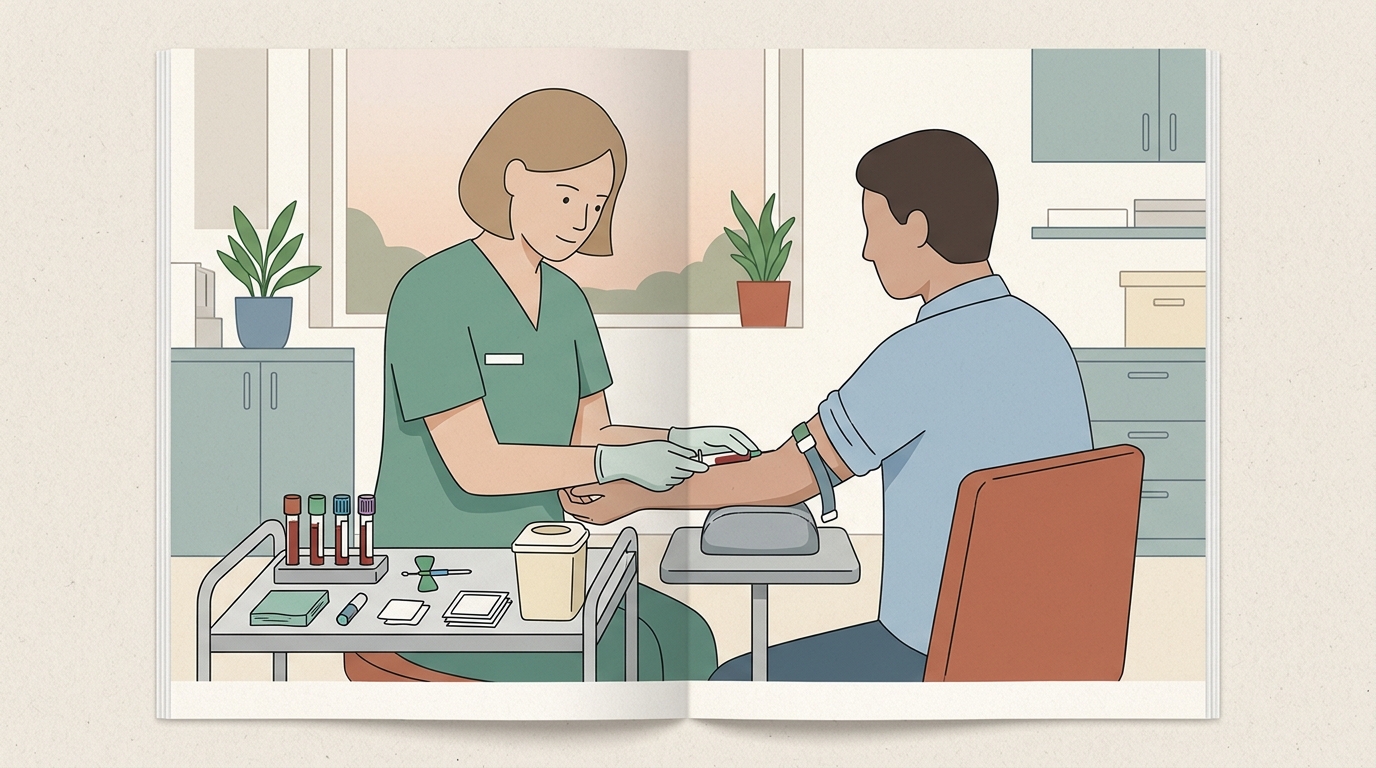
A phlebotomy interview is usually short, practical and focused on safety: how you confirm identity, how you label specimens, how you handle a fearful patient or a failed stick. Expect behavioral questions tied to real draws you have done, plus technical checks on order of draw, tube additives and what you do when a patient reacts badly.
Format varies by employer and setting — a hospital lab, a diagnostic laboratory, a blood donor center and a doctor's office all interview differently (U.S. Bureau of Labor Statistics, 2025). This guide covers what each tends to ask, sample answers you can adapt, and the answer patterns that get candidates screened out.
What This Interview Usually Covers
Most phlebotomy hiring runs in one or two rounds and takes under an hour in total. A recruiter or HR coordinator screens by phone for availability, shift flexibility and whether you hold a certification, then a lab supervisor, lead phlebotomist, charge nurse or donor center manager interviews you in person. Panels of two are common in hospital labs, where a lab manager and a shift lead sit together.
Expect three strands: behavioral questions about patients and errors, technical questions about order of draw, tube additives and specimen handling, and situational questions about adverse reactions. Some employers add a practical check — demonstrating a draw on a training arm, or shadowing a shift so a lead can watch you work.
Settings differ. Hospital and diagnostic laboratory interviews lean on morning rounds, STAT draws and difficult sticks; blood donor centers focus on donor screening, customer service and reaction management, and some donor center roles advertise paid training with no prior medical experience required (CareerOneStop, 2025). Offers are usually conditional on a background check, drug screen and immunization records. Licensing rules differ by state — check your state health department before you apply.
Common Questions and Sample Answers
Adapt these to your own draws. Keep each answer to roughly 60 to 90 seconds and name the tube, gauge or count.
Walk me through how you confirm a patient's identity before a draw.
Sample answer
At an outpatient draw station I covered on Mondays, two patients on the same morning list shared a last name and a birth month. My job was to collect a CBC and a metabolic panel on one of them without mixing the orders. I asked each patient to state their full name and date of birth rather than confirming it for them, matched that to the wristband and the requisition, and labeled every tube at the chair before leaving. The mismatch surfaced at check-in instead of in the lab, and I finished 14 months there with no mislabeled specimens.
Tell me about a time a patient was afraid of needles.
Sample answer
A 19-year-old came in for a pre-employment panel and told me he had fainted at his last draw. I needed three tubes and one clean stick. I had him lie on the recliner, applied a warm pack for two minutes, used a 23-gauge butterfly in the forearm, and talked him through each step before I did it, telling him to look at the wall clock and breathe out on insertion. He gave all three tubes on the first stick, stayed upright, and asked for me by name at his next visit.
Describe a difficult stick and how you handled it.
Sample answer
A dehydrated oncology patient on the fourth floor had scarred antecubital veins from months of treatment. I had orders for a PT/INR that the floor needed before the next dose. I warmed the arm, anchored a hand vein, and switched to a 23-gauge butterfly with a partial-draw tube to avoid collapsing the vein. The first attempt failed, so I moved to the opposite hand rather than repalpating the same site. The second stick filled the tube, and the result was in the chart within 40 minutes.
What do you do if a patient faints or has an adverse reaction?
Sample answer
During a mobile blood drive, a first-time donor went pale and quiet about halfway through the collection. My responsibility was to stop the reaction from becoming an injury. I released the tourniquet, removed the needle and applied pressure, lowered the chair and raised her legs, put a cold compress on her neck and called my charge phlebotomist over. She recovered in about four minutes, drank juice through a 15-minute observation period, and I documented the reaction on the donor record before she left.
Tell me about a time you caught a specimen or labeling error.
Sample answer
On a night shift I picked up a tray from a colleague who had been pulled to the ER and found a lavender-top tube whose label did not match the requisition number. My job was to protect the result, not to save the collection. I quarantined the tube, told the shift lead immediately, and recollected from the patient after reconfirming two identifiers. The original tube was discarded rather than relabeled. The unit's quarterly audit that cycle showed no mislabeled specimens reaching testing.
How do you get through a heavy morning rounds list?
Sample answer
My usual morning assignment was 38 patients across three floors, with STAT and timed draws dropping in while I worked. I sorted the list by floor and by timed collections first, drew STATs as they came, and restocked my tray once at the midpoint so I was not walking back for tubes. I also flagged two known hard sticks for the lead so we could pair up. We finished rounds before the 7:00 handoff on every shift that quarter.
Why do you want to work in this setting?
Sample answer
I spent a year in a busy outpatient clinic doing routine panels and wanted more variety in collection methods. The task I set myself was to get exposure to vacuum tube, syringe and butterfly draws on patients who are genuinely unwell rather than walk-ins. I shadowed a hospital lab for two shifts, saw the pace of 5:00 a.m. rounds, and decided it suited me. I am applying here because inpatient collections are where I will build the most technique the fastest.
Mistakes That Cost Candidates the Job
- Claiming you have never missed a vein. Supervisors hear it as inexperience or dishonesty; say instead how many attempts you make before escalating and who you hand off to.
- Describing labeling tubes at the nurses' station or after leaving the room. Say bedside, before you leave the patient, every time.
- Saying you would relabel a mismatched tube rather than discard it and recollect.
- Answering the fainting question with "I'd call for help" and stopping. Name the sequence: tourniquet off, needle out, pressure, lower the head, legs up, call, document.
- Badmouthing a former lab supervisor or complaining about short staffing when asked why you left. Give a forward-looking reason — more collection types, a shift that fits your schedule.
- Going vague on order of draw and tube additives. If you are rusty, review it the night before and be able to explain why the order matters for contamination.
- Turning up without your certification card, program documentation or a count of venipunctures and capillary sticks you have performed, when the posting asked you to bring them.
- Leading with questions about shift differential and weekends before you ask a single question about patient volume, training or the team.
Frequently asked questions
What should I wear to a phlebotomy interview?
Wear business casual, not scrubs, unless the employer tells you a shadowing shift is part of the day — then bring clean scrubs and closed-toe shoes in a bag. Keep nails short, hair tied back and jewelry minimal; interviewers read that as infection-control habit.
Do I need certification to get hired?
Not always. Phlebotomists typically enter with a certificate from a postsecondary program, though some qualify with a high school diploma and on-the-job training, and employers may prefer certified candidates (U.S. Bureau of Labor Statistics, 2025). Some postings list certification as preferred rather than required (CareerOneStop, 2025). Get certified if you can.
How do I answer the salary question?
Give a range, not a number you cannot justify. Build it first: look up the phlebotomist median annual wage reported for May 2025 in the Bureau of Labor Statistics Occupational Outlook Handbook, then check CareerOneStop's salary tool filtered to your state and metro area, and quote the local range.
Will I have to demonstrate a draw?
Often yes in hospital and laboratory settings — usually on a training arm, occasionally by shadowing a shift. Practice the full sequence out loud the night before: identity check, site selection, tourniquet under a minute, order of draw, bedside labeling, sharps disposal.
How many venipunctures should I be able to document?
Track every one. Certification routes set their own minimums — the ASCP PBT route for structured programs requires 40 classroom hours plus at least 100 successful unaided venipunctures (ASCP Board of Certification), and the NHA Certified Phlebotomy Technician exam requires evidence of at least 30 venipunctures and 10 capillary sticks on live individuals (National Healthcareer Association, September 2022).
How soon should I follow up?
Send a short thank-you email within 24 hours to each interviewer, naming one specific thing discussed. If you have heard nothing after the date they gave you, call the hiring manager once, a week later. Do not follow up more than twice.
Sources
- U.S. Bureau of Labor Statistics — Phlebotomists : Occupational Outlook Handbook (2025)
- O*NET OnLine (U.S. Department of Labor) — 31-9097.00 - Phlebotomists

Written by
Marisol steers Jobladderhq's coverage of hiring trends and the strange rituals of modern recruiting. She's drawn to the gap between what job ads promise and what the work actually feels like. Her editing hand favors clarity over jargon, always.