
Occupational Therapy Assistant vs. Physical Therapist Assistant: Which Career Path Is Right for You?
Both roles work under a licensed therapist, take about two years of college and a state credential, but what you help people do each day is different.
Quick answer
- The biggest practical difference is the goal of treatment: an OTA works on the task (buttoning a shirt, returning to a job), a PTA works on the movement (walking, strength, range of motion).
- Neither path requires more upfront schooling — both are typically a 2-year accredited associate's degree, though OTA programs add several months of fieldwork after coursework, and all states require PTAs to be licensed or certified while OTAs usually need a state license (U.S. Bureau of Labor Statistics, 2025).
- Both are projected to grow much faster than average over 2025–2035 — 20 percent for occupational therapy assistants and aides, 17 percent for physical therapist assistants and aides — and both are physically demanding, with PTAs especially vulnerable to back injuries (U.S. Bureau of Labor Statistics, 2025).
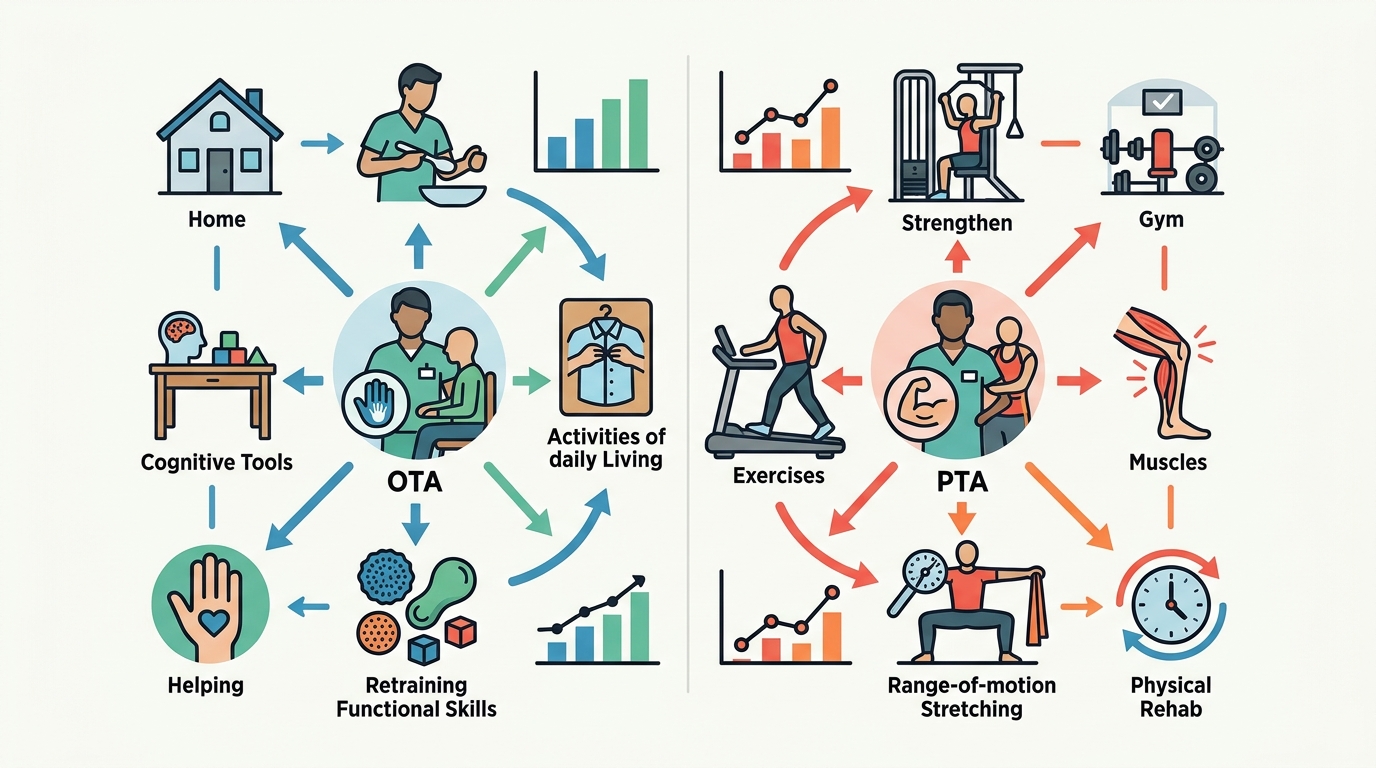
Occupational therapy assistants (OTAs) help people regain the ability to do everyday tasks — dressing, cooking, handwriting, play. Physical therapist assistants (PTAs) carry out treatment plans aimed at movement, strength and pain. Both are associate-degree roles with licensing exams, both involve a lot of standing and lifting, and both pay similarly at the national median: $72,300 for occupational therapy assistants and $68,380 for physical therapist assistants in May 2025, according to the U.S. Bureau of Labor Statistics (2025).
The choice usually comes down to which end of recovery interests you — the body mechanics, or the life the person wants to get back to.
Head-to-Head Comparison
| Dimension | Occupational Therapy Assistant | Physical Therapist Assistant |
|---|---|---|
| Typical entry requirement | An associate's degree from an accredited occupational therapy assistant program, though some bachelor's programs exist; associate programs generally take 2 years of full-time study plus several months of fieldwork (U.S. Bureau of Labor Statistics, 2025). A state-issued license is usually required, based on an accredited program, fieldwork and an exam; you must pass the National Board for Certification in Occupational Therapy (NBCOT) exam to use the Certified Occupational Therapy Assistant (COTA) title (U.S. Bureau of Labor Statistics, 2025; NBCOT, undated). | All states require an associate's degree from an accredited program, typically about 2 years including supervised clinical work, and all states require licensure or certification (U.S. Bureau of Labor Statistics, 2025). Licensure typically means graduating from an accredited program and passing the National Physical Therapy Examination (NPTE), administered by FSBPT (American Physical Therapy Association, undated). Some states add a state-law exam, a background check and a minimum age of 18. |
| Median pay (national) | $72,300 median annual wage in May 2025 (U.S. Bureau of Labor Statistics, 2025). | $68,380 median annual wage in May 2025 (U.S. Bureau of Labor Statistics, 2025). |
| Physical and schedule demands | Much of the day is spent standing, and you need to be moderately strong for lifting and moving clients, kneeling and stooping (U.S. Bureau of Labor Statistics, 2025). Most work full time, but part-time work is common, and schedules may include evenings or weekends to fit clients' routines (U.S. Bureau of Labor Statistics, 2025). | Frequently on your feet and moving, often lifting and moving patients, with real vulnerability to back injuries (U.S. Bureau of Labor Statistics, 2025). Most work full time, with some nights and weekends because clinics keep extended hours (U.S. Bureau of Labor Statistics, 2025). |
| Five-year outlook | Employment of occupational therapy assistants and aides is projected to grow 20 percent from 2025 to 2035, much faster than average, with about 8,600 openings projected each year on average over that decade (U.S. Bureau of Labor Statistics, 2025). The first five years sit inside that decade projection. | Employment of physical therapist assistants and aides is projected to grow 17 percent from 2025 to 2035, much faster than average (U.S. Bureau of Labor Statistics, 2025). Physical therapist assistants held about 114,100 jobs in 2025, with 44 percent in offices of physical, occupational and speech therapists and audiologists (U.S. Bureau of Labor Statistics, 2025). |
Two cautions on the numbers. The pay figures are national medians — half of workers earned less — and what you are offered depends on your state, metro area and setting, so check the BLS Occupational Outlook Handbook and Occupational Employment and Wage Statistics pages for your state, and compare them against current job postings where you live. The growth figures are ten-year projections for 2025–2035, not a guarantee of openings in any one city or year.
Licensing rules are set state by state. Before you enrol anywhere, read your own state licensing board's requirements, because program accreditation, fieldwork hours and exam rules are what the board checks.
One more difference worth weighing: with additional education and licensure, occupational therapy assistants may advance by becoming occupational therapists (U.S. Bureau of Labor Statistics, 2025), which gives the OTA route a named step up.
Day-to-Day Differences
Picture the same Tuesday in a rehabilitation unit, with both assistants working from plans written by the therapist who supervises them.
The OTA's morning starts in a patient room rather than a gym. A client recovering from a stroke wants to get dressed without help, so the session is the dressing itself: a sock aid, a buttonhook, and a worked-out sequence of putting the weaker arm into the sleeve first. Occupational therapy assistants guide clients through therapeutic activities such as exercises to improve motor skills, teach new ways of accomplishing everyday tasks, and instruct clients in the use of special equipment (U.S. Bureau of Labor Statistics, 2025). After lunch the OTA might lead children with disabilities in developmental play activities — a task a PTA never takes on — using play to build grip, attention and hand control. The afternoon could end with a kitchen assessment: can this person carry a hot pan safely, and what has to change at home if not.
The PTA's Tuesday is built around movement. The same stroke patient comes to the gym for gait training with a gait belt and parallel bars, then a set of sit-to-stand repetitions counted and recorded. Next is a knee replacement patient two weeks post-surgery: measuring range of motion with a goniometer, progressing resistance band work, applying heat or ice, and writing down how far the knee bent today compared with Friday. Progressing a patient along a prescribed exercise and modality plan toward measurable strength and mobility targets is PTA work; the OTA does not do it.
The overlap is real — both watch for pain, both document every session for the supervising therapist, both spend the day on their feet and both help transfer people between bed, chair and mat. The lifting is where the risk sits: physical therapist assistants and aides are vulnerable to back injuries (U.S. Bureau of Labor Statistics, 2025), and occupational therapy assistants need to be moderately strong for lifting, kneeling and stooping (U.S. Bureau of Labor Statistics, 2025).
Schedules differ at the edges. Part-time work is common for OTAs and sessions are often shifted to evenings or weekends to fit clients' routines, while PTAs more often work full time with some nights and weekends because clinics run extended hours (U.S. Bureau of Labor Statistics, 2025). Setting matters too: 44 percent of physical therapist assistant jobs in 2025 were in offices of physical, occupational and speech therapists and audiologists (U.S. Bureau of Labor Statistics, 2025), where the Tuesday above would be a column of booked appointments rather than a walk between hospital floors.
Who Thrives in Each Path
Occupational therapy assistant
- You like problem-solving around objects and routines. Working out that a client can cook again if the pans move to a lower shelf and the handles get built up is the core skill, not a side note.
- You have childcare, special education or early-years experience. Leading children with disabilities in developmental play activities is a standard part of the job (U.S. Bureau of Labor Statistics, 2025), and knowing how to hold a child's attention transfers directly.
- You want flexible hours. Part-time work is common among occupational therapy assistants and aides, and evening or weekend sessions are used to fit clients' schedules (U.S. Bureau of Labor Statistics, 2025), which suits people balancing caregiving or study.
- You want a defined route upward. With additional education and licensure, occupational therapy assistants may advance by becoming occupational therapists (U.S. Bureau of Labor Statistics, 2025), so the associate degree can be a first step rather than a destination.
Physical therapist assistant
- You are comfortable with measurement and repetition. Counting reps, tracking degrees of knee flexion and progressing resistance week by week is most of the job, and people who find that tedious burn out on it.
- You come from coaching, athletic training or personal training. Cueing someone through a squat or a gait pattern, and spotting when form breaks down, is the same muscle you already use.
- Your body can take it. You will be on your feet and moving most of the day, often lifting and moving patients, with real exposure to back injury (U.S. Bureau of Labor Statistics, 2025) — safe transfer technique has to become automatic.
- You prefer outpatient clinic rhythm. About 44 percent of the 114,100 physical therapist assistant jobs in 2025 were in offices of physical, occupational and speech therapists and audiologists (U.S. Bureau of Labor Statistics, 2025), which means back-to-back scheduled appointments rather than roaming a hospital.
Frequently asked questions
Which path takes longer to qualify for?
Neither is meaningfully longer. OTA programs are generally 2 years of full-time study plus several months of fieldwork, and PTA programs typically run about 2 years including supervised clinical work (U.S. Bureau of Labor Statistics, 2025). The difference is licensing scope: all states require PTAs to be licensed or certified, while OTAs usually need a state license. Check your state board's exact requirements.
Can I switch from PTA to OTA, or the other way, mid-career?
Yes, but it is a second accredited program, not a short conversion. You enrol in an accredited OTA or PTA associate program, request credit transfer for general education, anatomy and physiology from your first degree, complete the required fieldwork or clinical hours, then pass the relevant exam — the NBCOT exam for the COTA credential, or the NPTE for PTA licensure (NBCOT, undated; American Physical Therapy Association, undated).
Does one of them pay more?
At the national median, occupational therapy assistants earned $72,300 and physical therapist assistants earned $68,380 in May 2025 (U.S. Bureau of Labor Statistics, 2025). That gap is smaller than the spread between states, metro areas and settings, so treat it as a tiebreaker at most. Compare BLS state wage data and live postings in your own area before deciding.
Which is harder on your body?
Both are physically demanding. OTAs spend much of their time standing and must be moderately strong for lifting and moving clients, kneeling and stooping; PTAs are frequently on their feet and moving, often lift and move patients, and are vulnerable to back injuries (U.S. Bureau of Labor Statistics, 2025). PTA work carries the more specific documented back-injury risk, so transfer technique matters.
Which has the better outlook over the next decade?
Occupational therapy assistants and aides are projected to grow 20 percent from 2025 to 2035, with about 8,600 openings projected each year on average; physical therapist assistants and aides are projected to grow 17 percent over the same 2025–2035 period (U.S. Bureau of Labor Statistics, 2025). Both are much faster than average, and both are national projections, not local guarantees.
Sources
- U.S. Bureau of Labor Statistics — Occupational Therapy Assistants and Aides : Occupational Outlook Handbook (2025)
- U.S. Bureau of Labor Statistics — Physical Therapist Assistants and Aides : Occupational Outlook Handbook (2025)

Written by
Marisol steers Jobladderhq's coverage of hiring trends and the strange rituals of modern recruiting. She's drawn to the gap between what job ads promise and what the work actually feels like. Her editing hand favors clarity over jargon, always.