IT Support Specialist Career Overview: Is This the Right Path for You?
A look at the help-desk and network support roles behind the title, the hours they ask for, and the credentials hiring managers actually screen for.
Quick answer
- Entry routes vary: associate's degree (about two years) for network support, college courses or certifications for help desk (BLS, 2025).
- BLS publishes median annual wages for both support specialist groups (2025) — check the Occupational Outlook Handbook for the current figure.
- Demand is shrinking: BLS projects employment to decline from 2025 to 2035, with openings coming mainly from replacement needs.
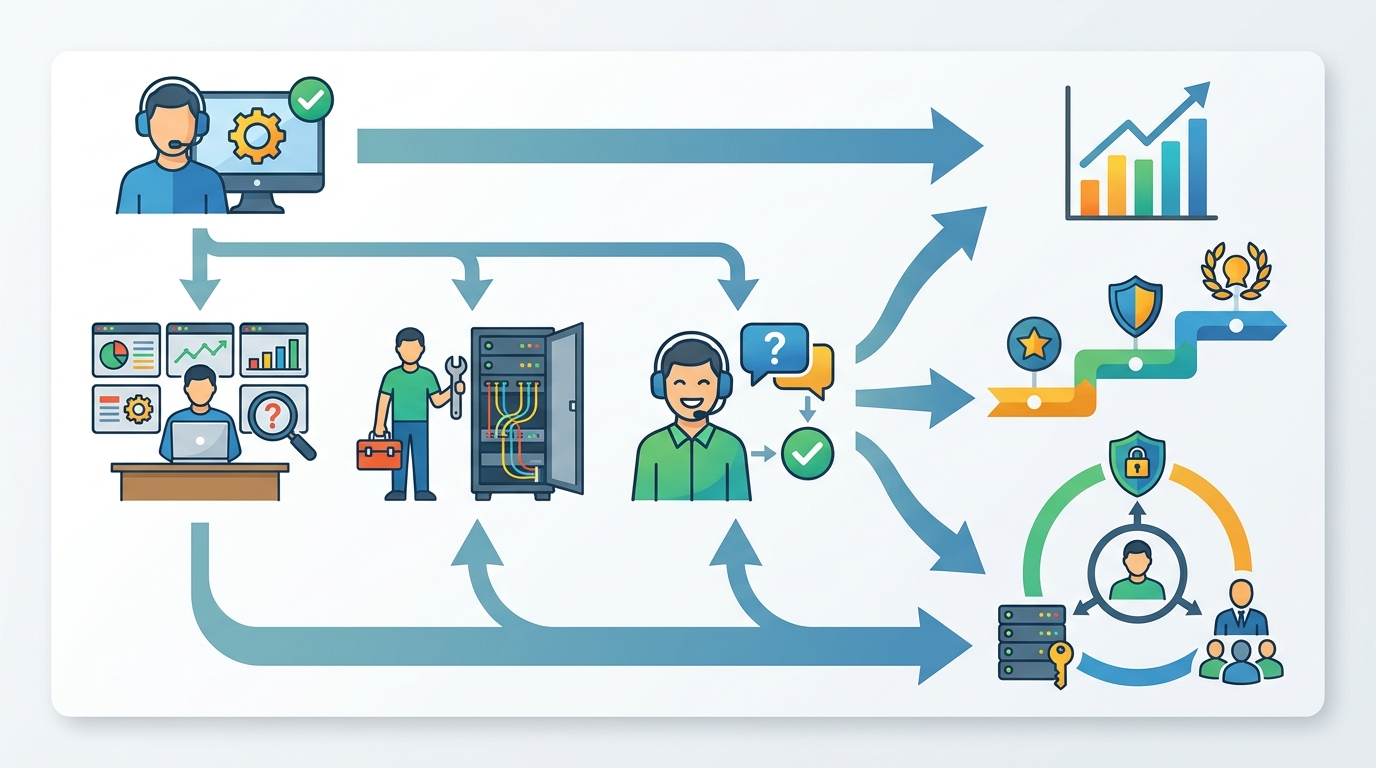
IT support specialists keep other people's technology working: diagnosing problems, setting up equipment, walking users through fixes, and maintaining the networks everything runs on. The U.S. Bureau of Labor Statistics (2025) splits the work into two groups — computer user support specialists, often called help-desk technicians, and computer network support specialists — and they differ in entry requirements and pay.
It is a realistic entry point into IT for someone without a four-year degree, but go in clear-eyed: BLS projects overall employment of computer support specialists to decline from 2025 to 2035, even while openings continue each year from workers leaving the field.
What This Job Involves Day to Day
Picture a weekday on a corporate service desk. You log in at 8 a.m. and triage the ticket queue that built up overnight, sorting password lockouts from the one report that says an entire floor lost file-share access. By 8:30 you are resetting accounts in Active Directory and calling back the three users who left voicemails before the shift started.
At 9:45 a laptop arrives that will not boot past the splash screen. You read through the manufacturer's technical manual, run the built-in hardware diagnostics, and swap the drive — the kind of minor hardware repair that sits squarely in the user support specialist's remit (U.S. Bureau of Labor Statistics, 2025). While it images, you install and configure a new accounting application for a finance team member and spend fifteen minutes showing her where the export function moved.
After lunch you take a remote desktop session with someone working from home, watch them reproduce the error, and document the exact steps in the ticket so the next technician does not start from zero. At 2:30 the floor-wide complaint turns out to be a switch port issue; you run ping and traceroute to isolate where packets stop, then hand it to the network side. If your job is network support, that handoff is your work: testing and evaluating existing systems, performing routine maintenance, and troubleshooting LANs, WANs, and internet connectivity (U.S. Bureau of Labor Statistics, 2025).
At 4:30 you update the knowledge-base article you rewrote last week and brief the evening technician. Because many organizations need coverage around the clock, some specialists work nights or weekends, and most work full time (U.S. Bureau of Labor Statistics, 2025). Some support roles allow telework; others require you onsite or travelling to clients' locations, which is worth confirming before you accept an offer (U.S. Bureau of Labor Statistics, 2025).
Common Tasks and Responsibilities
- Analyze reported computer problems and document a clear description of the symptoms, environment, and steps already attempted (U.S. Bureau of Labor Statistics, 2025).
- Walk users through problem-solving steps over the phone, by chat, or in a remote session until the issue is resolved or escalated.
- Set up and repair equipment — installing cables, operating systems, and peripherals for new hires and replacement machines (O*NET OnLine, U.S. Department of Labor).
- Install new hardware and software and train the people who will use it daily (U.S. Bureau of Labor Statistics, 2025).
- Oversee the daily performance of computer systems, watching for errors that recur across multiple users rather than treating each ticket as isolated (O*NET OnLine, U.S. Department of Labor).
- Read technical manuals and run diagnostic programs to pin down faults you have not seen before (O*NET OnLine, U.S. Department of Labor).
- Perform minor hardware and software repairs, including drive swaps, memory replacement, and driver rollbacks.
- Test and evaluate existing network systems and perform regular maintenance on LANs, WANs, and internet systems if you work on the network support side (U.S. Bureau of Labor Statistics, 2025).
- Escalate unresolved issues with enough written detail that the receiving team does not repeat your troubleshooting.
Salary and Job Outlook by Experience Level
Pay in IT support is almost always a salary or hourly rate rather than commission, with shift differentials common where nights and weekends are covered. The figures you need are published and free to look up — use the BLS Occupational Outlook Handbook for national medians and the BLS Occupational Employment and Wage Statistics program for state and metro-area figures, because a help-desk rate in one state is not a reliable guide to another.
| Stage | Years of experience | Where pay typically sits |
|---|---|---|
| Entry-level help desk | 0-2 years | Toward the lower percentiles BLS reports for computer user support specialists; BLS publishes the figure below which the lowest 10 percent earned (2025) |
| Mid-career support specialist | 2-6 years | Around the published median annual wage for computer user support specialists (2025), with location and industry shifting it either way |
| Experienced or network support | 6+ years | Toward the upper percentiles; BLS publishes a separate, higher median for computer network support specialists and the figure above which the highest 10 percent earned (2025) |
Figures to check: U.S. Bureau of Labor Statistics, Occupational Outlook Handbook, 2025 — medians for computer support specialists overall, for computer user support specialists, and for computer network support specialists, plus the 10th and 90th percentile earnings for each group.
On outlook, be honest with yourself about the trend. BLS projects overall employment of computer support specialists to decline from 2025 to 2035, and projects that the openings appearing each year over that decade come from the need to replace workers who transfer to other occupations or leave the labor force (U.S. Bureau of Labor Statistics, 2025). That means jobs exist, but the pool is not expanding, and competition for the better-paid network roles is real.
Skills and Traits That Fit This Work
- Listening without interrupting. A user says "the internet is broken" and your first three questions determine whether this is a browser cache issue or a dead switch port; BLS lists listening skills among the important qualities for the occupation (2025).
- Plain-language communication. You have to explain to a non-technical caller why their file is recoverable and what they must do next, without jargon and without making them feel foolish (U.S. Bureau of Labor Statistics, 2025).
- Customer-service patience. The same password reset request arrives for the fourth time this month and your tone on call four has to match call one (U.S. Bureau of Labor Statistics, 2025).
- Structured problem-solving. You test one variable at a time — swap the cable, then the port, then the adapter — instead of changing three settings and losing track of which fixed it (U.S. Bureau of Labor Statistics, 2025).
- Written precision. Your ticket notes are the only record the overnight technician has, so vague entries like "user issue, fixed" create work for somebody else.
- Tolerance for interruption. Deep troubleshooting gets cut short by a priority call from an executive, and you need to be able to park your thinking and come back to it.
- Willingness to keep studying. Operating systems, identity tools, and security requirements change, and the technician who stops reading release notes is the one still fixing printers in five years.
How to Get Started
- Settle your education baseline. BLS (2025) reports that computer network support specialists typically need an associate's degree — roughly two years full time — while computer user support specialists typically need to complete some college courses, and candidates with a high school diploma plus relevant IT certifications may also qualify. O*NET OnLine places computer user support specialist in Job Zone Three, which anticipates vocational training, related on-the-job experience, or an associate's degree, with usually one or two years of combined on-the-job and informal training.
- Earn a vendor-neutral certification. CompTIA A+ is the common first exam for help-desk work; CompTIA Network+ is the usual next step if you are aiming at network support. Register through the certifying body directly, confirm the current exam codes and fees on its own site, and check employer postings in your state to see which certifications local hiring managers actually list.
- Build verifiable hands-on practice. Set up a home lab with a spare machine, install and reinstall operating systems, configure a small network, and document what you did. Campus help desks, internal IT departments, and managed service providers are the usual first-job entry points; BLS (2025) notes that some support occupations expect work experience in a related occupation, so any role involving diagnostics and user contact counts toward it.
- Apply through the channels that reach entry-level queues. Employer career portals, your state workforce agency's job bank, and staffing firms that place contract service-desk technicians all list these roles. Use O*NET OnLine to check the task list against each job description so you can tell a true entry-level help-desk post from a sysadmin role in disguise.
- Plan the move beyond the desk. Many computer support specialists advance to information security analyst, network and computer systems administrator, or software developer roles, or into management of computer support services (U.S. Bureau of Labor Statistics, 2025). Pick your target early and let it guide which certification you study for next.
Frequently asked questions
How does pay progress over an IT support career?
Progression usually comes from moving between the two tracks rather than waiting for raises. BLS (2025) publishes a higher median annual wage for computer network support specialists than for computer user support specialists, so shifting toward network work raises your ceiling. Beyond that, advancement into security, systems administration, or support management carries its own wage data — look each occupation up separately in the Occupational Outlook Handbook.
What are the schedule demands really like?
Most computer support specialists work full time, and because some organizations need support available 24 hours a day, some specialists work nights or weekends (U.S. Bureau of Labor Statistics, 2025). Expect rotating on-call in many shops. The physical side is light but not nothing: carrying and racking equipment, crawling under desks to trace cables, and long stretches at a keyboard.
Can I do this job from home?
Sometimes. BLS (2025) notes that some computer support specialists are able to telework while others must be onsite or travel to clients' locations. Pure remote roles tend to be phone-and-remote-session help desks. Anything involving equipment setup, repairs, or network hardware pulls you back on site, so ask during the interview how the team splits remote and onsite duties.
Is this a shrinking field I should avoid?
BLS projects overall employment of computer support specialists to decline from 2025 to 2035, with the openings projected each year over that decade coming from replacement needs rather than growth (2025). That is a genuine tradeoff. It still works as an entry point if you treat it as a stepping stone and keep adding credentials toward security, administration, or development roles.
Do I need a four-year degree?
Not necessarily. BLS (2025) reports that user support specialists typically need to complete some college courses, and that a high school diploma plus relevant IT certifications may also qualify candidates. Network support specialists typically need an associate's degree, about two years full time. Requirements differ by employer and by state agency hiring rules, so read the posting rather than assuming.
What is the difference between the two support roles?
User support specialists, or help-desk technicians, analyze customer problems, document them, guide people through fixes, set up or repair equipment, and train users on new hardware and software. Network support specialists test and evaluate existing network systems, perform regular maintenance, and troubleshoot LANs, WANs, and internet systems (U.S. Bureau of Labor Statistics, 2025). The second requires more formal education.
Sources
- U.S. Bureau of Labor Statistics — Occupational Outlook Handbook: Computer Support Specialists (2025)
- O*NET OnLine (U.S. Department of Labor) — 15-1232.00 - Computer User Support Specialists

Written by
Desmond writes about the mechanics of job searching: resumes, interviews, the long silence after applying. He's fascinated by how much of getting hired depends on luck dressed up as skill.