Is Becoming a Physical Therapist Assistant a Good Career Change?
A licensed, hands-on clinical job you can reach with a two-year accredited degree — here is the real timetable, the exam, and the money you spend first.
Quick answer
- Entry requires an associate's degree from a CAPTE-accredited program plus a state license, so budget 2 to 3 years door to door (U.S. Bureau of Labor Statistics, 2025; American Physical Therapy Association).
- Employment of physical therapist assistants and aides is projected to grow 17 percent from 2025 to 2035, much faster than average (U.S. Bureau of Labor Statistics, 2025).
- Plan for the cash squeeze: $485 to register for the NPTE-PTA plus a $92 Prometric fee (test-prep provider Achievable, 2026), on top of tuition and 3 to 6 months of full-time unpaid clinicals.
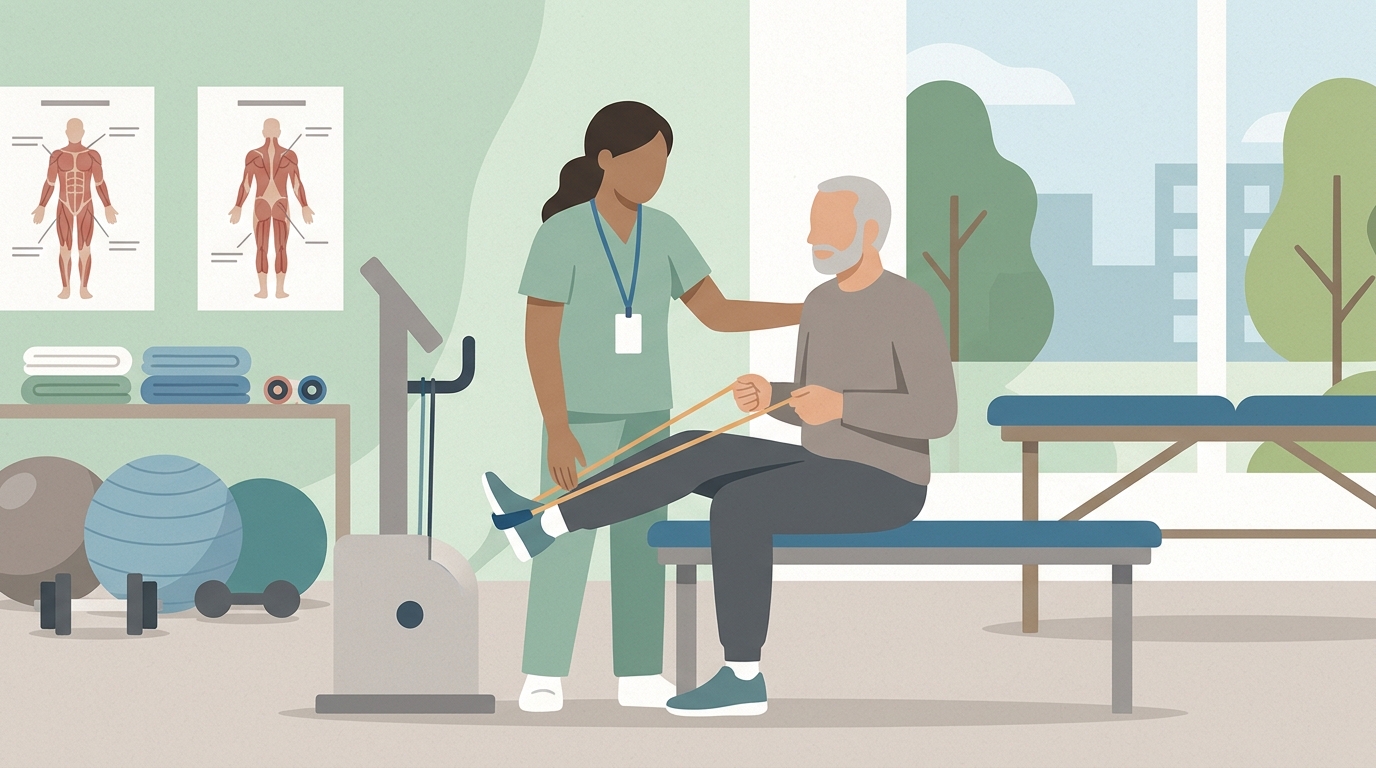
Becoming a physical therapist assistant (PTA) is one of the shorter regulated routes into clinical healthcare: an associate's degree from an accredited program, a national exam, and a state license (U.S. Bureau of Labor Statistics, 2025). For a career changer that usually means two to three years from first prerequisite class to first paid shift, with a stretch of full-time, unpaid clinical rotations at the end.
It suits you if you want patient contact without a doctorate and can absorb tuition plus months of reduced earnings. It suits you less if you must keep full-time hours throughout, or if lifting and standing all day is a problem.
What the Work Actually Involves
The core duty is assisting physical therapists in providing treatments and procedures (CareerOneStop, U.S. Department of Labor). In practice you run most of the hands-on time while the physical therapist evaluates, diagnoses and sets the plan of care.
A typical outpatient day looks like this:
- 5 to 6 hours of direct patient treatment. Clinics usually schedule 30- to 45-minute blocks, often two patients at once. You instruct, motivate, safeguard and assist patients through exercises — spotting a post-op knee on a step-up, correcting a shoulder patient's form, counting reps out loud when someone wants to quit (O*NET OnLine).
- 30 to 60 minutes of modalities and manual work, spread through the day. Manual therapeutic exercise, massage, or heat, light, sound and electrical modalities, plus securing patients to therapy equipment such as traction or a treadmill harness (O*NET OnLine).
- 45 to 75 minutes of documentation. Every visit needs a note recording what you did and how the patient responded. Some PTAs chart in five-minute bursts between patients; others stay 45 minutes past close. Career changers underestimate this part most.
- 10 to 20 minutes conferring with the physical therapist. You observe and report patient responses and discuss treatment plans — flagging the shoulder that lost range of motion, or the patient ready to progress (O*NET OnLine).
Settings change the rhythm. In a skilled nursing facility you may see 8 to 12 residents in short bouts, with more transfers and gait training. In home health you drive to 5 to 7 visits and work alone. Across all settings, expect to stand, kneel and lift for most of the shift.
Who This Career Change Suits
- Certified nursing assistants and home health aides. You already know safe transfers, body mechanics and how to talk to someone in pain. The degree is the missing piece, not the clinical instinct.
- Personal trainers and group fitness instructors. Cueing, exercise progression and motivating a reluctant client transfer directly; the difference is working under a plan of care written by a physical therapist.
- Massage therapists. You are used to hands-on treatment and reading tissue response, and you likely already hold a state license, so licensure paperwork will not surprise you.
- EMTs and paramedics. You can spot a patient who is deteriorating and report it precisely — exactly what observing and reporting responses to the physical therapist requires. The trade is adrenaline for repetition.
- Elementary and special education teachers. Breaking a complex movement into steps a frustrated person can follow is instruction, and you have done it for 25 children at once.
- Retail and restaurant managers. You can run a schedule and handle an upset person without escalating — useful when three patients overlap and one arrives 20 minutes late.
- Military medics and dental or medical assistants. Protocol-driven care, charting discipline and scope-of-practice boundaries all feel familiar, and you may already hold prerequisite science credits.
It suits you less if you want a desk job, need remote work, or have a chronic back or knee problem that makes repeated lifting and kneeling unrealistic.
Transferable Skills That Carry Over
| Prior Career | Skill | How It Applies Here |
|---|---|---|
| Elementary teacher | Task breakdown and repeated instruction | Teaching a home exercise program to someone who will forget half of it by the parking lot |
| Restaurant or retail manager | Scheduling and triage under time pressure | Keeping a double-booked treatment schedule moving without rushing a patient |
| CNA or home health aide | Safe transfers and body mechanics | Gait training, bed-to-chair transfers, and protecting your own back over a long career |
| Personal trainer | Exercise cueing and load progression | Administering therapeutic exercise and adjusting difficulty within the PT's plan of care |
| EMT or paramedic | Structured observation and handoff reporting | Observing and reporting patient responses to the physical therapist (O*NET OnLine) |
| Medical biller or claims clerk | Documentation standards and coding literacy | Daily treatment notes that have to justify continued care to a payer |
| Hairstylist or barber | Rapport built across repeat visits | Keeping trust with patients you see three times a week for two months |
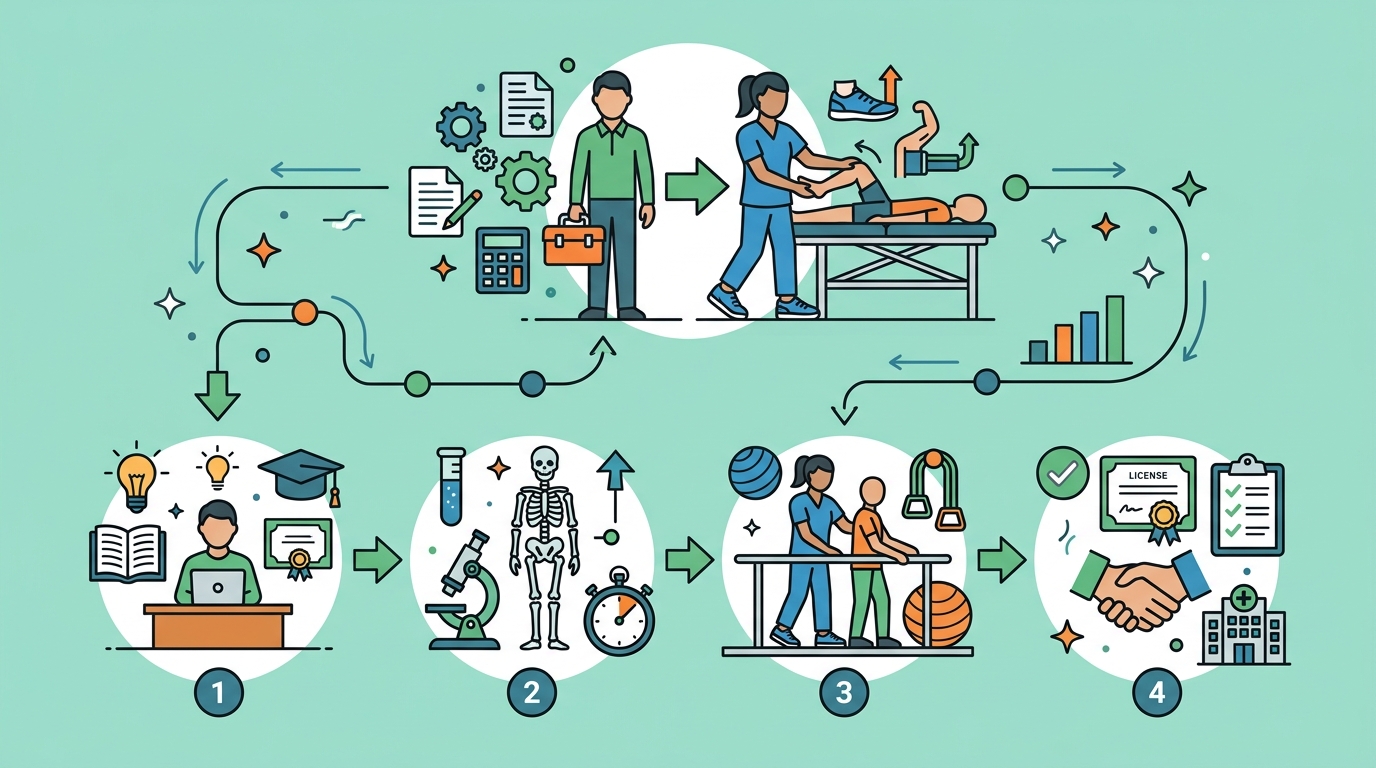
How to Get Started
- Check your state board's rules before you look at a single school. All states require PTAs to be licensed or certified, and individual state regulatory boards set the terms (U.S. Bureau of Labor Statistics, 2025; American Physical Therapy Association). Some states add a state-law exam, a criminal background check and a minimum age of 18 (U.S. Bureau of Labor Statistics, 2025). If you have an old conviction, raise it with the board before you spend tuition money.
- Build your shortlist from the CAPTE accreditation list. The Commission on Accreditation in Physical Therapy Education is the agency recognized by the U.S. Department of Education for accrediting PT and PTA education programs, and graduating from a CAPTE-accredited program is what makes you exam-eligible (American Physical Therapy Association). A non-accredited program will not get you licensed.
- Arrange observation hours in two settings. Many programs ask applicants for documented hours with a licensed physical therapist — check each program's admissions page for the number. Do one outpatient orthopedic clinic and one skilled nursing facility so you see both ends of the work before committing.
- Complete the prerequisite science courses. The curriculum itself covers anatomy, physiology and kinesiology (U.S. Bureau of Labor Statistics, 2025), and programs expect groundwork first. Most career changers take these part-time at a community college over one or two semesters while still working.
- Enroll in the associate's degree program, which typically runs about 2 years and includes supervised clinical work (U.S. Bureau of Labor Statistics, 2025). Academic terms may leave room for evening shifts; the full-time rotations at the end usually do not.
- Get CPR and basic life support (BLS) certification during the program. PTAs may earn CPR, BLS or other first-aid certifications, and CareerOneStop lists where to find them (U.S. Bureau of Labor Statistics, 2025).
- Register for and pass the NPTE-PTA. The National Physical Therapy Exam is administered by the Federation of State Boards of Physical Therapy and is required for licensure (American Physical Therapy Association). It costs $485 to register plus a $92 Prometric testing fee, with 4 hours for 180 multiple-choice questions and a passing score of 600 or above (test-prep provider Achievable, 2026). Start structured review 8 to 12 weeks out.
- Submit your license application, then apply where you did clinicals. Clinical instructors are the people most likely to recommend you for a first job, so treat every rotation as a long interview.
Costs and Time Commitment
Unsourced figures below vary by state, school and employer — get current numbers from the program's published tuition page and your state licensing board.
| Item | Typical Cost | Typical Time |
|---|---|---|
| Prerequisite science courses | Varies by college and state; community college rates are usually lowest | 1 to 2 semesters, part-time |
| CAPTE-accredited associate degree | Varies widely; public in-district rates differ sharply from private-school rates | About 2 years, including supervised clinical work (U.S. Bureau of Labor Statistics, 2025) |
| Books, scrubs, immunizations, background check | Varies by program and state | Spread across the 2 years |
| CPR / BLS certification | Low; check providers listed on CareerOneStop | 1 day, renewed every 2 years |
| NPTE-PTA exam | $485 registration plus $92 Prometric fee (test-prep provider Achievable, 2026) | 4 hours for 180 questions, plus 8 to 12 weeks of study |
| State license application | Set by each state board | 2 to 8 weeks for processing in most states |
| Income gap during full-time clinicals | Your lost earnings for the period | Roughly 3 to 6 months of little or no outside work |
The honest total: 24 to 36 months from first prerequisite class to first licensed paycheck, including several months when you cannot hold a full-time job. Write that arithmetic down before you enroll.
Frequently asked questions
Am I too old to start at 45 or 55?
Licensure rules set a minimum age of 18 in some states and no maximum anywhere (U.S. Bureau of Labor Statistics, 2025). Career changers in the 45-to-60 range do get asked in interviews whether they can handle transfers and a full day on their feet, so answer it directly with examples from your clinical rotations rather than waiting for it to come up. Because the occupation sits in O*NET Job Zone Three, medium preparation, hiring managers are weighing a 2-year credential and clinical performance rather than how long ago you left your last field.
How hard is the NPTE-PTA to pass?
A test-prep source citing Federation of State Boards of Physical Therapy data puts the first-time pass rate at 79 percent in 2025, within a 76 to 81 percent band since 2021 (TherapyExams.com, 2026). Counting retakes, that source reports 93 percent of 2024 accredited-program graduates had passed (TherapyExams.com, 2026). You get 4 hours for 180 multiple-choice questions and need 600 or more to pass (Achievable, 2026), so most candidates build in 8 to 12 weeks of review.
Do I need a bachelor's degree first?
No. Every state requires an associate's degree from an accredited program, and the majority of employer respondents surveyed by O*NET said an associate's or other 2-year degree is what a new hire needs (U.S. Bureau of Labor Statistics, 2025; O*NET OnLine). The occupation's O*NET Job Zone Three rating carries an SVP range of 6.0 to under 7.0. If you already hold a bachelor's in anything, some general-education credits may transfer and shorten the prerequisite stage by a semester.
Is the pay enough to justify the switch?
The median annual wage for physical therapist assistants was $68,380 in May 2025 (U.S. Bureau of Labor Statistics, 2025), with actual pay varying by state, setting and employer — home health and skilled nursing often differ from outpatient clinics. Check your own state's figures on the Bureau of Labor Statistics occupational wage pages before you enroll. If you currently earn well above that median, this is a deliberate trade of income for a licensed, hands-on job.
Sources
- U.S. Bureau of Labor Statistics — Physical Therapist Assistants and Aides (2025)
- O*NET OnLine (National Center for O*NET Development) — 31-2021.00 - Physical Therapist Assistants

Written by
Noor writes personal essays and interviews about career changes, burnout, and starting over. She's interested in the stories people tell themselves about what a job is supposed to mean.