
Insurance Agent Pay: Average Salary, Range, and What Affects It
Commission, salary, or a mix of the two — how insurance agents actually get paid, and which licenses, products and employers move the number most.
Quick answer
- The U.S. Bureau of Labor Statistics publishes the national median annual wage for insurance sales agents in its 2025 Occupational Outlook Handbook, and the national mean annual wage in the May 2023 Occupational Employment and Wage Statistics (OEWS) release — check both for the current dollar figures.
- The spread from new agent to top earner is wide: BLS (2025) reports the highest 10 percent earning more than $138,140, against a bottom-decile figure published in the same release, so experienced commission earners can make several times what a first-year agent does.
- Commission is the most common form of pay, especially for experienced agents, and the amount depends on the type and volume of insurance sold and whether the policy is new or a renewal (U.S. Bureau of Labor Statistics, 2025).
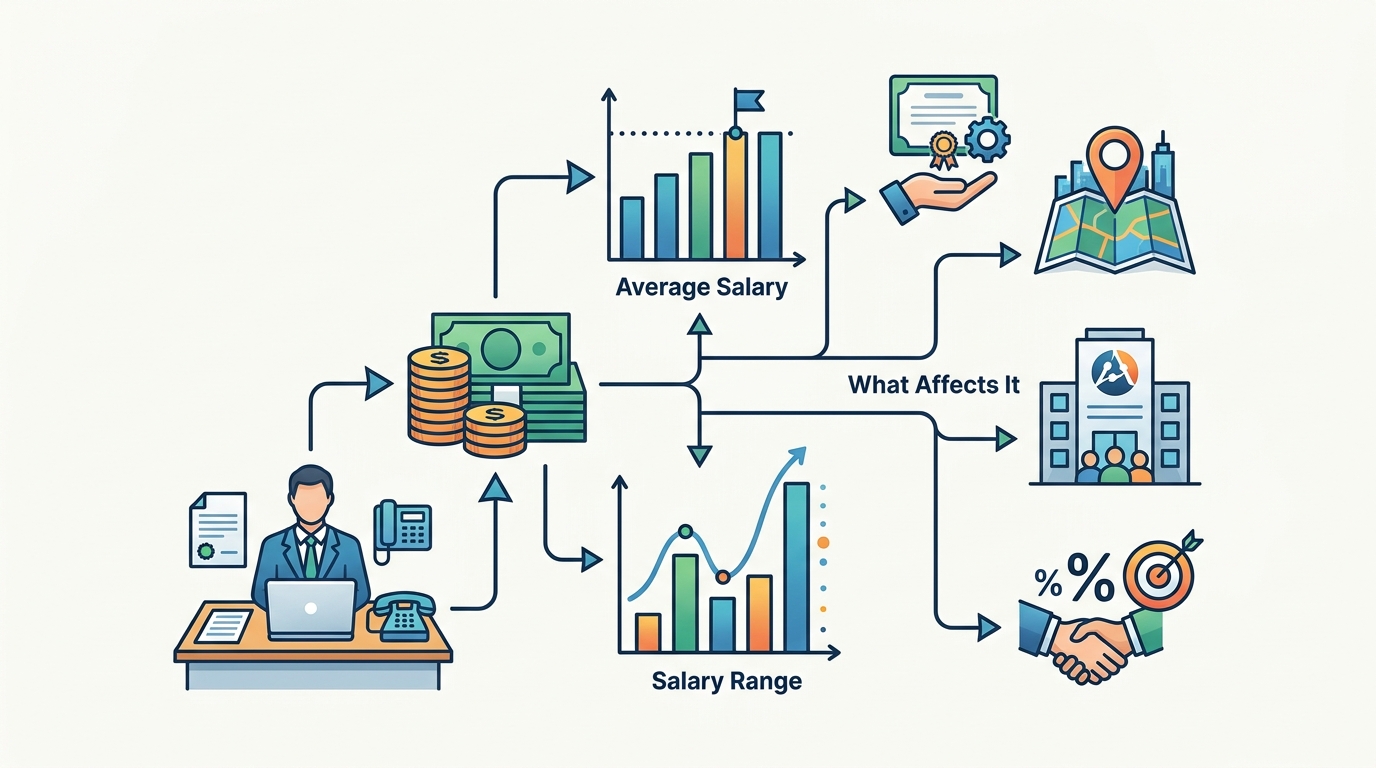
Insurance sales agents are paid in one of three common ways: commission only, salary only, or salary plus commission or bonus (U.S. Bureau of Labor Statistics, 2025). The Bureau of Labor Statistics publishes a national median annual wage for the occupation each year, and in its 2025 figures the highest-paid 10 percent of insurance sales agents earned more than $138,140, while the lowest-paid 10 percent earned less than the bottom-decile figure BLS lists alongside it.
Those published wages already include sales commissions, tips and production bonuses, but not overtime or shift differentials (U.S. Bureau of Labor Statistics, 2025) — which matters, because for experienced agents commission is usually the largest part of the total.
What This Job Pays
There are two official national numbers for this job, and they are not the same thing.
The first is the median annual wage for insurance sales agents, published by the U.S. Bureau of Labor Statistics in its 2025 Occupational Outlook Handbook. A median means half of agents earned more and half earned less. The second is the national mean (average) annual wage, published in the BLS Occupational Employment and Wage Statistics (OEWS) estimates for May 2023. The mean is pulled upward by high commission earners, so it usually sits above the median. Look at the median if you want a sense of the typical agent, and the mean only as a cross-check.
For the range, BLS (2025) reports that the lowest-paid 10 percent of insurance sales agents earned less than the bottom-decile figure given in that release, and the highest-paid 10 percent earned more than $138,140. The May 2023 OEWS release gives the full set of percentile annual wage estimates — 10th, 25th, 50th, 75th and 90th — which is the better table to read if you want to see where you might land rather than just the midpoint. OEWS also publishes the national employment total for the occupation (May 2023), which tells you how large the sample behind those estimates is.
One detail changes how you should read all of these figures. BLS states that wage data for insurance sales agents include tips, sales commissions and bonuses for meeting production targets, but exclude premium pay such as overtime and shift differentials (U.S. Bureau of Labor Statistics, 2025). So the published median is closer to total cash compensation than to base salary. If a recruiter quotes you a base salary and the BLS median in the same breath, those are two different measures — ask what the on-target commission is on top.
Pay structure itself varies by how you are engaged. Independent agents may be paid commission only, while agents employed by an agency or a carrier may be paid salary only, salary plus commission, or salary plus bonus (U.S. Bureau of Labor Statistics, 2025). Commission is the most common arrangement overall, and it is especially common for experienced agents (U.S. Bureau of Labor Statistics, 2025).
To check the current numbers yourself, go to the BLS Occupational Outlook Handbook entry for insurance sales agents for the median, and to the OEWS occupational profile for the mean, the percentiles, and the state and metro breakdowns. Both are free and updated on a published schedule.
Salary by Experience and Location
Insurance agent pay is published by percentile rather than by years of experience, because experience and earnings are only loosely linked in a commission job — a second-year agent with a strong book can out-earn a tenth-year agent with a weak one. The percentiles below are the standard proxy. State and metro figures are means, published by BLS OEWS for May 2023; the national median and the top-decile threshold come from the BLS 2025 Occupational Outlook Handbook.
| Pay point | Source and data year | What the figure is |
|---|---|---|
| Entry-level (10th percentile) | BLS, 2025 Occupational Outlook Handbook; also in OEWS percentile estimates, May 2023 | The amount the lowest-paid 10 percent of agents earned less than — the realistic floor for a first-year agent still building a book |
| Mid-career (median, 50th percentile) | BLS, 2025 Occupational Outlook Handbook | The national median annual wage; half of all insurance sales agents earn above it |
| Experienced (90th percentile) | BLS, 2025 Occupational Outlook Handbook | More than $138,140 — the threshold the highest-paid 10 percent exceeded |
| National average | BLS OEWS, May 2023 | The national mean annual wage, higher than the median because top commission earners pull the average up |
| Texas | BLS OEWS, May 2023 | State mean annual wage for insurance sales agents |
| California | BLS OEWS, May 2023 | State mean annual wage for insurance sales agents |
| New York | BLS OEWS, May 2023 | State mean annual wage for insurance sales agents |
| Florida | BLS OEWS, May 2023 | State mean annual wage for insurance sales agents |
| Chicago-Naperville-Elgin, IL-IN-WI | BLS OEWS, May 2023 | Metropolitan area mean annual wage |
The OEWS state and metro tables are the place to look up each of those dollar amounts, and they also give you the 10th and 90th percentile for the same state, which is more useful than the state mean alone. A high state mean often reflects a concentration of commercial and specialty brokerage work in one or two metros rather than better pay everywhere in the state — compare the metro figure with the statewide one before you draw conclusions about a smaller market.
Licensing is state-by-state, so moving states is not purely a pay question. Agents must be licensed in the states where they work, with separate licenses for life and health insurance and for property and casualty insurance (U.S. Bureau of Labor Statistics, 2025).
What Affects Pay in This Field
- Whether you are paid commission or salary. Independent agents may work on commission only; agents employed by an agency or carrier may be on salary only, salary plus commission, or salary plus bonus (U.S. Bureau of Labor Statistics, 2025). A salary-only role gives you a predictable number from day one; commission-only gives you the shot at the top-decile figure BLS puts at more than $138,140 (2025), and the risk of landing near the bottom decile instead.
- The industry you sell for. BLS publishes separate 2025 median annual wages for agents working for direct health and medical insurance carriers and for agents working in insurance agencies and brokerages. Compare those two medians side by side in the Occupational Outlook Handbook before you accept an offer — they are not the same, and the gap between them is the clearest published evidence that employer type moves pay.
- New business versus renewals. Commission amounts depend on the type and amount of insurance sold and on whether the policy is new or a renewal (U.S. Bureau of Labor Statistics, 2025). New-business commission rates are typically the higher of the two, while renewals build a smaller but recurring base — which is why agent income usually rises with the age of the book, not just with hours worked.
- Which licenses you hold. Separate state licenses are required for life and health versus property and casualty (U.S. Bureau of Labor Statistics, 2025). Holding both lets you write across product lines and earn commission on business you would otherwise have to refer away.
- Securities licensing. Agents who also sell securities or other financial products must be licensed by FINRA. The Series 6 exam qualifies an agent to sell products such as mutual funds and variable annuities; the Series 7 qualifies them as a general securities sales representative (U.S. Bureau of Labor Statistics, 2025). This opens a second commission stream rather than raising the insurance commission rate.
- State and metro market. OEWS (May 2023) publishes mean annual wages by state and metro area — including Texas, California, New York, Florida and the Chicago-Naperville-Elgin, IL-IN-WI metro area — and the figures differ between them. Pull the ones for the markets you are comparing.
- How the quoted number is built. Because BLS wage data already include commissions and production bonuses but exclude overtime and shift differentials (2025), an employer quoting base salary only is quoting something lower than the published median. Ask for base, on-target earnings, and the commission schedule separately.
How This Job's Pay Compares
BLS lists three sales occupations alongside insurance sales agents as similar work, and publishes a 2025 median annual pay figure for each. Looking them up together is the fastest way to see whether insurance is the better-paying door into sales for you.
- Real estate brokers and sales agents — 2025 median annual pay published by the U.S. Bureau of Labor Statistics. Like insurance, this is largely commission work, so the median hides a very wide spread and the same caution about base pay applies.
- Securities, commodities and financial services sales agents — 2025 median annual pay published by the U.S. Bureau of Labor Statistics. This is the group insurance agents move into when they add a Series 6 or Series 7 license (U.S. Bureau of Labor Statistics, 2025), so it is worth comparing directly if you are considering that step.
- Advertising sales agents — 2025 median annual pay published by the U.S. Bureau of Labor Statistics. Another commission-weighted sales role with a similar entry bar but no state licensing requirement.
Read all four medians from the same BLS 2025 release so you are comparing like with like. Then check the 10th and 90th percentiles for each in the OEWS tables — in commission occupations the gap between the bottom and top decile tells you more about your likely first two years than the median does. For insurance sales agents, that top-decile threshold is more than $138,140 (U.S. Bureau of Labor Statistics, 2025).
Frequently asked questions
Is insurance agent pay salary or commission?
Both exist. Independent agents may be paid commission only, while agents employed by an agency or carrier may be paid salary only, salary plus commission, or salary plus bonus (U.S. Bureau of Labor Statistics, 2025). Commission is the most common arrangement, and it is especially common among experienced agents (U.S. Bureau of Labor Statistics, 2025).
Do the BLS figures include commission and bonuses?
Yes. BLS states that wage data for insurance sales agents include tips, sales commissions and bonuses for meeting production targets, and exclude premium pay such as overtime and shift differentials (U.S. Bureau of Labor Statistics, 2025). So the published median is close to total cash compensation, not base salary alone.
How much can an experienced insurance agent earn?
The highest-paid 10 percent of insurance sales agents earned more than $138,140 (U.S. Bureau of Labor Statistics, 2025). Reaching that level is not automatic with tenure — it tracks the size and renewal mix of your book, the product lines you are licensed for, and whether you are on a commission schedule at all.
Which pays more, working for a carrier or for an agency?
BLS publishes separate 2025 median annual wages for insurance sales agents in direct health and medical insurance carriers and for those in insurance agencies and brokerages. Compare those two medians in the Occupational Outlook Handbook for the current year — the difference between them is the published answer, and it can shift between releases.
Does where I live change what I earn?
Yes, and BLS OEWS (May 2023) publishes state and metro mean annual wages so you can check it — including Texas, California, New York, Florida and the Chicago-Naperville-Elgin, IL-IN-WI metro area. The specific factors behind the differences are the product mix in that market, the concentration of commercial and specialty brokerage work, and the local cost and competitiveness of the book you can build. Licensing is also state-specific (U.S. Bureau of Labor Statistics, 2025).
Will extra licenses raise my pay?
They widen what you can sell rather than raising a commission rate directly. Separate state licenses are needed for life and health versus property and casualty insurance, and agents selling securities or other financial products must be licensed by FINRA — the Series 6 covers products such as mutual funds and variable annuities, and the Series 7 qualifies you as a general securities sales representative (U.S. Bureau of Labor Statistics, 2025).
Sources
- U.S. Bureau of Labor Statistics — Insurance Sales Agents : Occupational Outlook Handbook (2025)
- U.S. Bureau of Labor Statistics — Insurance Sales Agents (OEWS occupational profile, 41-3021) (2023-05)

Written by
Wyatt covers work outside the office: construction, logistics, repair, and the people who keep things running. He's skeptical of career advice that assumes everyone sits at a desk.