How to Prepare for a Warehouse Job Interview
A week-by-week prep plan for warehouse interviews, from practising lifting and safety answers to packing the folder you carry through the gate.
Quick answer
- A week before: write out answers to at least 10 common questions using real examples from past jobs, as CareerOneStop (U.S. Department of Labor) recommends.
- Two days before: print extra resume copies and your reference list, and locate work documents such as your Social Security card (CareerOneStop, U.S. Department of Labor).
- Day before: do a test run to the site at the same time of day, so you can arrive 10 to 15 minutes early (U.S. Bureau of Labor Statistics, 2016).
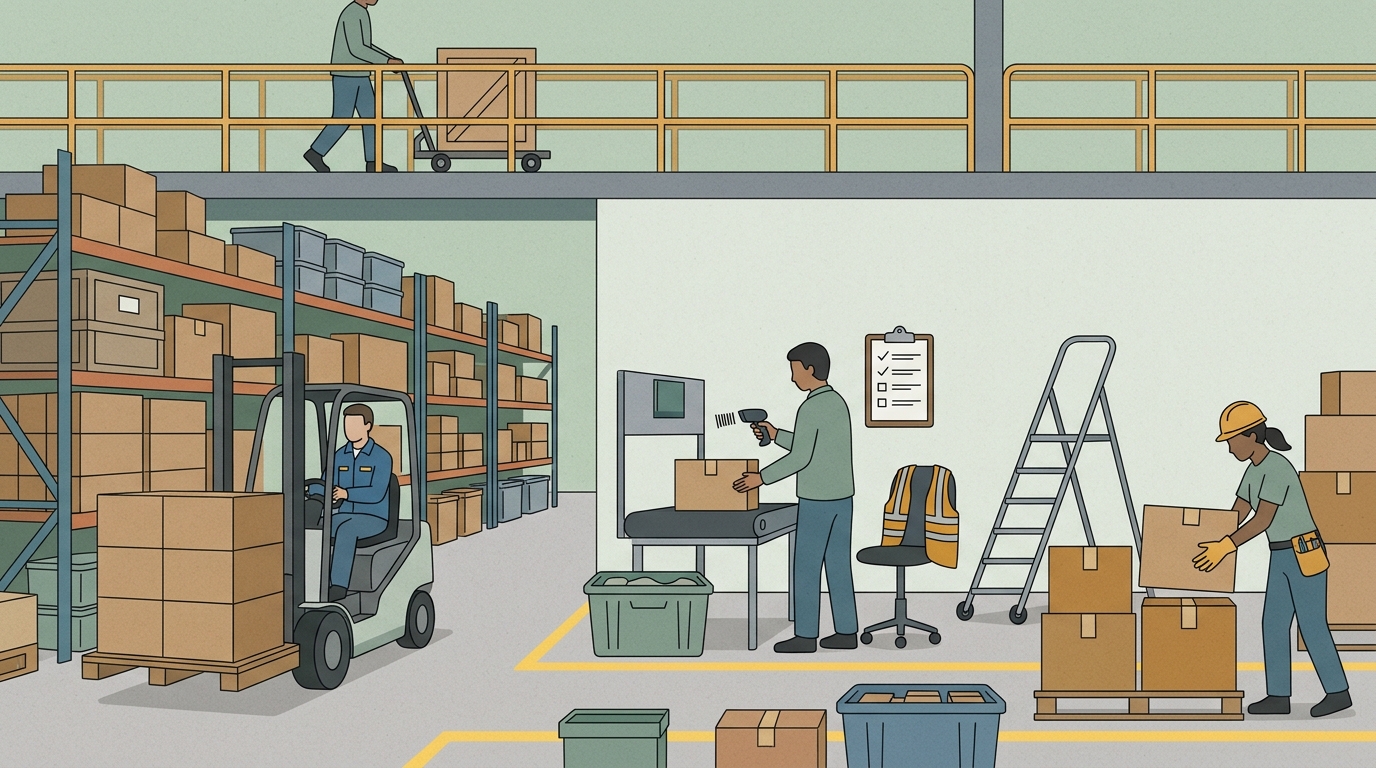
Warehouse interviews are usually short and practical. They test whether you can do the physical work safely, whether you show up on time, and whether you can follow a process without being chased.
Preparing means writing out specific answers about picking, lifting, forklifts and safety, then handling the logistics — route, documents, clothing — so nothing goes wrong on the day. This guide gives you a timeline starting a week out, a morning-of checklist, and exact wording for the moments that catch people out.
Your Prep Timeline
- One week out — write your answers (60–90 minutes). CareerOneStop (U.S. Department of Labor) recommends reviewing common questions and writing out answers to 10 or more of them in advance, using stories from past experience. Cover heavy lifting, a full shift on your feet, a safety hazard you spotted, a picking or counting error you made, and why you want this shift. Structure each as situation, task, action, result.
- One week out — map the role against the job ad (30 minutes). Print the posting and underline the equipment named: pallet jack, RF scanner, forklift, cycle counting, WMS. O*NET OnLine (U.S. Department of Labor) lists 'Warehouse Worker' as an alternate title under Laborers and Freight, Stock, and Material Movers, Hand (53-7062.00) — read that page for the vocabulary. Write one sentence of your own experience beside each underlined item.
- Five days out — sort out your forklift position (30 minutes). OSHA requires employers to train and evaluate operators under 29 CFR 1910.178(l) before they operate, and there is no OSHA-issued forklift licence (industry source citing OSHA regulation). Certification involves formal instruction, hands-on training and an evaluation (industry source citing OSHA regulation), re-evaluated at least every three years under 29 CFR 1910.178(l)(4)(iii). If you have been trained, note who trained you and the date of your last evaluation.
- Three days out — write your questions (15 minutes). CareerOneStop (U.S. Department of Labor) recommends a list of questions showing interest in the job and company. Ask about shift pattern, overtime, how pick rates are measured, and first-month training.
- Two days out — build your folder (30 minutes). The U.S. Bureau of Labor Statistics (2016) suggests a folder with pen and paper, copies of your resume or application, and references; CareerOneStop adds work documents such as a Social Security card. Pay varies by employer, state and shift — check the employer's own posting and the Bureau of Labor Statistics Occupational Employment and Wage Statistics page for your metro area.
- Day before — test run the route (time it, plus a 20-minute buffer). The U.S. Bureau of Labor Statistics (2016) notes some career counselors suggest a test run to the site in advance. Warehouses sit in industrial parks with confusing gates, so find the visitor door, not the dock.
- Morning of — set up or suit up (20 minutes). In person, dress for a possible tour: closed-toe boots, no loose jewellery. For a virtual interview, CareerOneStop advises checking your computer, camera, microphone and the employer's video platform so you can sign on 10 to 15 minutes early.
Day-Of Checklist
Work down this list before you leave the house.
- Three printed resume copies in a folder, plus your printed reference list (CareerOneStop, U.S. Department of Labor).
- Work documents packed, including your Social Security card (CareerOneStop, U.S. Department of Labor).
- A notebook and two working pens in the folder (CareerOneStop, U.S. Department of Labor).
- Your printed list of questions tucked inside the notebook (CareerOneStop, U.S. Department of Labor).
- Any forklift or safety training certificate, with the date of your last evaluation on a sticky note.
- Closed-toe boots cleaned and laid out, with a shirt that lets you raise your arms.
- Departure alarm set on your phone, calculated from yesterday's test run plus 20 minutes, so you arrive 10 to 15 minutes early (U.S. Bureau of Labor Statistics, 2016).
- Coffee cup, water bottle and backpack left at home or in the car (CareerOneStop, U.S. Department of Labor).
- Interviewer's name, gate or door number, and a phone number saved in your contacts.
- Virtual interview only: camera, microphone and the employer's platform tested, link opened once already (CareerOneStop, U.S. Department of Labor).
- A thank-you email drafted in your phone, ready to send within 24 hours (CareerOneStop, U.S. Department of Labor).
What to Say in Tricky Moments
The greeting at reception
Arriving at the visitor door
"Good morning — I'm Dana Ortiz, here for the 9:15 interview for the warehouse associate role with Marcus in operations. I'm early, so I'm happy to wait here."
'Tell me about yourself'
A 30-second answer that lands on warehouse work
"I spent two years on a grocery dock. Last December we were two pickers short, so I took the overnight replenishment run and finished the 180-location sweep every shift, with zero mis-picks in the weekly audit."
The lifting and stamina question
When asked about the physical side
"Yes. My last role was 10-hour shifts moving cases up to 50 pounds, hand-stacking about 20 pallets a night. I lift from the knees and call a second person over 50 pounds — two years, no recordable injury."
The safety question
Describing a hazard you caught
"In August a pallet in aisle 7 overhung the rack edge. I was closing the aisle for cycle counting, so I tagged it, told the shift lead, and we re-stacked it in ten minutes. Nobody passed under it."
Declining to name a pay figure first
When asked what you expect
"I'd rather hear the posted range for this shift first. I've checked Bureau of Labor Statistics wage data for this area, so we'll be close — what does the role pay, including shift differential?"
Asking about next steps
At the end of the interview
"Thanks for your time. What are the next steps, and when should I expect to hear? I can send my references over today if that helps."
Send your thank-you email within 24 hours, as CareerOneStop (U.S. Department of Labor) recommends, naming one specific thing from the conversation so the note reads as yours.
Frequently asked questions
How early should I arrive?
Arrive 10 to 15 minutes early, which both CareerOneStop (U.S. Department of Labor) and the U.S. Bureau of Labor Statistics (2016) recommend. For a virtual interview, be signed on in that same window with your camera and microphone already tested.
What should I bring with me?
A folder with extra resume copies, your reference list, a notebook and pens, plus work documents such as your Social Security card (CareerOneStop, U.S. Department of Labor). Leave your coffee, water bottle and backpack in the car.
Do I need a forklift licence before I apply?
No. There is no OSHA-issued forklift licence; employers must train and evaluate operators under 29 CFR 1910.178(l) before they operate (industry source citing OSHA regulation). Say you are ready to complete the employer's training and evaluation.
Do I need experience to be considered?
Not necessarily. The U.S. Bureau of Labor Statistics (2025) reports hand laborers and material movers typically need no formal educational credential, and most positions require less than one month of on-the-job training. Lead with reliability and physical examples.
Sources
- CareerOneStop (U.S. Department of Labor) — Get ready to interview
- CareerOneStop (U.S. Department of Labor) — Interviews

Written by
Wyatt covers work outside the office: construction, logistics, repair, and the people who keep things running. He's skeptical of career advice that assumes everyone sits at a desk.