How to Prepare for a Truck Driver Interview
Carriers hire on paperwork and safety history as much as answers, so bring the file, know your own record, and rehearse the road questions out loud.
Quick answer
- One week out: request your motor vehicle record from every state where you have held a license in the past three years, since the carrier must do the same under 49 CFR 391.23 (interviewersignal.com).
- Two days out: build a folder with several copies of your resume plus copies of your CDL, DOT physical and truck driving school certificate (Hamrick School).
- The day before: time the drive to the terminal at the same hour as your interview and lay out the clothes and footwear you can walk a yard in.
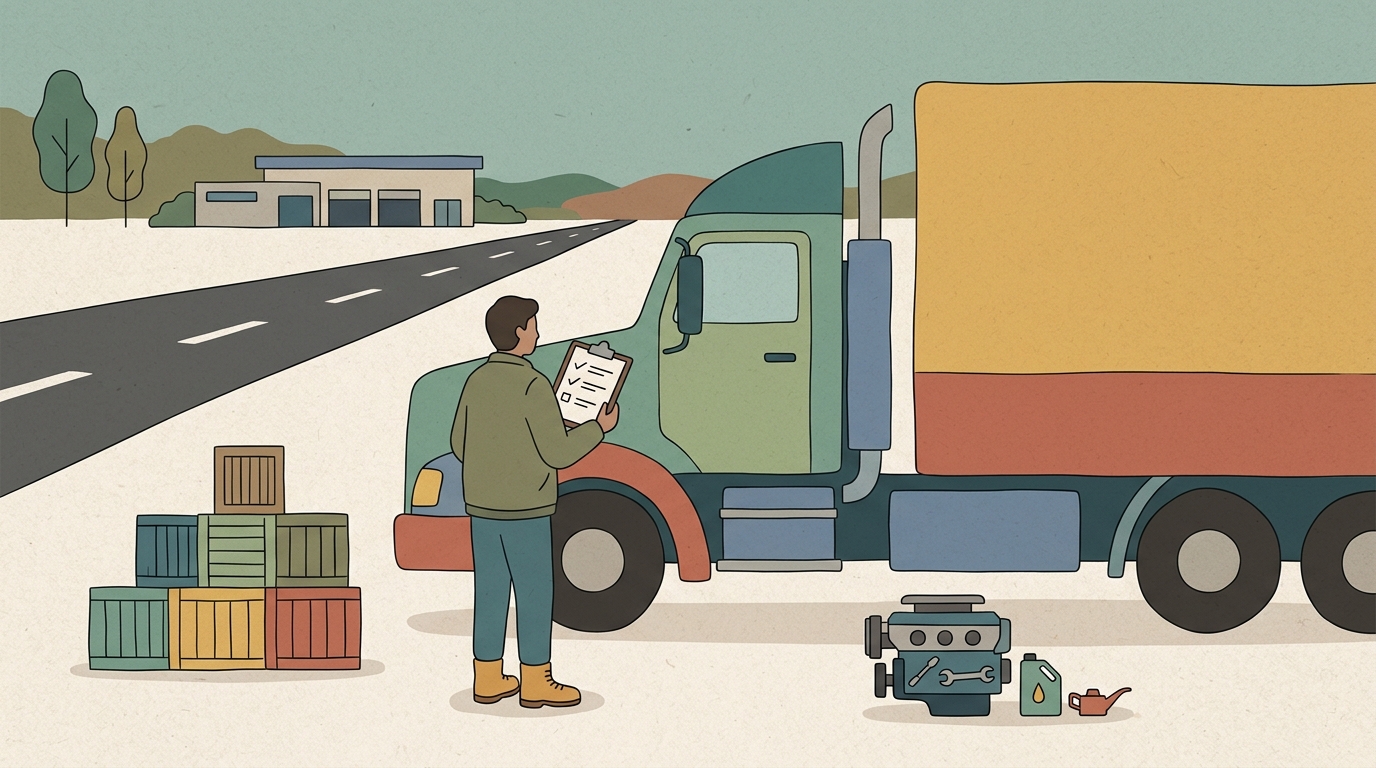
A truck driver interview is really two interviews at once: a conversation about how you drive, and a document check against the file the carrier is legally required to keep on you. Prepare for both by assembling copies of your CDL, medical card and driving record before you walk in, and by practising short, specific answers about hours of service, trip planning and your safety history.
Most of the preparation is physical — printing, timing a route, listing past employers with dates — not rehearsing lines. Do that work in the week before, and the interview itself becomes a short talk about the work.
Your Prep Timeline
- One week out — pull your own records (about 45 minutes). Order your motor vehicle record from each state licensing agency where you have held a license in the last three years. The carrier will request the same records within 30 days of hire and will investigate your safety performance history with DOT-regulated employers over that same three-year period (interviewersignal.com), so you want to see what they will see first. If you have driven commercially before, also pull your CSA and DAC reports (Hamrick School).
- One week out — check your medical certificate and endorsements (about 20 minutes). A DOT physical from an FMCSA-certified examiner produces a medical certificate valid for up to 24 months (Penske Truck Rental), and expired cards or exams done by a non-certified examiner are common rejection reasons (CDL Help). The card itself is issued on Form MCSA-5876, on paper or electronically (CDL Help). If the job calls for hazardous materials, confirm where you stand on the fingerprint-based TSA background threat assessment that endorsement requires (CareerOneStop, 2024).
- Five days out — research the carrier's actual operation (about 30 minutes). Find the USDOT number in the job posting or on the careers page, then look the company up in FMCSA's public company snapshot search to see fleet size, driver count and inspection history. Write down three questions from what you find — equipment age, lanes, home time.
- Three days out — rehearse the English interview topics out loud (about 30 minutes). FMCSA recommends an English interview conducted by a carrier manager, and says interpreters, I-Speak cards, cue cards, smartphone applications or on-call interpretation services should not be used for that portion of the hiring interview (Fleetworthy). Practise explaining, in plain spoken English, your trip details, hours-of-service and logs, your CDL class and endorsements, shipping papers, and the inspection-related equipment on the vehicle (Fleetworthy).
- Two days out — build the document folder (about an hour). Several copies of your resume, plus copies of your CDL, DOT physical, birth certificate, Social Security card, truck driving school certificate, pre-hire letters, MVR, and CSA and DAC reports if you have driven before (The Job Network; Hamrick School). Carriers must maintain a driver qualification file with required documents under 49 CFR 391.51 (Cisive, 2026), and handing over clean copies speeds that up.
- Day before — time the route and set out clothes (about 45 minutes). Drive or map the trip to the terminal at the same hour your interview falls, note where visitor parking and the security gate are, and lay out a collared shirt, clean work boots or closed shoes, and a belt.
- Morning of — 20-minute walk-through. Re-read the job posting, check the folder page by page against your list, confirm your Clearinghouse login works, and leave early enough to arrive 15 minutes before the appointment.
Day-Of Checklist
Tick each item physically before you leave the house.
- Folder packed with three printed copies of your resume on plain paper.
- Copies inside: CDL (front and back), current DOT medical card, truck driving school certificate, birth certificate, Social Security card, MVR, and CSA and DAC reports if you have commercial driving history (The Job Network).
- Originals of your CDL and medical card in your wallet, separate from the copies.
- One typed page listing every employer for the past three years with company name, address, phone number and exact start and end dates — the carrier must investigate that window (interviewersignal.com).
- Clearinghouse username and password tested on your phone that morning, since you must give electronic consent through the Clearinghouse before the employer can view the record under 49 CFR 382.703 (interviewersignal.com).
- Corrective lenses or hearing aids with you if your medical certificate lists that restriction.
- Phone charged above 80 percent and set to silent, plus the recruiter's direct number saved.
- Route timed the day before, with departure time written down and 15 minutes of buffer added.
- Pen, notepad, and the three questions you wrote during your carrier research.
- Water and a snack in the truck or bag, in case the visit includes a road test or a yard tour.
What to Say in Tricky Moments
Checking in at the front desk
Arriving at the terminal
"Good morning, I'm Marcus Hale. I have a nine o'clock driver interview with the safety manager. I've brought copies of my CDL, medical card and MVR."
"Tell me about yourself"
Keep it to one situation, one task, one action, one result.
Opening answer
"I've run regional reefer three years. Last winter my dispatcher lost two Midwest lanes overnight. I replanned every trip around my 30-minute breaks and closed the quarter at 99 percent on-time, no preventable accidents."
A violation or accident on your record
Name it before they read it, and say what changed afterwards.
Addressing a citation
"In March 2023 I took a logbook citation on a night run. I notified my employer in writing within the 30 days the rules require, retrained on the ELD, and I've had clean inspections since."
CDL holders must report traffic convictions other than parking to their employer in writing within 30 days, and report any suspension, revocation or disqualification before the end of the next business day (Seattle Truck Law, PLLC).
When they ask what pay you want
Pay here is usually built from cents per mile, hourly, or a percentage of the load, plus detention, layover, stop and tarp pay — so the structure matters more than one number. Before you answer, check the Occupational Employment and Wage Statistics pages for heavy and tractor-trailer truck drivers in your state on the U.S. Bureau of Labor Statistics site, and compare the per-mile rates in current postings for the same lanes.
Deferring the number
"I'm paid by the mile now and I'm flexible on structure. Could you walk me through cents per mile, detention and layover pay? Once I see the whole package I'll give you a figure."
Asking about next steps
Closing the interview
"What happens next — road test, Clearinghouse query, background check? When should I expect to hear, and is there anything else you need from me today?"
A pre-employment Clearinghouse query is required before an employer can use a driver in a safety-sensitive function under 49 CFR 382.701 (interviewersignal.com), so expect that step to be named.
Frequently asked questions
How early should I arrive?
Fifteen minutes before the scheduled time. Terminals often sit behind a security gate with visitor check-in, and that eats five to ten minutes on its own. Park where visitors are directed, not in the yard.
What do I absolutely have to bring?
Your folder: copies of your resume, CDL, DOT physical and truck driving school certificate, plus CSA and DAC reports if you have driven commercially (Hamrick School). Carry the original CDL and medical card in your wallet as well.
Will there be a road test the same day?
Assume yes and dress for it. Driver qualification rules in 49 CFR part 391 include a medical exam, a road test and a background check (Seattle Truck Law, PLLC), and many carriers combine the interview and road test into one visit.
I'm new and only have school training — what do I say about experience?
Lead with the training itself. Heavy and tractor-trailer drivers usually hold a high school diploma and attend a professional truck driving school (U.S. Bureau of Labor Statistics, 2025), and first-time Class A or B applicants must complete FMCSA entry-level driver training before testing (Cisive, 2026). Name your school hours and the equipment you trained on.
Sources
- U.S. Bureau of Labor Statistics — Heavy and Tractor-Trailer Truck Drivers : Occupational Outlook Handbook (2025)
- Cisive — DOT Driver Requirements: FMCSA Regulations for CDL Truck Drivers (2026)

Written by
Desmond writes about the mechanics of job searching: resumes, interviews, the long silence after applying. He's fascinated by how much of getting hired depends on luck dressed up as skill.