How to Prepare for a Dental Hygienist Interview
A week-by-week prep plan for dental hygiene interviews, covering licence paperwork, working interview logistics and what to say under pressure.
Quick answer
- One week out: print your licence verification, CPR/BLS card and CODA-accredited programme transcript, and confirm with the office whether a working interview is part of the day.
- Two days out: read the practice's website and online patient reviews, then write down three questions about their hygiene schedule, recall system and whether they use hand instruments, ultrasonics or both.
- The night before: lay out scrubs and clinic-appropriate shoes, pack loupes and your own instruments if asked, and time the drive at the same hour as your appointment.
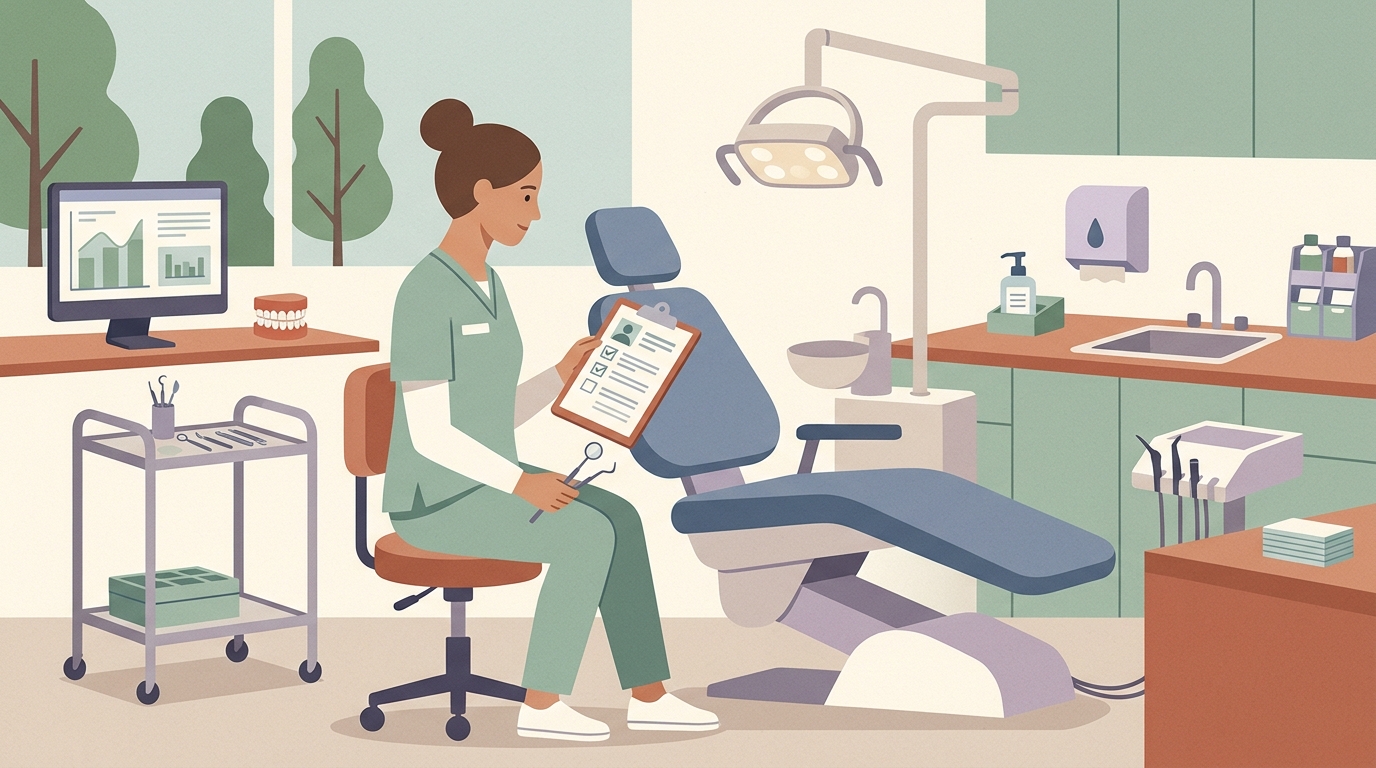
Preparing for a dental hygienist interview means two jobs at once: proving you can scale, chart and educate patients safely, and proving your paperwork is in order. Most practices will want to see your licence status, confirm you graduated from a programme accredited by the Commission on Dental Accreditation, and watch how you talk to patients — often in a working interview where you treat real people.
This guide gives you a timeline that starts a week out, a physical checklist for the morning, and exact wording for the moments that catch candidates off guard.
Your Prep Timeline
- One week before — assemble your credential file (60–90 minutes). Pull up your state dental board's online licence lookup, print the page showing your licence number and status, and add your CPR/BLS certification card and proof of graduation from a CODA-accredited programme. All states require graduation from a CODA-accredited dental hygiene programme (LicenseMap, undated), and most states require CPR or BLS certification as part of licensure (Dental Now, undated), so offices expect these on request. If your licence is pending, print your National Board Dental Hygiene Examination and clinical board score reports instead — every state requires both exams (LicenseMap, undated).
- One week before — call the office and ask what the interview includes (10 minutes). Ask directly: is there a working interview, how many patients, will you use their instruments or bring your own, and how long should you block out. Write the answer down. A working interview changes what you pack and what you wear.
- Five days before — rehearse four clinical answers out loud (45 minutes). Pick a difficult perio case, a nervous patient, a disagreement with a dentist over a treatment plan, and a time you caught something on a radiograph. Use Situation, Task, Action, Result and include a real number — probing depths, appointment length, recall interval.
- Two days before — research the practice with a method, not a skim (30 minutes). Read their services page, their new-patient forms if posted, and the most recent 20 online reviews. Note whether they are general, periodontal or paediatric, and whether reviews mention wait times or hygiene appointments specifically. Turn that into three questions you will ask them.
- Two days before — check your state's continuing education and renewal rules (20 minutes). Go to your state dental board site and note your CE hours completed this renewal period and your renewal date. Continuing education is required for licence renewal (LicenseMap, undated), and interviewers often ask where you stand.
- The day before — time the route and pack the bag (40 minutes). Drive or map the trip at the same time of day as the interview, then add 20 minutes. Pack the credential folder, loupes, a spare pair of scrubs, and your instrument kit if the office asked for it.
- Morning of — run a 15-minute rehearsal. Say your two-minute introduction out loud once, re-read your three questions, and check your phone is silenced and your notifications are off before you leave the car.
Day-Of Checklist
Work through this in order and tick each one physically before you leave the house.
- Printed licence verification page from your state board site, plus CPR/BLS card and a copy of your transcript or diploma from your CODA-accredited programme — three copies, in a plain folder.
- Printed résumé, three copies, with your licence number and expiry date in the header.
- Written list of three references with current phone numbers and email addresses, on a separate sheet.
- Scrubs laid out and clean, plus closed-toe clinic shoes, even if the office said business attire — bring both if a working interview is possible.
- Hair tied back, nails short and unpolished, jewellery removed or in your bag.
- Loupes, safety glasses and your own instrument cassette packed if the practice asked you to bring them.
- Route timed at the same hour as your appointment, with arrival planned for 15 minutes early and parking confirmed.
- Phone charged, set to silent, and the office's direct phone number saved in your contacts in case you are delayed.
- Three written questions for the interviewer on an index card in your pocket.
- Water bottle and a small snack in the bag — working interviews can run past lunch.
What to Say in Tricky Moments
Greeting the front desk
At check-in
"Good morning, I'm Maya Ellison, here at 9:00 for the hygiene interview with Dr. Pak. I have my licence verification and CPR card with me if the office needs copies."
"Tell me about yourself"
Two-minute opener, Situation–Task–Action–Result
"I've been an RDH for four years in a general practice seeing eight to ten patients a day. My task was rebuilding a lapsed recall list. I called 140 overdue patients over six weeks and rebooked 62 of them. I'm looking for a practice with a stronger perio focus."
A clinical disagreement question
When asked about conflict with a dentist
"A patient had 5mm pocketing in two quadrants and the dentist had charted a prophy. I showed him my probe readings and bitewings before he entered the op, and we re-planned it as scaling and root planing that visit."
If asked your salary expectations too early
Deferring the number
"I'd rather understand the role first — daily patient load, appointment length, and whether assisted hygiene is used. Once I know that, I'm happy to talk numbers. What range has the practice budgeted for this position?"
Asking about next steps
At the close
"Thank you — this was helpful. What does your timeline look like from here, and is there anything else you need from me, like my board scores or references?"
If you are asked to perform a procedure you haven't done recently
Honest and specific
"I haven't placed arestin in about a year, so I'd want a quick refresher on your protocol before I do it on a patient today. I'm comfortable with the scaling and the radiographs right now."
Frequently asked questions
How early should I arrive?
Fifteen minutes early. Arriving earlier puts pressure on a front desk that is checking in patients. Sit in your car until the 15-minute mark, then go in.
What should I bring to a working interview?
Clean scrubs, closed-toe clinic shoes, loupes, safety glasses, and your own instrument cassette if the office asked for it. Also bring your printed licence verification and CPR/BLS card, since most states require that certification for licensure (Dental Now, undated).
Will they ask about my board exams?
Often, yes — especially if you are newly licensed. Bring printed score reports from the National Board Dental Hygiene Examination and your clinical board exam, both of which every state requires for licensure (LicenseMap, undated).
What should I ask the interviewer?
Ask how long hygiene appointments are scheduled, whether assisted hygiene is used, and how the practice handles overdue recall patients. Those three answers tell you more about the daily workload than anything on the job posting.
Sources
- LicenseMap — How to Become a Dental Hygienist in 2026: Complete Licensing Guide
- Dental Now — How to Become a Dental Hygienist (2026)

Written by
Priya tracks wages, layoffs, and the slow shifts in what counts as a stable job. She writes for readers trying to make sense of numbers that rarely match their own experience.