How to Negotiate a Higher Salary as a Dental Hygienist
Where to find wage data for your own metro, the exact sentences to use when you name a number, and what to do when the answer is not this year.
Quick answer
- Base your ask on a printed wage range, not a feeling: the BLS Occupational Employment and Wage Statistics tables (U.S. Bureau of Labor Statistics, May 2023) publish median and 10th-to-90th percentile annual wages for dental hygienists nationally and by state and metro area, and the Occupational Outlook Handbook publishes median pay (2024) and median wages by top employing industry (May 2025).
- For a general raise benchmark, look up the current figure yourself in the Payscale Salary Budget Survey reported by WorldatWork (2024), the Salary.com National Salary Budget Survey (2024), Indeed's published average annual raise percentage for US employees (2025), or BambooHR's compensation survey (2025) — each reports an average or median increase and each is updated annually.
- BambooHR (2025) found that employees who changed jobs that year received a larger average increase than those who stayed, so an outside offer is real leverage — but only if you would genuinely accept it.
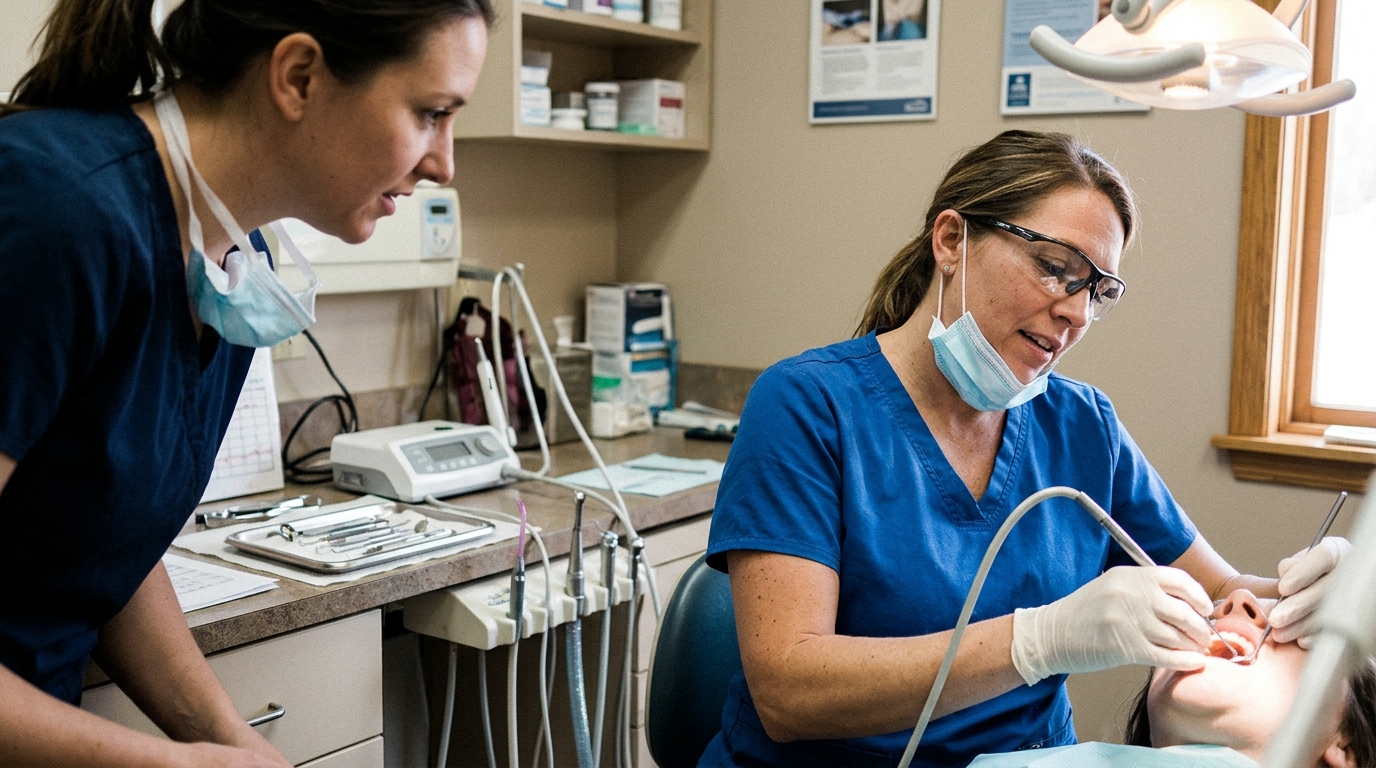
Negotiating as a dental hygienist works differently from most office jobs: many hygienists are paid hourly or per diem, raises are often decided by one owner-dentist rather than an HR system, and the rate in your own metro matters more than any national average. The way to win the conversation is to arrive with three things — a printed wage range for your area, a written list of what you produce for the practice, and one target number you can say out loud without flinching.
This guide covers how to build those three things, what to say when you ask, and how to respond when the answer is "we can't right now."
Before You Ask: Research and Preparation
Each step should end with something you can hold or open on a screen. If a step produces nothing you can point to, it isn't finished.
- Print your local wage range. Open the BLS Occupational Employment and Wage Statistics tables for dental hygienists (SOC 29-1292) and pull the national figures, which report the median annual wage and the 10th-to-90th percentile range (U.S. Bureau of Labor Statistics, May 2023), then pull the state and metropolitan-area tables for where you work. Print them. Hourly and annual figures are both published — note which one you are using, because hygienists are frequently paid hourly and an annual figure assumes full-time hours you may not be scheduled for. Look up California, Texas and New York in that same release and you will see three different medians for the same license.
- Pull the industry comparison. The Occupational Outlook Handbook reports median annual wages for dental hygienists by top employing industry (U.S. Bureau of Labor Statistics, May 2025). Offices of dentists are not the only line. Write each industry median next to your current situation.
- Write a one-page achievement list with numbers on it. Not "I'm reliable." Write patients seen per day, your recall or reappointment rate, perio therapy cases started, radiographs taken, days you covered for a colleague, new patients who asked for you by name. If your practice management software reports production by provider, print the last year.
- Separate base pay from everything else. Build a two-column sheet: hourly or annual base in one column; production bonus, per-diem premium, paid CE days, licensure and association dues, loupe or uniform allowance, retirement match, health coverage, PTO and paid holidays in the other. A higher hourly rate elsewhere can be worth less once unpaid CE and no retirement match are counted. Decide which column you are negotiating before you walk in.
- Set one target number and one walk-away number. The target comes from your wage printout plus your achievement page. The walk-away is the number below which you start looking. Write both down; say only the target in the room.
- Check the general raise benchmarks. Read the current reported figures in the Payscale Salary Budget Survey reported by WorldatWork (2024), the Salary.com National Salary Budget Survey (2024), Indeed's average annual raise percentage for US employees (2025) and BambooHR's compensation survey (2025). Mercer's QuickPulse US compensation planning survey, reported by HR Dive (April 2025), found employers delivered smaller merit and total increases than they had projected — so the budget pressure you hear about may be genuine.
- Confirm your credential is current and visible. All states require dental hygienists to be licensed, and requirements vary by state (U.S. Bureau of Labor Statistics, 2024); CareerOneStop's license finder lists the state-issued licenses that apply. Have your license, CE transcript and any expanded-function or local-anesthesia permit ready to mention. Credentials the practice can bill against are the easiest argument you will make.
What to Say
Book the conversation in advance rather than raising it between patients. Ask for a short block at a time the schedule is light.
The brackets below are placeholders. Fill them in from your own printed wage tables before you use the lines, so you are saying your own numbers rather than someone else's.
Opening the ask
You, starting the conversation
"Thanks for making time. I want to talk about my pay. I'm running a full column most days, and I've pulled the Bureau of Labor Statistics wage data for our metro area. I'd like to go through what I'm asking for and why."
Naming the number
You, asking for an hourly rate
"I'm at $[current rate] an hour now. Based on the BLS Occupational Employment and Wage Statistics figures for this metro area (May 2023) and the perio cases I've started this year, I'm asking to move to $[target rate] an hour — that's a [target]% increase, effective with the next pay period."
You, if your practice sets pay annually
"I'd like my base moved up by [target]%, to $[target salary]. Separately, I'd like us to agree how the production bonus is calculated, so I know what total compensation looks like and not just base."
Say the number, then stop talking. Let the silence sit.
When they push back
Them: "The budget's already set for this year — I can't do anything right now."
You: "I understand the budget is set. Then I'd like two things: a date in writing when we revisit this, and agreement on what the number would be if I hit it. If $[target rate] an hour isn't possible now, tell me what is, and tell me what you'd need to see from me to get there at that review."
When they offer less than you asked
You: "Thank you — that's movement and I appreciate it. I'd still like to close the gap. If the rate can't go higher this year, I'd take the difference as paid CE days and covered association dues, and we revisit the rate at a set date."
Non-cash items are often easier for an owner-dentist to approve than a rate change that resets payroll for everyone. Ask for them by name.
Negotiation Checklist
Every line is a yes or no. Work through it the day before you ask.
- I have printed the BLS Occupational Employment and Wage Statistics tables (May 2023) showing median and percentile wages for dental hygienists in my state and metro area.
- I have written down whether my target is an hourly rate or an annual salary, and whether it includes production bonus.
- I have written a one-page list of accomplishments from the past year with a number attached to each.
- I have printed my production or patient-volume report from practice management software, or confirmed it is unavailable.
- I have written one target number and one walk-away number on paper.
- I have listed my current non-cash compensation — PTO, paid CE days, dues, retirement match, health coverage — in a single column.
- I have confirmed my state license and any expanded-function permit are current and have the documents to hand.
- I have read the current reported raise figure in at least one named survey: Payscale via WorldatWork (2024), Salary.com (2024), Indeed (2025) or BambooHR (2025).
- I have booked a specific time for the conversation rather than planning to raise it in passing.
- I have said my ask sentence out loud until it sounds flat and ordinary.
- I have written the exact sentence I will use if the answer is no.
- I have decided whether a deferred review date in writing counts as an acceptable outcome.
- I have decided whether I am willing to look elsewhere, and I have not bluffed about an offer I do not have.
Frequently asked questions
How much of a raise is realistic to ask for?
Start from the gap between your current rate and the percentile figures for your metro area in the BLS Occupational Employment and Wage Statistics tables (U.S. Bureau of Labor Statistics, May 2023), rather than from a generic percentage. For context on what employers are granting, check the current figures in the Payscale Salary Budget Survey reported by WorldatWork (2024), the Salary.com National Salary Budget Survey (2024), Indeed's average annual raise percentage (2025) and BambooHR's compensation survey (2025). Mercer's survey reported by HR Dive (April 2025) found employers delivered smaller merit and total increases in 2025 than projected, so a practice may have less room than it expected. No framing guarantees a yes.
When is the best time to ask?
There is no universally best moment, and the right one turns on things you can check: your practice's fiscal or review cycle, whether a hygiene column has just been added or lost, whether the practice is short-staffed, and how long it has been since your last increase. If there are formal annual reviews, open the conversation several weeks before, while the budget is still being written.
Should I bring another offer to the table?
Only if you would genuinely take it. BambooHR (2025) found that among employees who changed jobs that year, most received a raise and the average increase was larger than for those who stayed, so an outside offer carries weight. But a bluff that gets called leaves you with a job you no longer want and a manager who knows it. If you mention an offer, state it plainly and pair it with a clear preference to stay.
Does moving to a different kind of practice pay more?
It can, and the comparison is checkable: the Occupational Outlook Handbook reports median annual wages for dental hygienists by top employing industry (U.S. Bureau of Labor Statistics, May 2025), so you can see how offices of dentists compare with other employing industries. Factor in hours too — a higher hourly rate over fewer scheduled days is not automatically more money across a year.
What if I'm paid per diem or through an agency?
Negotiate the day rate and the cancellation policy together, and get both in writing. Per-diem work usually carries no paid CE, no retirement match and no PTO, so compare the day rate against a staff role's whole package rather than its base alone. Use the same BLS Occupational Employment and Wage Statistics metro figures (May 2023) as your anchor, converted to the same unit before you compare.
Sources
- U.S. Bureau of Labor Statistics — Dental Hygienists : Occupational Outlook Handbook (2024)
- U.S. Bureau of Labor Statistics — Occupational Employment and Wages, May 2023 - 29-1292 Dental Hygienists (2023-05)

Written by
Priya tracks wages, layoffs, and the slow shifts in what counts as a stable job. She writes for readers trying to make sense of numbers that rarely match their own experience.