
How to Get Your EMT Certification
The National Registry route runs from course enrollment to an Authorization to Test, and your State EMS Office decides what happens after you pass.
Quick answer
- EMT programs usually ask for a high school diploma or equivalent plus CPR or basic life support certification, and most take less than 1 year for EMT-Basic (U.S. Bureau of Labor Statistics, 2025).
- The National Registry EMT cognitive exam is computer-adaptive, 70 to 120 questions with a 2-hour limit (How To NREMT, undated), scored 100 to 1500 with the passing point at 950 (EMS Quiz, undated).
- National certification is portable, but the license to practice is not: all states license EMTs, most accepting National Registry certification and others requiring an equivalent state exam (U.S. Bureau of Labor Statistics, 2025).
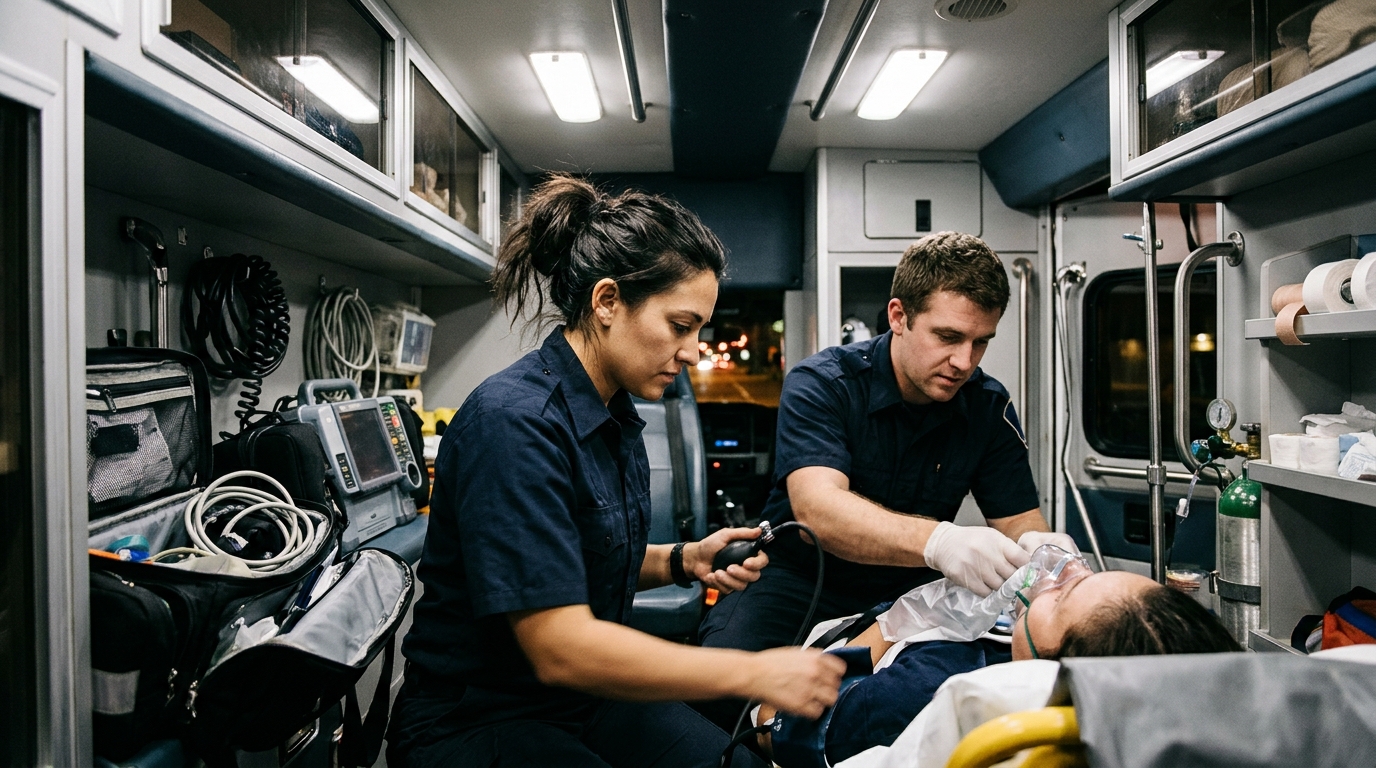
EMT certification has two layers: national certification from the National Registry of Emergency Medical Technicians (NREMT), and a state license that actually lets you work on an ambulance. The national credential requires a state-approved EMT course meeting the National EMS Education Standards, a passing result on the National Registry EMT certification examination, and a BLS skills competency requirement approved by your State EMS Office (National Registry of Emergency Medical Technicians, undated).
Every state licenses EMTs, and the requirements differ from state to state (U.S. Bureau of Labor Statistics, 2025). The national exam is the common spine; the paperwork around it is local.
Why This Credential Matters
The certifying body is the National Registry of Emergency Medical Technicians (NREMT). It does not license you — it certifies that you completed a state-approved EMT course and passed a standardized national examination (National Registry of Emergency Medical Technicians, undated). The licensing authority is your State EMS Office, which sits inside a state health department or public safety agency depending on the state.
That split matters when you apply for work. Ambulance services, private medical transport companies, fire departments, hospital emergency departments and event medical contractors all hire at the EMT level, and every one of them needs to see a current state license. All states require EMTs and paramedics to be licensed in the state where they work, and requirements vary by state (U.S. Bureau of Labor Statistics, 2025). Most states require candidates to hold the certification, while others accept passage of an equivalent state exam; states may also set a minimum age and require a background check, and state licensing board requirements are listed on CareerOneStop (U.S. Bureau of Labor Statistics, 2025).
To a hiring manager, National Registry certification signals training that met the National EMS Education Standards rather than a local shortcut — useful if you expect to move between states. Two requirements sit outside the credential: employers typically want a driver's license and may prefer ambulance driver certification (U.S. Bureau of Labor Statistics, 2025). Entry-level education is a postsecondary nondegree award rather than a degree, and employment of EMTs and paramedics is projected to grow 6 percent from 2025 to 2035, with about 18,200 openings a year on average over the decade (U.S. Bureau of Labor Statistics, 2025).
Step-by-Step Path to Certification
- Clear the prerequisites. Program applicants usually need a high school diploma or equivalent plus CPR or basic life support certification (U.S. Bureau of Labor Statistics, 2025). Check your state's minimum age and background check rules through your State EMS Office or the state licensing pages on CareerOneStop (U.S. Bureau of Labor Statistics, 2025), and get a driver's license, since employers typically require one.
- Enroll in a state-approved EMT education program. Certification requires completion of a state-approved course meeting or exceeding the National EMS Education Standards for the EMT, and enrollment is Step 1 of the National Registry process (National Registry of Emergency Medical Technicians, undated). These run at community colleges, fire academies, hospital training centers and private EMS schools, taking less than 1 year for EMT-Basic and up to 2 years for EMT-Intermediate (U.S. Bureau of Labor Statistics, 2025).
- Create your National Registry account. This is Step 2 and follows enrollment (National Registry of Emergency Medical Technicians, undated). Use your legal name exactly as it appears on the government-issued ID you will present at the test center.
- Submit the certification application and payment about four weeks before you finish the course. Your Program Director must approve the application once course requirements are met (National Registry of Emergency Medical Technicians, undated). Ask your instructor early who holds that role, because nothing moves until the approval is entered.
- Complete the BLS skills competency requirement approved by your State EMS Office. The separate AEMT and Paramedic psychomotor exam was discontinued, with the last one administered June 30, 2024, but EMT candidates still complete a state-approved BLS skills competency verification (ReadyToServe, 2026). Some states build it into the course, so confirm the local requirement with your State EMS Office or instructor (National Registry of Emergency Medical Technicians, undated).
- Schedule and sit the National Registry EMT certification examination. The National Registry adds an Authorization to Test (ATT) to your account within 1-2 business days, and you have up to 90 days from issuance to test or the ATT and payment are forfeited (National Registry of Emergency Medical Technicians, undated).
- Apply to your State EMS Office for the license. National certification alone does not authorize practice. Submit the state application, fees and background check documents, then apply to ambulance services, fire departments and hospital-based EMS agencies.
Exam and License Details
| Detail | Specification |
|---|---|
| Exam name | National Registry EMT certification examination (cognitive), computer-adaptive (How To NREMT, undated) |
| Number of questions | 70 to 120 questions, 2-hour time limit (How To NREMT, undated) |
| Passing score | Pass/fail on a scale of 100 to 1500, passing point 950 (EMS Quiz, undated) |
| Fee | $104 per examination attempt at the EMT level (Practice Test Geeks, 2026) |
| Skills requirement | State EMS Office approved BLS skills competency verification, sometimes built into the course (National Registry of Emergency Medical Technicians, undated) |
| Testing window | ATT issued within 1-2 business days; 90 days from issuance to test (National Registry of Emergency Medical Technicians, undated) |
| Retake policy | Each attempt needs its own application and $104 fee (Practice Test Geeks, 2026); confirm current attempt limits and waiting periods with the National Registry before rebooking |
| Validity of passed components | Passed exam portions and skills verification stay valid 24 months if other eligibility requirements are met (National Registry of Emergency Medical Technicians, undated) |
| Renewal | Finish between January 1 and June 30 and certification expires March 31 two years later; finish between July 1 and December 31 and it expires March 31 three years later (National Registry of Emergency Medical Technicians, undated) |
| Lapsed certification | Re-entry requires 40 credits of continuing education meeting all current National Continued Competency Program requirements within the past two years (National Registry of Emergency Medical Technicians, undated) |
| State license | Issued separately by your State EMS Office; all states license EMTs and requirements vary by state (U.S. Bureau of Labor Statistics, 2025) |
Realistic Timeline
This assumes an EMT-Basic course, which typically runs less than 1 year (U.S. Bureau of Labor Statistics, 2025). A full-time accelerated course compresses the middle; an evening course stretches it.
- Month 1: Finish a CPR or basic life support course, request your high school transcript or equivalency certificate, and check your state's age and background check rules through your State EMS Office or CareerOneStop (U.S. Bureau of Labor Statistics, 2025). Apply to a state-approved program at a community college, fire academy or private EMS school.
- Months 2-5: Classroom, lab and clinical hours. Create your National Registry account early here, since it is Step 2 and follows enrollment (National Registry of Emergency Medical Technicians, undated).
- About four weeks before your final class: Submit the certification application and the $104 payment (Practice Test Geeks, 2026), and confirm your Program Director will approve it once course requirements are met (National Registry of Emergency Medical Technicians, undated).
- Month 5 or 6, final weeks of the course: Complete the state-approved BLS skills competency verification — on a scheduled lab day if your state folds it into the course, otherwise booked separately through the state (National Registry of Emergency Medical Technicians, undated).
- Month 6, days 1-2 after program completion: Your Authorization to Test appears in your account within 1-2 business days (National Registry of Emergency Medical Technicians, undated).
- Months 6-9: Test inside the 90-day ATT window. Many candidates book within 2 to 4 weeks of finishing, while the material is fresh.
- Months 6-8: State license application, fingerprinting and background check, then job applications to ambulance services, fire departments and hospital EMS agencies. Ask your State EMS Office for current processing turnaround before promising an employer a start date.
- By Month 9 at the latest: You hold national certification plus an active state license, expiring March 31 either two or three years out depending on when in the calendar year you finished (National Registry of Emergency Medical Technicians, undated).
Frequently asked questions
What should I budget beyond the exam fee?
Tuition is the largest cost and is set by the training provider, so a community college course, a fire academy seat and a private school place will not price the same. On top of tuition you pay $104 for each attempt at the EMT-level examination (Practice Test Geeks, 2026), plus whatever your State EMS Office charges for the license application and fingerprinting. Ask the program for a written fee sheet covering textbooks, uniforms and immunization requirements before you enroll.
Does my National Registry certification transfer if I move to another state?
The certification is national, but the authority to practice is not. Most states require candidates to hold it, while others require passage of an equivalent state exam, and states may add their own age and background check conditions (U.S. Bureau of Labor Statistics, 2025). Look up the destination state's board requirements on CareerOneStop and contact that State EMS Office before you move, because reciprocity rules are theirs alone to set.
I already hold a state EMT license. Can I add national certification without redoing the course?
Yes. For candidates with a current state EMT license, the education requirement can be met with 20 credits of continuing education meeting the National Continued Competency Program's national component requirements within the past two years, or with a state-approved EMT refresher course (National Registry of Emergency Medical Technicians, undated). Keep certificates for every continuing education hour, because you may be asked to document them.
What happens if I miss the testing window?
If the 90-day period runs out, both the authorization and the money you paid are gone, and you begin the application again with a fresh fee (National Registry of Emergency Medical Technicians, undated). Book a seat as soon as the authorization appears, even for a date several weeks out — moving a booked appointment is usually easier than recovering a forfeited one.
Sources
- National Registry of Emergency Medical Technicians (NREMT) — EMT Candidate Handbook · Introduction
- National Registry of Emergency Medical Technicians (NREMT) — EMT Full Education Program Pathway

Written by
Wyatt covers work outside the office: construction, logistics, repair, and the people who keep things running. He's skeptical of career advice that assumes everyone sits at a desk.