
How to Become a Veterinary Technician
What the credentialing exam, state-by-state licence rules and the anaesthesia, lab and restraint work of a clinic shift actually ask of you.
Quick answer
- Fastest common path: a two-year associate's degree in veterinary technology, then your state's credentialing exam.
- Typical timeline from starting school to credentialed and working: about 24 to 30 months, plus one to two years of on-the-job training after hire (O*NET OnLine, 2026).
- Minimum credential most employers expect: an associate's degree plus state registration, licensure or certification (U.S. Bureau of Labor Statistics, 2025).
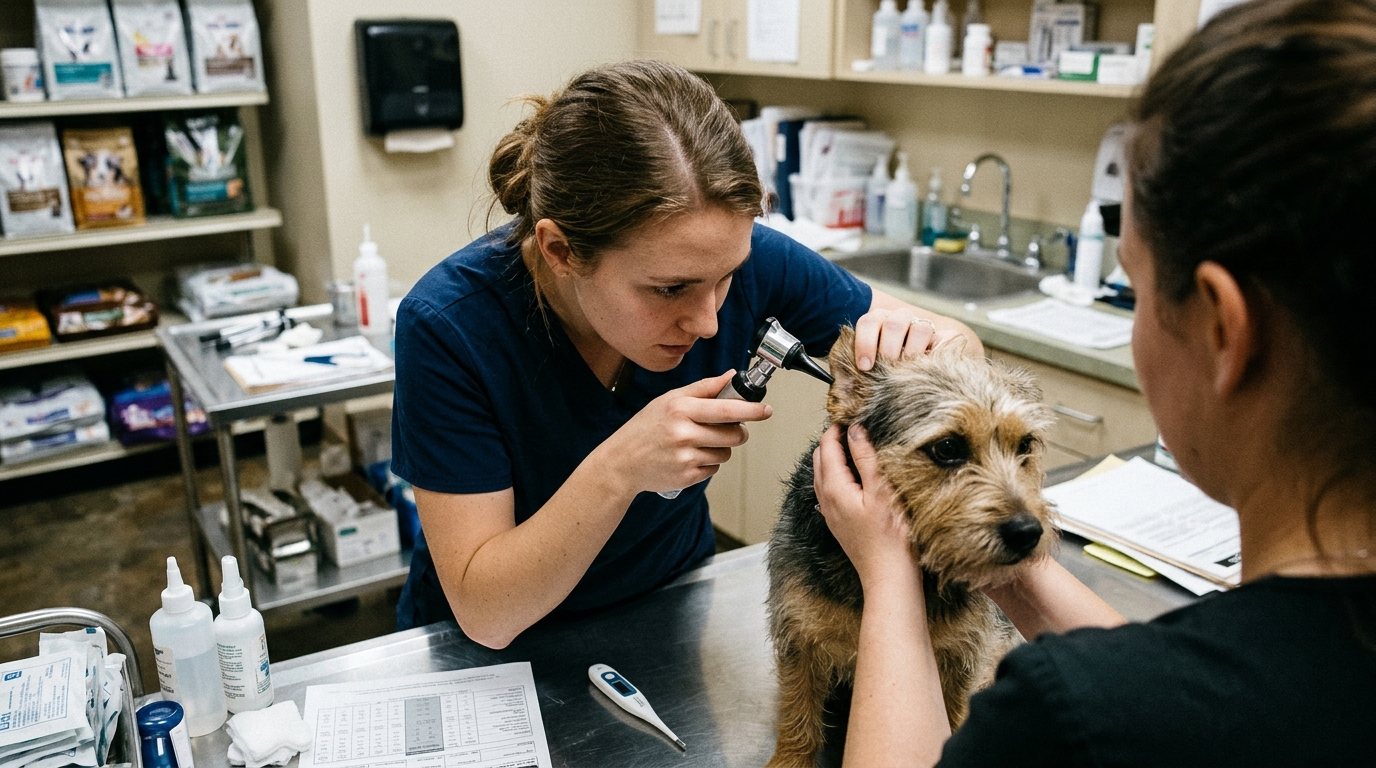
Veterinary technologists and technicians are the people who draw the blood, place the catheter, monitor the anaesthesia and run the lab samples while the veterinarian diagnoses and operates. The usual route is an associate's degree in a veterinary technology program for technicians and a bachelor's degree for technologists (U.S. Bureau of Labor Statistics, 2025), followed by a credentialing exam and registration, licensure or certification in the state where you work (U.S. Bureau of Labor Statistics, 2025).
Plan on roughly two years of schooling plus a credentialing step, then one to two years of on-the-job learning alongside experienced staff before the work feels routine (O*NET OnLine, 2026).
Is This Career Right for You?
This is hands-on clinical work with animals that do not want to be handled. Veterinary technologists and technicians have one of the highest rates of injuries and illnesses of all occupations, and can be bitten, scratched or kicked by frightened or aggressive patients (U.S. Bureau of Labor Statistics, 2025). You will lift and carry dogs onto tables, hold large breeds still for radiographs, and spend most of the shift standing on a hard floor.
Hours are not always weekday-daytime. The job may involve evenings, weekends or holidays (U.S. Bureau of Labor Statistics, 2025), and emergency and 24-hour hospitals run overnight shifts by design. The veterinary services industry accounts for the largest share of these jobs (U.S. Bureau of Labor Statistics, 2025), so the typical setting is a general or specialty practice — exam rooms, a treatment area, a surgical suite and an in-house lab — rather than an office.
The work suits people who can stay methodical while a patient is crashing, who tolerate blood, faeces and anal glands without flinching, and who can tell an upset owner that a cost estimate has gone up. It suits people less well if you need predictable hours, cannot lift repeatedly, or find euthanasia appointments and owners' grief hard to set down at the end of a shift. Those are the specific pressures — not the animals themselves — that most often push people out.
Entry-level technicians spend more time on restraint, kennel care, sample collection and record entry. Experienced technicians take on anaesthesia monitoring, dental procedures, difficult venipuncture and training new hires.
Steps to Becoming a Veterinary Technician
- Take science classes in high school (or catch up later). Biology and other science courses are the standard preparation (U.S. Bureau of Labor Statistics, 2025). If you left school without them, a single semester of community college biology or chemistry usually satisfies program prerequisites.
- Work or volunteer around animals first (1-6 months). A few shifts a week as a kennel assistant, shelter volunteer or veterinary assistant tells you quickly whether the smells, the restraint and the euthanasia appointments are something you can live with. Many programs also want documented animal-care hours.
- Enrol in a veterinary technology program (2 years for an associate's, 4 years for a bachelor's). Technicians usually need an associate's degree in a veterinary technology program; technologists usually need a bachelor's (U.S. Bureau of Labor Statistics, 2025). Cost varies enormously between in-district community college rates and private colleges — compare published cost per credit before you apply, and confirm with your state board that the program meets its credentialing requirements.
- Complete clinical rotations or an externship (usually built into the program). This is where you move from models to live patients: placing IV catheters, positioning for radiographs, running faecal floats and blood smears, and charting in practice management software.
- Pass the credentialing exam and register with your state (allow several weeks to a few months of study, plus exam and application fees). Technologists and technicians typically must pass a credentialing exam and become registered, licensed or certified, depending on the state in which they work (U.S. Bureau of Labor Statistics, 2025). Fees and the exact title differ by state, so budget from your own board's published schedule.
- Take an entry-level position and expect structured on-the-job training. BLS notes on-the-job training is typical after hire (2025), and ONET places the occupation in Job Zone Three, where employees usually need one or two years of training combining on-the-job experience and informal instruction from experienced workers (ONET OnLine, 2026).
- Keep your credential current (ongoing, every 1-3 years depending on the state). Continuing education hours and renewal cycles are set by your state board; the American Association of Veterinary State Boards is one of the national bodies listed for this occupation (O*NET OnLine, 2026).
- Advance deliberately (3+ years in). Routes include specialty credentialing in areas such as anaesthesia, emergency or dentistry, moving into laboratory animal work, supervising a treatment floor, or teaching in a veterinary technology program. CareerOneStop publishes certification information for this occupation (U.S. Bureau of Labor Statistics, 2025).
Education and Certification Options
| Path | Typical time | Approximate cost | Required or preferred |
|---|---|---|---|
| Associate's degree in veterinary technology | About 2 years full time | Varies by state and institution; in-district community college tuition is usually the lowest published rate — compare cost per credit | The typical entry-level education for technicians (U.S. Bureau of Labor Statistics, 2025); required in most credentialing states |
| Bachelor's degree in veterinary technology | About 4 years full time | Higher than an associate's at most institutions; check published in-state versus out-of-state rates | Usually needed to work as a veterinary technologist (U.S. Bureau of Labor Statistics, 2025); preferred for research and academic settings |
| On-the-job training as a veterinary assistant | 1-2 years of informal training with experienced workers (O*NET OnLine, 2026) | Paid, so no tuition, but wages are typically lower than for credentialed staff | Does not replace a degree where the state requires credentialing; useful as a stepping stone |
| State credentialing exam and registration, licensure or certification | Study period plus application and exam processing | Exam and application fees set by your state board | Typically required to use the protected title and perform certain tasks (U.S. Bureau of Labor Statistics, 2025) |
| Specialty certification after credentialing | Usually several years of practice plus case logs | Academy application and exam fees vary | Preferred, not required; see CareerOneStop for certification information (U.S. Bureau of Labor Statistics, 2025) |
Where to Find Veterinary Technician Jobs
- The National Association of Veterinary Technicians in America (NAVTA), listed by O*NET as a national association for this occupation (2026) — useful for job listings, specialty academy information and state-by-state credential terminology.
- The American Veterinary Medical Association (AVMA) and your state veterinary medical association, which run career resources and annual conferences where practices recruit directly (O*NET OnLine, 2026).
- The American Animal Hospital Association (AAHA), whose accredited-practice network is a route into general and specialty hospitals (O*NET OnLine, 2026).
- The American Association for Laboratory Animal Science (AALAS) if you want research work in pharmaceutical companies, universities or government labs rather than clinical practice (O*NET OnLine, 2026).
- Your state board and the American Association of Veterinary State Boards (AAVSB) for credential verification, reciprocity between states and board-adjacent job notices (O*NET OnLine, 2026).
- CareerOneStop, which publishes certification information for this occupation and links state training and employment services (U.S. Bureau of Labor Statistics, 2025).
- Employer types worth approaching directly: private small-animal and mixed practices (the veterinary services industry holds the largest share of these jobs, U.S. Bureau of Labor Statistics, 2025), 24-hour emergency and specialty referral hospitals, university veterinary teaching hospitals, animal shelters and humane societies, zoos and aquariums, and federal and state agencies with animal health roles.
- Your externship site. Clinics routinely hire the student who already knows their anaesthesia protocols and their record system; treat the rotation as a months-long interview.
Frequently asked questions
How much does it cost to become a veterinary technician?
The two big costs are tuition for a veterinary technology program and the fees for your state's credentialing exam and registration. Tuition varies widely between in-district community colleges, in-state public institutions and private colleges, so compare published cost per credit rather than relying on an average. Exam and application fees are set by your state board and published on its website.
How long does it take from starting out to working as a credentialed technician?
An associate's degree in veterinary technology typically takes about two years full time (U.S. Bureau of Labor Statistics, 2025), and you then need to sit the credentialing exam and complete your state's registration, licensure or certification process. Allow a few extra months for study, scheduling and application processing. O*NET also notes that workers in this job zone usually need one or two years of on-the-job experience and informal training with experienced workers before they are fully up to speed (2026).
Is there an age requirement or a background check?
Programs generally require a high school diploma or equivalent, and state boards set their own eligibility rules, which can include minimum age, a criminal history disclosure or fingerprinting. Because registration, licensure and certification requirements differ by state (U.S. Bureau of Labor Statistics, 2025), check your own board's application packet before enrolling. Employers handling controlled drugs may run their own background checks on top of the board's.
What will I be paid, and is the field growing?
Pay is usually hourly in private practice and salaried in research and academic settings, with differentials common for overnight, weekend and holiday shifts. The U.S. Bureau of Labor Statistics publishes a median annual wage for veterinary technologists and technicians along with the range between the lowest- and highest-paid 10 percent (May 2025) — check the Occupational Outlook Handbook for the current figures and your state's data. The same source publishes the projected growth rate and average annual openings for 2025-35, which is the number to look at rather than any general claim about demand.
Can I work as a vet tech without a degree?
You can work as a veterinary assistant and learn a great deal on the job, but that is a different occupation with a narrower scope. Technologists and technicians typically must pass a credentialing exam and be registered, licensed or certified depending on the state (U.S. Bureau of Labor Statistics, 2025), and that normally requires completing a veterinary technology program first. Check your state board's rules, because what an uncredentialed employee may legally do varies considerably between states.
Sources
- U.S. Bureau of Labor Statistics — Veterinary Technologists and Technicians : Occupational Outlook Handbook (2025)
- O*NET OnLine (U.S. Department of Labor, Employment and Training Administration) — 29-2056.00 - Veterinary Technologists and Technicians (2026)

Written by
Wyatt covers work outside the office: construction, logistics, repair, and the people who keep things running. He's skeptical of career advice that assumes everyone sits at a desk.