How to Become a Licensed Esthetician
Esthetics licensing runs through your state board, so the training hours, exam fees and renewal rules that apply to you depend on where you plan to work.
Quick answer
- Every state except Connecticut requires skincare specialists to finish a state-approved cosmetology or esthetician program and pass a state exam before working (U.S. Bureau of Labor Statistics, undated).
- The written exam used in many states is the National Esthetics Theory Examination, which has 110 items — 100 of them scored — and a 90-minute time limit (National-Interstate Council of State Boards of Cosmetology, 2020).
- Training hours and renewal rules are state-specific: one state listing requires 1,000 hours in an approved school or 2,000 hours of apprenticeship, and another sets a Master Esthetician tier at 1,200 school hours or 1,500 apprenticeship hours with an $85 licensing fee (Dermascope Magazine, undated).
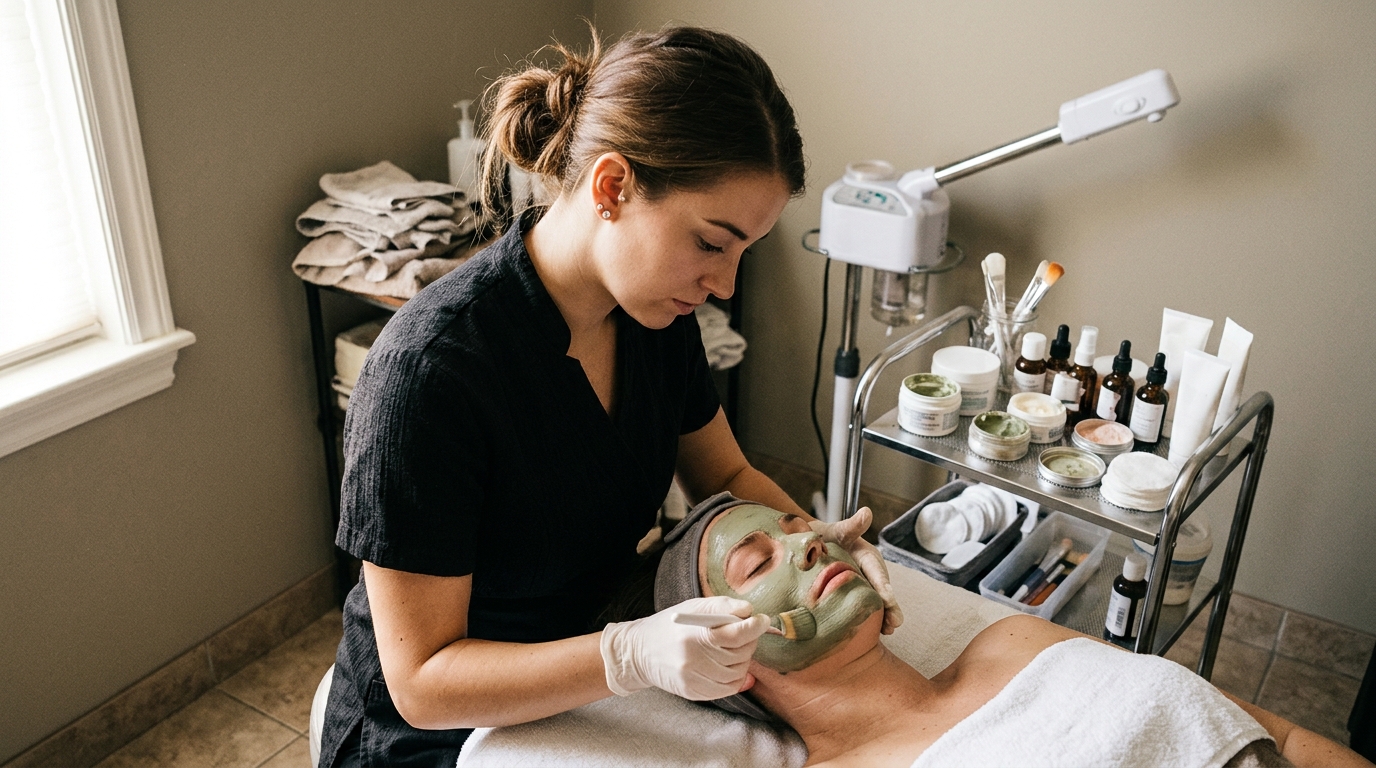
To work as an esthetician you complete a state-approved esthetics or cosmetology program and then pass a state licensing exam — a requirement in every state except Connecticut (U.S. Bureau of Labor Statistics, undated). Most states test you twice: a written theory exam, often the National Esthetics Theory Examination developed by the National-Interstate Council of State Boards of Cosmetology, and a hands-on practical covering facials, waxing and makeup.
The path is predictable, but the details are not national. Training hours, fees and renewal cycles are set state by state, so your first move is your own board's rules rather than a general summary.
Why This Credential Matters
An esthetics license is not an optional add-on. Skincare specialists must complete a state-approved cosmetology or esthetician program and pass a state exam to be licensed, and that applies in all states except Connecticut (U.S. Bureau of Labor Statistics, undated). Without it you cannot legally perform facials, waxing or chemical exfoliation on paying clients in the states that regulate the work.
The credential is issued by your state's cosmetology board — in North Carolina, the Board of Cosmetic Art Examiners, which uses the testing vendor Prov to deliver its exams (Prov, undated). Boards set the training hours, the exam content and the renewal cycle. Some states combine cosmetology and esthetics into one license; others license esthetics separately, and required hours vary state to state (assessment.com MAPP career guide, undated).
The written portion in many states is the National Esthetics Theory Examination, built by the National-Interstate Council of State Boards of Cosmetology (2020). Because that exam is shared across member states, a hiring manager at a day spa, a medical spa attached to a dermatology practice, a resort spa, a salon or a department-store skincare counter reads your license as proof you have been tested on infection control, skin anatomy, product chemistry and contraindications to a published standard.
Federally, the occupation is tracked as Skincare Specialists under ONET-SOC code 39-5094.00 and BLS reporting code 39-5094 (assessment.com, citing ONET, undated) — useful when you search state labor data and want estheticians rather than cosmetologists generally.
Step-by-Step Path to Certification
- Pull your state board's esthetician rules and application packet in writing. Find the board that regulates cosmetic arts where you intend to work — such as the North Carolina Board of Cosmetic Art Examiners — and confirm whether your state licenses esthetics separately or only through a combined cosmetology license (assessment.com MAPP career guide, undated).
- Meet the entry prerequisites before you enrol. Boards typically ask for proof of minimum age and education, usually a high school diploma or GED transcript, plus a completed application. Confirm the exact documents on the board's own form rather than with a school admissions office.
- Complete a state-approved esthetics or cosmetology program. You must finish an approved program before you can be licensed (U.S. Bureau of Labor Statistics, undated), and hour requirements differ widely: one published state listing requires 1,000 hours in an approved school or 2,000 hours in an approved apprenticeship, while another sets a Master Esthetician tier at 1,200 school hours or 1,500 apprenticeship hours (Dermascope Magazine, undated). Keep your hour sheets and transcript.
- File the license application and register with the board's testing vendor. In North Carolina that means registering through Prov, where the Esthetician Practical fee is $84.00 and the theory exam fee is $84.00 (Prov, undated). Check whether your school submits proof of hours for you — an unsubmitted transcript is the usual cause of a delayed exam date.
- Study the published content outline, then rehearse the practical. Where the National Esthetics Theory Examination is used you get 90 minutes for 110 items, 100 of which are weighted (NIC, 2020). The National Esthetics Practical Examination core domains include Work Area Preparation and Set Up of Supplies (10 minutes), Client Preparation and Basic Facial (25 minutes), a second Work Area Preparation (10 minutes), Hair Removal of the Eyebrows Using Simulated Soft Wax and Tweezing (5-minute set-up, untimed procedure) and Facial Makeup (20 minutes) (NIC, 2020). Time yourself on each block with your own kit.
- Pass both exams, then activate and diary the renewal. The board issues the license once you pass; one state listing shows an $85 licensing fee at the Master Esthetician tier alongside separate exam fees (Dermascope Magazine, undated). Note the expiry date the day the license arrives.
Exam and License Details
Figures below come from the National-Interstate Council of State Boards of Cosmetology exam specifications and from North Carolina, used as a worked example. Check your own board's candidate bulletin before you register.
| Detail | Specification |
|---|---|
| Written exam name | National Esthetics Theory Examination, developed by the National-Interstate Council of State Boards of Cosmetology (NIC, 2020) |
| Number of questions | 110 items, 100 of them weighted toward your score, in 90 minutes (NIC, 2020) |
| Practical exam | National Esthetics Practical Examination; 151 minutes for the North Carolina Esthetician Practical (Prov, undated) |
| Passing score | 75 on the North Carolina Esthetician Practical and 75 on the state Cosmetologist Theory exam (Prov, testing vendor for the NC Board of Cosmetic Art Examiners, undated) |
| Fee amount | $84.00 for the North Carolina Esthetician Practical and $84.00 for the Cosmetologist Theory exam (Prov, undated) |
| Retake policy | Set by your state board and its vendor; in North Carolina you re-register through Prov at the same $84.00 per exam (Prov, undated) |
| Licensing and renewal | State-specific; one published listing shows an $85 licensing fee alongside exam fees for a Master Esthetician credential (Dermascope Magazine, undated) |
| Training hours required | 1,000 school hours or 2,000 apprenticeship hours in one state listing; 1,200 or 1,500 hours for a Master tier in another (Dermascope Magazine, undated) |
Realistic Timeline
This assumes a 1,000-hour state-approved program (Dermascope Magazine, undated) studied full time. Part-time study, or a state with higher hour requirements, stretches the middle of this timeline.
- Month 1: Request your board's esthetics rules and application packet, confirm the age and education documents, and check schools against the board's approved list. Order your high school transcript or GED record now — it is the slowest document to arrive.
- Months 2–8: Attend the approved program and track clocked hours weekly. At roughly 30 hours a week, 1,000 hours runs about seven to eight months. Build your practical kit as you go.
- Months 7–8: Start timed practice on the National Esthetics Practical Examination domains, including the 25-minute basic facial and 20-minute facial makeup sections (NIC, 2020), and work through the NIC theory content outline.
- Month 9: Finish your hours, have the school send your transcript, file the board application and register with the vendor — in North Carolina, Prov, at $84.00 per exam (Prov, undated). Book as soon as you are eligible, since seats are limited.
- Months 9–10: Sit the theory exam, 110 items in 90 minutes (NIC, 2020), and the practical, which runs 151 minutes in North Carolina with a passing score of 75 (Prov, undated). Many candidates take both the same day where the board allows it.
- Months 10–11: Pay the licensing fee and allow two to six weeks between passing and your name appearing in the board's public register; employers check it before your first shift.
- Month 12 onward: Diary your renewal date and any continuing-education deadline set by your board.
Frequently asked questions
What will the whole process cost me beyond tuition?
Budget separately for testing, the license itself and your kit. In North Carolina each exam costs $84.00 through the board's vendor Prov (undated), and one published state listing shows an $85 licensing fee for a Master Esthetician credential (Dermascope Magazine, undated). Tuition, supplies and any re-examination charges sit on top, and all are set by your school and state board.
Can I use my license in another state?
Not automatically. Each state board decides whether to grant licensure by endorsement or reciprocity, and some license esthetics separately while others fold it into a combined cosmetology license (assessment.com MAPP career guide, undated). Contact the destination board before you move and ask what proof of hours and results it accepts, because a shortfall against its hour rule can mean extra schooling.
Do I need a license in Connecticut?
Connecticut is the one state that does not require skincare specialists to hold a state license (U.S. Bureau of Labor Statistics, undated). Employers there may still ask for a diploma from a state-approved program. If you expect to move later, testing anyway makes that transition simpler.
How long is the license valid and what does renewal involve?
Renewal periods, fees and continuing-education hours are set by each board, and compiled state-by-state listings show they differ widely (Dermascope Magazine, undated). Check the renewal page on your board's website the week your license is issued. Reinstating a lapsed license usually costs more than renewing on time.
Sources
- U.S. Bureau of Labor Statistics — Skincare Specialists : Occupational Outlook Handbook
- National-Interstate Council of State Boards of Cosmetology (NIC) — National Esthetics Theory Examination CIB (2020-01-01)
Written by
Marisol steers Jobladderhq's coverage of hiring trends and the strange rituals of modern recruiting. She's drawn to the gap between what job ads promise and what the work actually feels like. Her editing hand favors clarity over jargon, always.