How to Become a Firefighter With No Experience
Firefighter hiring runs on physical testing, EMS training and academy certificates rather than college transcripts — here is what to line up first.
Quick answer
- A degree is not required: the Bureau of Labor Statistics lists a postsecondary nondegree award as typical entry-level education for firefighters, and in O*NET's survey 70% of respondents said a high school diploma or equivalent is what a new hire needs (U.S. Bureau of Labor Statistics, 2025; O*NET OnLine, undated).
- Pre-service fire academies run 14 to 18 weeks — 14 weeks at Tarrant County College, 18 semester weeks at Oxnard College — while registered apprenticeships such as the City of Eugene's run two years (Tarrant County College, undated; Oxnard College, undated; City of Eugene, Oregon, undated).
- EMS work transfers directly, because firefighters typically need training in emergency medical services and EMT certification requirements are set by your state or locality (U.S. Bureau of Labor Statistics, 2025).
You do not need a college degree to be hired as a firefighter. The U.S. Bureau of Labor Statistics reports that firefighters typically need a high school diploma plus training in emergency medical services, with entry-level education listed as a postsecondary nondegree award and no prior work experience in a related occupation required (U.S. Bureau of Labor Statistics, 2025).
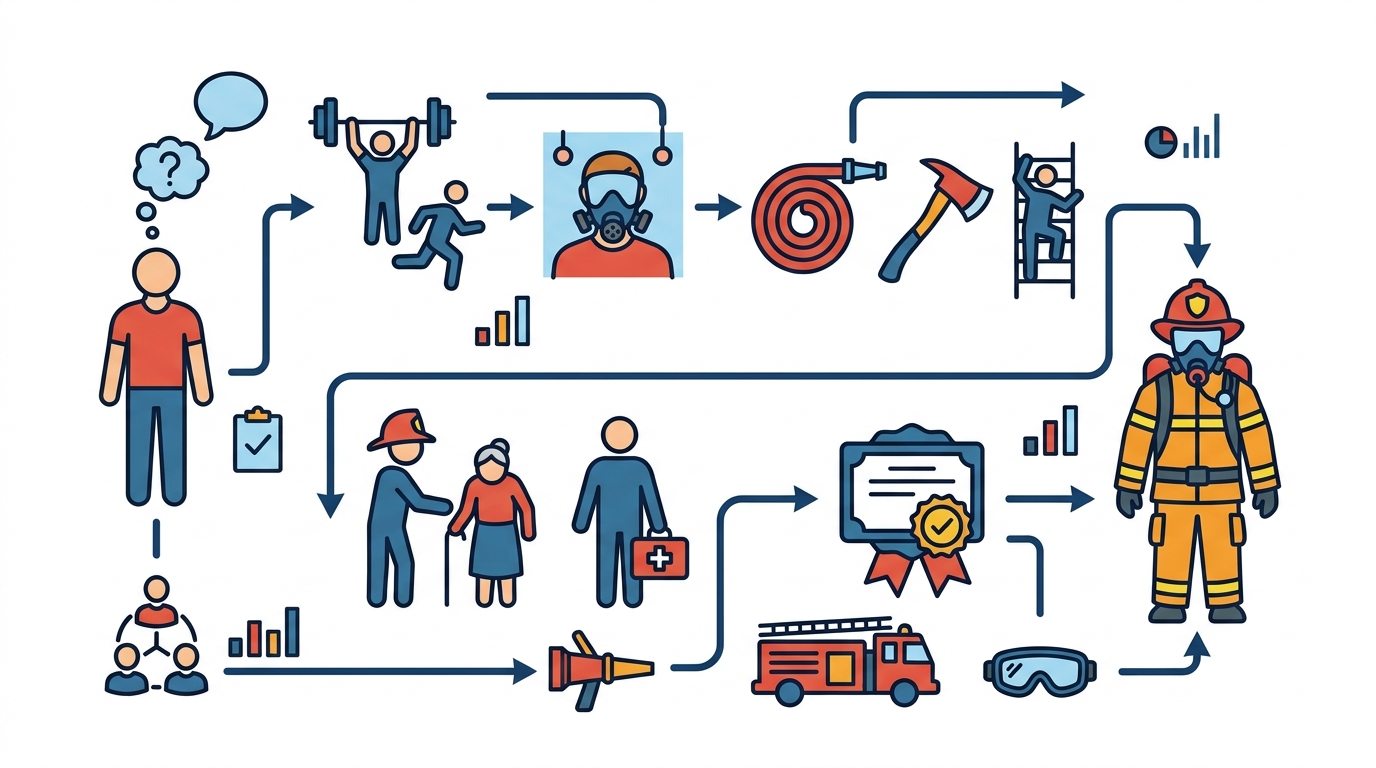
What replaces the degree is a stack of checkable things: a passed physical ability test, EMS certification where your state or locality requires it, and a fire academy certificate or registered apprenticeship. Expect roughly 4 to 12 months from first step to a hireable application, longer on the apprenticeship route.
Who Successfully Makes This Transition
Three backgrounds show up repeatedly in recruit classes, and none of them involve a bachelor's degree.
EMTs and paramedics. This is the closest match. The Bureau of Labor Statistics notes that firefighters typically need training in emergency medical services, with credential requirements such as EMT certification set by the state or locality (U.S. Bureau of Labor Statistics, 2025). Much of a fire company's call volume is medical, so a candidate holding a current EMT or paramedic certification has already cleared the one credential many departments will not waive — plus patient assessment, radio discipline and documentation habits.
Military service members and veterans, particularly from ground, engineering, aviation or shipboard damage-control roles. Departments hire into a rank structure with standing orders, inspections and a probationary period, and they look for people who have worked inside one. Entry-level firefighters complete a few months of training at academies run by the department or the state, then a probationary period (U.S. Bureau of Labor Statistics, 2025) — a structure veterans recognise immediately.
Construction and skilled trades workers — roofers, carpenters, linemen, heavy equipment operators, arborists. The job is physical work on ladders, roofs and unstable ground while carrying weight; the Candidate Physical Ability Test has candidates wear a 50-pound vest simulating breathing apparatus and protective clothing (City of Corpus Christi Fire Department, undated). Knowledge of building construction, roof framing and hydraulic equipment is directly useful on the fireground.
Seasonal wildland crew experience also transfers. Wildland apprenticeship programs last up to 4 years, combining instruction with on-the-job training under experienced firefighters (U.S. Bureau of Labor Statistics, 2025).
Traditional Path vs. Alternative Path
Both paths end at the same recruit academy and the same probation. The difference is what you pay and how long you wait before applying.
| Factor | Degree path (fire science associate or bachelor's) | Alternative path (academy certificate or apprenticeship) |
|---|---|---|
| Time to Entry | 2 years for an associate or 4 years for a bachelor's before applying, then a few months of department or state academy plus probation (U.S. Bureau of Labor Statistics, 2025) | 14–18 weeks of pre-service academy — 14 weeks at Tarrant County College, 16 weeks at San Antonio College, 18 semester weeks at Oxnard College — or a 2-year registered apprenticeship such as the City of Eugene's (Tarrant County College, undated; San Antonio College, undated; Oxnard College, undated; City of Eugene, Oregon, undated) |
| Upfront Cost | Full tuition, driven by in-state versus out-of-state residency and public versus private institution; ask the financial aid office for a written net price. The academy component alone is about $4,240 at San Antonio College, carrying 27 college credit hours (San Antonio College, undated) | $1,700–$2,400 at Tarrant County College including tuition, textbook, uniforms and bunker gear rental, plus a test fee — the CPAT costs $200 in New Hampshire (Tarrant County College, undated; New Hampshire Division of Fire Standards and Training and Emergency Medical Services, undated). A registered apprenticeship pays you while you train (City of Eugene, Oregon, undated) |
| Credential Required | High school diploma plus EMS training; licensure and certification rules vary by state or locality (U.S. Bureau of Labor Statistics, 2025) | Identical. NFPA 1001 Firefighter I & II is the certification standard taught in these academies (Texas A&M Engineering Extension Service, undated) |
| Typical Starting Pay | Departments pay from a published rank scale, not your transcript. The national median was $59,280 in May 2025, with the lowest 10 percent under $34,910 (U.S. Bureau of Labor Statistics, 2025) | The same scale, same starting step. National estimates put the 10th percentile at $31,600 and the median at $57,120 (U.S. Bureau of Labor Statistics, 2023) |
A degree can matter later for promotion to officer ranks in some departments. It is rarely the gate on entry.
Step-by-Step Alternative Path
- Confirm the rules where you want to work, in writing. Licensure and certification requirements vary by state or locality, and candidates are advised to check with their state licensing agency or local fire department (U.S. Bureau of Labor Statistics, 2025). Call two or three recruitment offices in your target area and ask which certifications must be held at application. In New Hampshire, the Division of Fire Standards and Training and Emergency Medical Services makes the CPAT the required entrance exam for all full-time firefighters in the state (New Hampshire Division of Fire Standards and Training and Emergency Medical Services, undated).
- Start EMS training. Firefighters typically need emergency medical services training, with EMT certification requirements set by state or locality (U.S. Bureau of Labor Statistics, 2025). Community college EMS departments and county EMS offices run the courses; your state EMS licensing agency publishes the approved program list.
- Train for and pass the Candidate Physical Ability Test. The CPAT is eight job-related events performed in continuous sequence, pass/fail, inside 10 minutes and 20 seconds, wearing a 50-pound vest (City of Albuquerque Fire Rescue, undated; City of San Antonio, undated; City of Corpus Christi Fire Department, undated). Book an orientation or practice session before paying for the real attempt, which costs $200 in New Hampshire (New Hampshire Division of Fire Standards and Training and Emergency Medical Services, undated).
- Enrol in an academy certifying to NFPA 1001 Firefighter I & II. The Texas A&M Engineering Extension Service runs a sixteen-week hybrid Recruit Fire Academy — twelve weeks of computer-based training then a four-week skills camp, meeting the NFPA 1001 (2019 edition) standard (Texas A&M Engineering Extension Service, undated). Community college versions cost less: Tarrant County College's Basic Fire Fighting program is 14 weeks and 528 certificate hours at an estimated $1,700–$2,400 (Tarrant County College, undated).
- Apply to registered apprenticeships in parallel. The International Association of Fire Fighters and the U.S. Department of Labor launched a federally registered Fire and EMS Apprenticeship Program intended to reduce barriers to entry (International Association of Fire Fighters, undated), and ONET OnLine lists 'Fire Fighter' among apprenticeship titles approved for Registered Apprenticeship Programs (ONET OnLine, undated). The City of Eugene, Oregon runs a two-year firefighter apprenticeship with essentially no minimum requirements, because the apprentice receives all necessary training and licensure during employment (City of Eugene, Oregon, undated). For wildfire work, apprenticeships run up to 4 years (U.S. Bureau of Labor Statistics, 2025).
- Work the hiring cycle, then probation. Use CareerOneStop's occupation and local training finders to track openings and approved programs in your state (CareerOneStop, undated). Once hired, expect a few months at a department or state academy, a probationary period, and more than a year of on-the-job training overall (U.S. Bureau of Labor Statistics, 2025; CareerOneStop, undated).
What to Have Ready Instead of a Degree
Assemble these before a posting opens — hiring windows close fast.
- A high school diploma or equivalent; 70% of ONET survey respondents said that is what a new hire needs, and 12% said a post-secondary certificate (ONET OnLine, undated).
- A current CPAT pass card showing the test date and testing site (City of San Antonio, undated).
- EMT or paramedic certification issued or recognised by your state EMS licensing agency, if your target departments require it at application (U.S. Bureau of Labor Statistics, 2025).
- An NFPA 1001 Firefighter I & II certificate from an accredited academy — for example the Texas A&M Engineering Extension Service Recruit Fire Academy, or San Antonio College's, which also yields 27 college credit hours you can bank toward a degree later (Texas A&M Engineering Extension Service, undated; San Antonio College, undated).
- Documented apprenticeship or on-the-job hours signed off by the sponsoring department; Registered Apprenticeship records are the cleanest proof (O*NET OnLine, undated).
- A valid driver's license in good standing, plus any emergency-vehicle endorsement your state requires (U.S. Bureau of Labor Statistics, 2025).
- Two or three references who can speak to your reliability under physical strain: a volunteer department training captain, an EMS field supervisor, or a trades foreman.
- A consistent application packet — employment dates with no unexplained gaps, driving record, and anything that will surface in a background investigation disclosed up front.
Frequently asked questions
Will departments treat an academy certificate as weaker than a fire science degree?
For entry-level hiring, most do not — the Bureau of Labor Statistics lists typical entry-level education as a postsecondary nondegree award with no related work experience required (U.S. Bureau of Labor Statistics, 2025). Recruiters screen on whether your certifications are current, accredited and accepted in their state. A degree tends to count later, when you compete for officer or specialist positions in departments that award promotional points for it.
Do no-degree hires earn less than degree holders in the same department?
Career departments pay from a published rank-and-step scale, so two recruits in the same class normally start on the same step regardless of schooling. Some agencies add educational incentive pay on top of base, so ask the recruitment office whether that exists before assuming it does. The national spread — the lowest 10 percent under $34,910 against the highest 10 percent over $101,040 in May 2025 — mostly reflects geography, rank and overtime (U.S. Bureau of Labor Statistics, 2025).
Is an apprenticeship realistic if I cannot pay for an academy up front?
Yes, and it is built for that situation. The City of Eugene's two-year program states the apprentice receives all necessary training and licensure during employment, with essentially no minimum requirements for the position (City of Eugene, Oregon, undated). The IAFF and U.S. Department of Labor program was launched specifically to reduce barriers to entry into fire and EMS careers (International Association of Fire Fighters, undated).
How long before I am actually working on an engine?
After hiring, entry-level firefighters spend a few months at an academy run by the department or the state, then serve probation (U.S. Bureau of Labor Statistics, 2025). CareerOneStop describes more than one year of on-the-job training as usual for the occupation (CareerOneStop, undated). You ride and work during that period, but under close supervision and with limited assignments until probation clears.
Sources
- U.S. Bureau of Labor Statistics — Firefighters : Occupational Outlook Handbook (2025)
- U.S. Bureau of Labor Statistics — Occupational Employment and Wages, May 2023 - 33-2011 Firefighters (2023-05)

Written by
Priya tracks wages, layoffs, and the slow shifts in what counts as a stable job. She writes for readers trying to make sense of numbers that rarely match their own experience.