How to Become a Firefighter
What the hiring process actually tests, which certifications your state may require, and how long it takes to go from applicant to probationary recruit.
Quick answer
- Minimum credential: a high school diploma or equivalent plus emergency medical services training, with fire academy training provided after hire — the entry-level education level is listed as a postsecondary nondegree award (U.S. Bureau of Labor Statistics, 2025).
- Realistic time from starting training to a first firefighting job: roughly 12 months to 3 years, driven mostly by when departments open hiring.
- EMT certification, paramedic certification and any CDL or firefighter licence endorsement requirements vary by state or locality (U.S. Bureau of Labor Statistics, 2025); the job also carries shift schedules, random drug testing after hire and routine physical fitness assessments (U.S. Bureau of Labor Statistics, 2025).
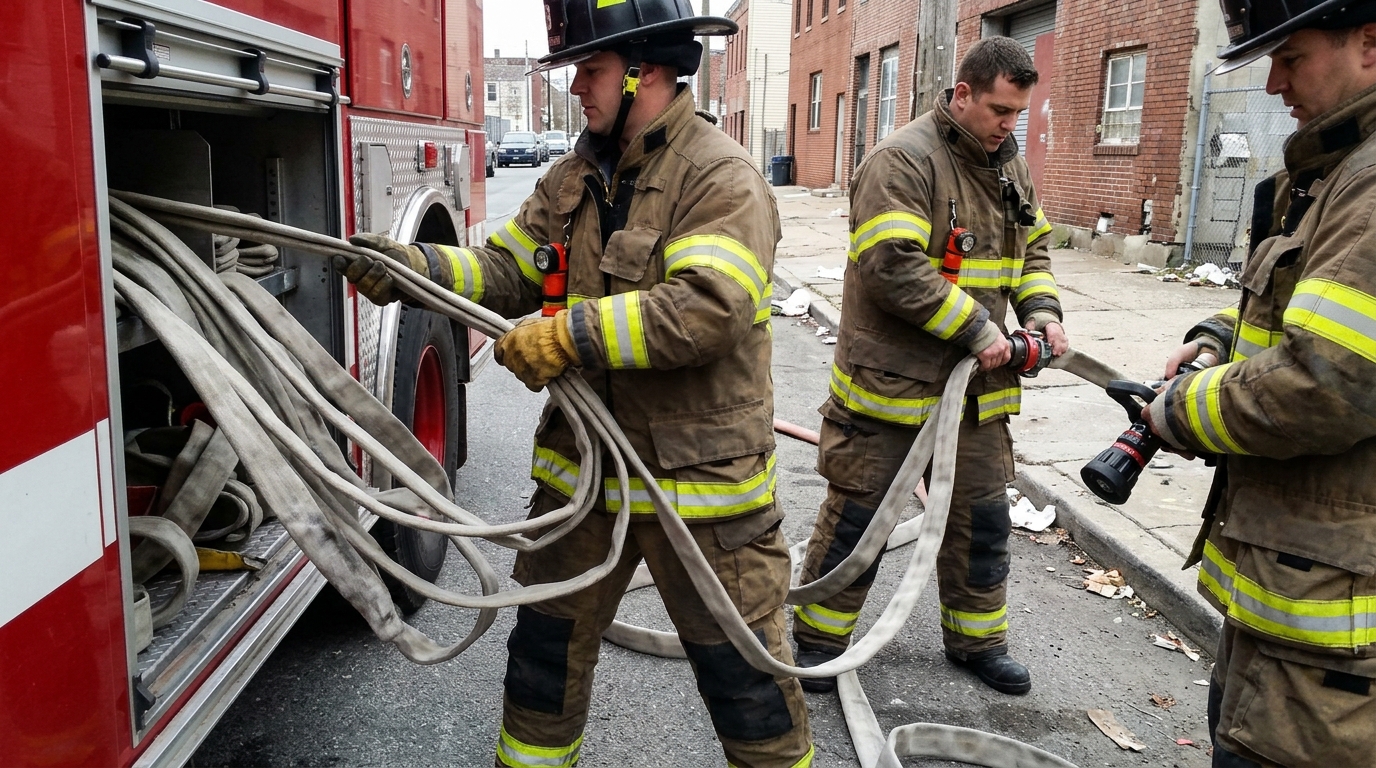
Becoming a firefighter is less about one diploma and more about clearing a sequence of gates: a high school diploma or equivalent, emergency medical training, a competitive department hiring process with written and physical testing, and then a few months at a fire academy followed by a probationary period (U.S. Bureau of Labor Statistics, 2025). Most candidates spend somewhere between one and three years from starting EMT training to being sworn in, because hiring cycles open on a department's schedule, not yours.
Requirements are set locally. EMT and paramedic certification rules, driver's licence endorsements and minimum ages vary by state or locality, so the specific list you must satisfy depends on the departments you intend to apply to (U.S. Bureau of Labor Statistics, 2025).
Step-by-Step Path to Entry
- Finish a high school diploma or equivalent and meet the baseline hiring conditions. Firefighters typically need a high school diploma and training in emergency medical services (U.S. Bureau of Labor Statistics, 2025). Applicants typically must be at least 18 years old, hold a valid driver's license, and pass a medical exam and drug screening to be hired (U.S. Bureau of Labor Statistics, 2025). Age minimums and residency rules are set by the city, county or state you apply to — read the job announcement itself.
- Earn EMT certification. Some postsecondary instruction — assessing patients' conditions, dealing with trauma, clearing obstructed airways — is usually needed to obtain EMT certification, and EMT requirements vary by city and state (U.S. Bureau of Labor Statistics, 2025). Many departments will not accept an application without it. Where paramedic certification is required or heavily preferred, that is a longer course of study on top of EMT.
- Build related experience in a named role. Working as a volunteer firefighter may be helpful in getting a job as a career firefighter (U.S. Bureau of Labor Statistics, 2025). Other routes that put you on a fireground: a seasonal wildland firefighter position, or a wildland firefighting apprenticeship program, which can last up to 4 years and combines instruction with on-the-job training (U.S. Bureau of Labor Statistics, 2025). Working as an EMT on an ambulance is another common bridge.
- Apply during an open hiring cycle and pass the testing sequence. Prospective firefighters must pass written and physical tests and complete interviews (U.S. Bureau of Labor Statistics, 2025). The physical test used by many departments is the Candidate Physical Ability Test (CPAT), published by the International Association of Fire Fighters. Expect a background investigation, a medical exam and a drug screening as conditions of hire.
- Complete fire academy training. Entry-level firefighters receive a few months of training at fire academies run by the fire department or the state, covering firefighting and fire-prevention techniques, local building codes, and emergency medical procedures (U.S. Bureau of Labor Statistics, 2025).
- Obtain any required driving credential. Depending on the state or locality, some firefighters are required to have a commercial driver's license (CDL) or a driver's license with a firefighter endorsement to operate a firetruck (U.S. Bureau of Labor Statistics, 2025).
- Clear the probationary period and keep credentials current. After the academy, firefighters usually must complete a probationary period (U.S. Bureau of Labor Statistics, 2025). Continuing education is required to maintain EMT and paramedic certifications (U.S. Bureau of Labor Statistics, 2025), and some firefighters later attend federal training sessions sponsored by the National Fire Academy covering anti-arson techniques, disaster preparedness, hazardous materials control, and public fire safety and education (U.S. Bureau of Labor Statistics, 2025).
Education and Certification Options
Costs vary widely by state, by whether a program is run by a community college or a fire district, and by whether you are already employed. Check published tuition for the specific program and the fee schedule in the job announcement rather than assuming a national figure.
| Route | Typical duration | Approximate cost | Required or preferred |
|---|---|---|---|
| High school diploma or equivalent | 4 years, or months for an equivalency route | Free in public schools; equivalency testing fees set by the state | Required — firefighters typically need a high school diploma (U.S. Bureau of Labor Statistics, 2025) |
| EMT certification course | Typically one semester or less of postsecondary instruction (U.S. Bureau of Labor Statistics, 2025) | Community college or private provider tuition plus state certification fees; check the provider's published cost | Commonly required; requirements vary by city and state (U.S. Bureau of Labor Statistics, 2025) |
| Paramedic certification | Substantially longer than EMT — typically a year or more of study and clinical hours | College-level tuition; check the program's published cost | Required by some departments, preferred by others; varies by state or locality (U.S. Bureau of Labor Statistics, 2025) |
| Fire academy run by the department or the state | A few months (U.S. Bureau of Labor Statistics, 2025) | Usually no tuition when you attend as a hired recruit; state or college academies you attend before hire charge tuition | Required — most firefighters receive training at a fire academy (U.S. Bureau of Labor Statistics, 2025) |
| Associate degree in fire science | About 2 years full time | Community college tuition rates, which differ by state and district | Preferred by some departments for hiring points; not a universal requirement |
| Wildland firefighting apprenticeship program | Up to 4 years, combining instruction with on-the-job training (U.S. Bureau of Labor Statistics, 2025) | Apprenticeships pay you while you train; check the sponsoring agency | A route into wildland work rather than a municipal requirement |
| Volunteer firefighter service | Ongoing; training schedules set locally | Training usually provided by the department | Not required, but may be helpful in getting a career job (U.S. Bureau of Labor Statistics, 2025) |
| Bachelor's degree in fire science, public administration or a related field | About 4 years full time | University tuition; varies by state and institution | Not needed to enter; many departments require it for promotion beyond battalion chief (U.S. Bureau of Labor Statistics, 2025) |
| CDL or driver's license with firefighter endorsement | Weeks of testing and training | State licensing fees plus any training cost | Required in some states and localities (U.S. Bureau of Labor Statistics, 2025) |
Are You Ready? Readiness Checklist
Work through these before you spend money on a course. Each one is something you can confirm with a document, a test result or a phone call to a department's recruitment office.
- You hold a high school diploma or equivalent, or have a dated plan to complete one.
- You are at least 18 and hold a valid driver's license, which applicants typically must have to be hired (U.S. Bureau of Labor Statistics, 2025). Confirm the minimum age for the specific departments you want, since it is set locally.
- You have read the CPAT description published by the International Association of Fire Fighters and have trained against its events, not just general gym work.
- You can pass a medical exam and a drug screening, and you accept that random drug tests and routine physical fitness assessments continue after hire (U.S. Bureau of Labor Statistics, 2025).
- You have checked the EMT certification requirements for your state and city, because they vary (U.S. Bureau of Labor Statistics, 2025), and you know whether paramedic certification is required where you plan to apply.
- Your background will stand up to a department's investigation — driving record, criminal history and employment history are reviewed as part of hiring.
- You have checked whether your state or locality requires a CDL or a firefighter licence endorsement to operate a firetruck (U.S. Bureau of Labor Statistics, 2025), and know how long that takes to obtain.
- You can live with the schedule and the exposure: shift work including nights and weekends, a probationary period after the academy (U.S. Bureau of Labor Statistics, 2025), and repeated medical calls, which make up a large share of the workload in most municipal departments.
Typical Timeline From Start to First Job
Hiring cycles, not coursework, usually control the clock. A department may test once a year or less, and lists can stay active for months before anyone is called.
- Month 0-3: Confirm the diploma or equivalency requirement is met, get a valid driver's license, and start CPAT-specific physical preparation using the event list published by the International Association of Fire Fighters.
- Month 3-9: Complete an EMT course and certify. Some postsecondary instruction is usually needed to obtain EMT certification, and requirements vary by city and state (U.S. Bureau of Labor Statistics, 2025).
- Month 6-18: Build related experience — join a volunteer department, where service may be helpful in getting a career job (U.S. Bureau of Labor Statistics, 2025), take a seasonal wildland position, or enter a wildland apprenticeship program lasting up to 4 years (U.S. Bureau of Labor Statistics, 2025). Many candidates do this while waiting for a hiring cycle to open.
- Month 9-24: Apply when announcements open. Pass the written test, the physical ability test and the interviews, then clear the background investigation, medical exam and drug screening (U.S. Bureau of Labor Statistics, 2025). Expect to apply to several departments; a failed cycle usually means waiting for the next one.
- Month 12-30: Attend the fire academy run by the department or the state — a few months covering firefighting and fire-prevention techniques, local building codes, and emergency medical procedures (U.S. Bureau of Labor Statistics, 2025).
- Month 15-36: Start work as a probationary firefighter, often titled Firefighter-EMT, and complete the probationary period that usually follows the academy (U.S. Bureau of Labor Statistics, 2025). Promotion afterwards runs through engineer, lieutenant, captain and battalion chief (U.S. Bureau of Labor Statistics, 2025).
Frequently asked questions
Can I become a firefighter without a four-year degree?
Yes. The typical entry-level education is listed as a postsecondary nondegree award, and firefighters typically need a high school diploma plus emergency medical services training (U.S. Bureau of Labor Statistics, 2025). The practical route is an EMT certification course followed by a department hiring process and fire academy. A bachelor's degree matters later: many departments require one for promotion beyond battalion chief (U.S. Bureau of Labor Statistics, 2025).
Do I need EMT certification before I apply?
It depends where you apply. EMT requirements vary by city and state, and firefighters may need EMT and paramedic certifications depending on the state or locality (U.S. Bureau of Labor Statistics, 2025). Many departments list EMT as an application prerequisite; others certify recruits after hire. Read the job announcement for each department before enrolling, and check whether paramedic certification is required.
What is the CPAT and how should I prepare?
The Candidate Physical Ability Test is a named physical ability test used in firefighter hiring, published by the International Association of Fire Fighters. Prospective firefighters must pass written and physical tests as part of hiring (U.S. Bureau of Labor Statistics, 2025). Train against the specific events rather than general fitness, and note that routine physical fitness assessments continue after you are hired.
How much do firefighters earn?
The median annual wage for firefighters was $59,280 in May 2025, equal to $28.50 per hour (U.S. Bureau of Labor Statistics, May 2025). That is a national median, so half earned more and half less, and pay differs considerably by state, locality and department size. Check current figures on the Bureau of Labor Statistics occupational pages and your own state's wage data.
What are the main downsides of the job?
Shift work covering nights, weekends and holidays; a probationary period after the academy during which you can be released (U.S. Bureau of Labor Statistics, 2025); random drug tests and routine fitness assessments throughout your career (U.S. Bureau of Labor Statistics, 2025); and repeated exposure to medical emergencies and trauma. Hiring is competitive and cycles are infrequent, so entry can take years.
Where can I check what the work actually involves?
O*NET OnLine, run by the U.S. Department of Labor, lists an occupational profile for Firefighters under SOC code 33-2011.00, which sets out tasks, tools and work activities. Pair that with the recruitment page of the specific departments you plan to apply to, since minimum age, residency, certification and driving licence rules are set locally.
Sources
- U.S. Bureau of Labor Statistics — Firefighters : Occupational Outlook Handbook (2025)
- International Association of Fire Fighters (IAFF) — Candidate Physical Ability Test (CPAT) - IAFF

Written by
Noor writes personal essays and interviews about career changes, burnout, and starting over. She's interested in the stories people tell themselves about what a job is supposed to mean.