Dental Assistant Interview Questions: What to Expect and How to Prepare
Most dental offices screen by phone, then test you chairside — here is how each stage works, plus answers that show sterilization and patient skills.
Quick answer
- Rehearse a step-by-step room turnover out loud — cassette transport, ultrasonic, autoclave logs, barriers — since infection control is one of the three component exams in the Certified Dental Assistant credential (Dental Assisting National Board, undated).
- Name the practice management software you have touched; Dentrix, SOFTDENT and Eaglesoft are among the systems dental assistants commonly use (O*NET OnLine, U.S. Department of Labor, undated).
- Check your state dental board's rules on radiography and expanded functions before you go in, and state precisely which permits you hold — some states require assistants to be licensed, registered or certified, others do not (U.S. Bureau of Labor Statistics, undated).
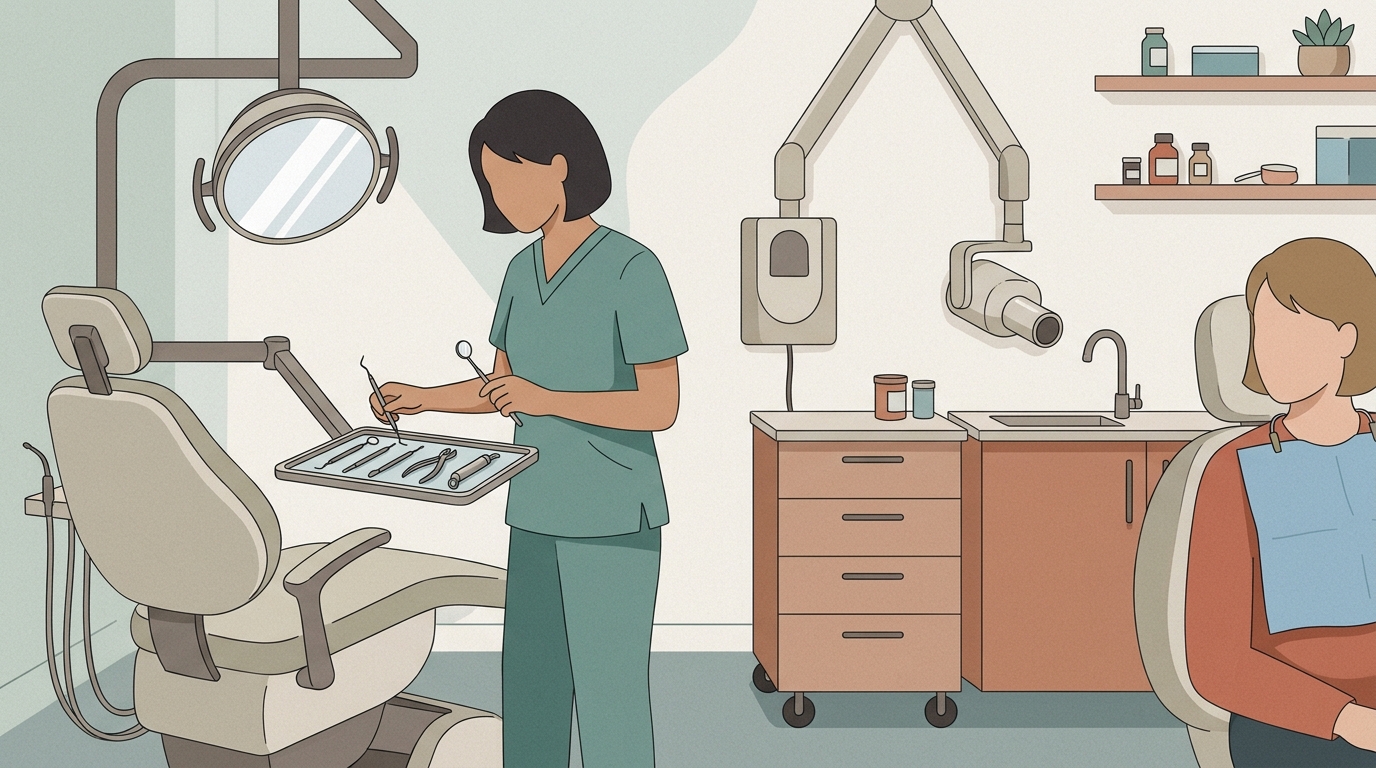
A dental assistant interview is rarely one conversation. Expect a short phone screen with the office manager, an in-person round with the dentist, and in many practices a working interview where you set up trays and pass instruments while someone watches your hands.
The questions cluster around three things: infection control, how you handle frightened patients, and whether you can keep a packed schedule moving. Employment of dental assistants is projected to grow much faster than average for all occupations (U.S. Bureau of Labor Statistics, undated), so offices are hiring — but they still hire the person who can describe a room turnover step by step.
What This Interview Usually Covers
Hiring usually runs in two or three stages. A dental office interview toolkit from the California Dental Association recommends a phone interview stage before the in-person stage (California Dental Association, undated). The phone screen is normally the office manager, ten to twenty minutes, confirming your availability, your credentials, and which software you have used.
The in-person round is often a small panel — the dentist with the office manager, sometimes the lead assistant — held in a consultation room or an empty operatory. Questions tend to fall into general questions, background and experience questions, and in-depth role questions such as describing how you sterilize and disinfect equipment and prepare the exam room (Indeed, undated).
Many practices add a working interview: half a day in scrubs, setting up trays, suctioning, turning rooms over. Ask the office manager in advance whether you will be near patients and whether the day is paid.
The technical depth varies by state. Some states require graduation from an accredited program and a passing exam score, while others have no formal educational requirement and assistants learn through on-the-job training (U.S. Bureau of Labor Statistics, undated). Across the states tracked, most allow entry through on-the-job training alone (GetLicenseMap, undated).
Common Questions and Sample Answers
Walk me through how you sterilize instruments and turn over an operatory.
Sample answer
At my last practice we ran four operatories and two doctors, often 32 patients a day, and rooms had to turn in under eight minutes. My job was to clear, sterilize and reset without holding the doctor. I transported used instruments in a closed cassette to the sterilization area, ran the ultrasonic, pouched and autoclaved them, logged every cycle, and ran the weekly spore test. Then I replaced barriers on the chair, light handles and tubing, and laid the tray in order of use. We passed our state inspection that year with no instrument-handling findings.
Describe what you believe an average day as a dental assistant looks like.
Sample answer
On a typical Tuesday I arrived 25 minutes before the first patient to run the autoclave cycle and check that all six operatories were stocked. My task was to keep two hygiene columns and one doctor column running. I seated and prepared patients, took bitewings, set trays, assisted chairside with suction and retraction, and recorded treatment notes before the patient left the chair. Between columns I restocked and sterilized. We finished on time on 14 of 15 days that month, and the doctor never waited on a tray.
A patient panics in the chair and says they want to skip the appointment. What do you do?
Sample answer
A patient booked for a crown prep sat down, saw the anesthetic syringe on the tray and said she was leaving. My job was to keep her safe and keep the appointment if she wanted it. I covered the tray, raised the chair upright, and asked what part worried her most — it was the injection. I explained the topical gel step, agreed a raised-hand stop signal, and told the doctor to go slowly. She finished the prep and came back for the seat appointment three weeks later.
Tell me about a time you explained a procedure to a nervous patient.
Sample answer
A father brought in a nine-year-old for a sealant appointment, and the child had never had anything done beyond a cleaning. I was asked to settle him while the doctor finished next door. I showed him the curing light and the suction, let him hold the tip against his hand, and called the etch "blue paint that rinses off." I used the same words the doctor would use so nothing surprised him. He sat for four sealants in one visit, and the father asked for me by name at the recall.
What practice management software have you used, and how do you keep records accurate?
Sample answer
My last office moved from paper routing slips to Dentrix during my second year, and I was one of two assistants trained first. My task was charting treatment notes and perio entries before the patient stood up. I built a short template for each common procedure, confirmed tooth numbers aloud with the doctor, and checked the day sheet at close for blank notes. Over a 90-day audit we went from 11 incomplete notes a month to none, which cut the billing queries the office manager had to chase.
Tell me about a time you helped manage a medical emergency in the office.
Sample answer
An older patient went pale and lightheaded in the chair after a long extraction appointment. I was the assistant closest to him. I laid the chair back, raised his legs, called the doctor in, and brought the emergency kit and oxygen while the front desk cleared the hallway. I noted the time and his symptoms as the doctor assessed him. He recovered in about six minutes without transport, and afterwards I rewrote the kit checklist so expiry dates were checked monthly rather than yearly.
How do you stay organized when the schedule falls apart?
Sample answer
One Friday we had an emergency walk-in with a fractured molar dropped into a full hygiene day. The office manager asked me to fit him in without pushing the afternoon back. I set a second tray during the morning lull, pulled his radiographs and medical history before he arrived, and seated him in the open operatory while the doctor finished the previous patient. The doctor treated him in 20 minutes and we left at our normal time, down only one scheduled unit.
Mistakes That Cost Candidates the Job
- Answering the sterilization question with "I clean the instruments properly" instead of naming the sequence — cassette transport, ultrasonic, pouching, autoclave, cycle log, spore test.
- Saying you can take x-rays when your state requires a separate radiography permit or credential you do not hold. Some states require assistants to be licensed, registered or certified (U.S. Bureau of Labor Statistics, undated), and the office will check.
- Blaming the previous dentist or office manager when asked why you left, rather than naming what you wanted next.
- Showing up to a working interview with long nails, loose hair, jewellery or strong fragrance — the dentist is watching whether you could step into an operatory that day.
- Standing back during the chairside tryout waiting to be told what to hand over, instead of watching the procedure and anticipating the next instrument.
- Telling a role-play patient "it won't hurt" rather than describing what they will feel and offering a stop signal.
- Raising pay in the first two minutes of the phone screen, before the office manager has described the role or the hours.
- Having no questions at the end. Ask about operatory count, doctor-to-assistant ratio, software, and who handles sterilization monitoring.
Frequently asked questions
What should I wear to a dental assistant interview?
Wear clean business casual — closed shoes, nails short, hair back, no fragrance — for the phone-screen follow-up and the in-person round. If the office has told you there is a working interview or chairside tryout, bring scrubs in a bag and change on site rather than arriving in them.
What should I bring with me?
Bring two printed copies of your resume, your CPR or BLS card, your state radiography permit if you hold one, your immunization record, and any DANB certificate. Candidates for Certified Dental Assistant status must hold a current hands-on CPR, BLS or ACLS certification from an accepted provider (Department of Defense COOL, undated), so offices expect to see the card.
When should I bring up pay, and how do I name a number?
Wait until the in-person round or until they ask. Then give a range, not a single figure. Build it from the state and metro wage data on the U.S. Bureau of Labor Statistics Occupational Outlook Handbook page for dental assistants, cross-checked against three current local job postings for the same duties and hours.
How do I follow up after the interview?
Email every person you met within 24 hours, each with one specific line from your conversation — their new intraoral scanner, the second hygiene column they are adding. If you have heard nothing after the date they gave you, call the office manager once in the morning before patients arrive.
Can I get hired with no clinical experience?
In many states, yes. Most states tracked allow entry into dental assisting through on-the-job training alone (GetLicenseMap, undated). Check your state dental board's page for radiography and expanded-function rules, then lead with transferable proof: sterilization or stocking duties, scheduling, and any CPR or BLS card you hold.
Should I mention that I am working toward DANB certification?
Yes, and be specific. Say which of the three component exams — General Chairside Assisting, Radiation Health and Safety, Infection Control — you have passed or booked (Dental Assisting National Board, undated). Eligibility can come from a CODA-accredited program or 3,500 verified work hours under a dentist's supervision (Army COOL, undated).
Sources
- U.S. Bureau of Labor Statistics — Dental Assistants : Occupational Outlook Handbook
- O*NET OnLine (U.S. Dept. of Labor) — 31-9091.00 - Dental Assistants

Written by
Noor writes personal essays and interviews about career changes, burnout, and starting over. She's interested in the stories people tell themselves about what a job is supposed to mean.