CNA Salary: What to Expect by Experience and Location
Where the published nursing assistant wage numbers come from, how to read percentiles, and which state and industry figures to check before you accept a shift.
Quick answer
- The national median annual wage for nursing assistants is published by the U.S. Bureau of Labor Statistics in its May 2025 wage release, with a separate 2025 Median Pay figure for the combined "nursing assistants and orderlies" group in the Occupational Outlook Handbook.
- Read entry-level to experienced pay as the distance between the 10th- and 90th-percentile annual wages for your state (O*NET OnLine, 2025; CareerOneStop, U.S. Department of Labor, 2024).
- Base wage is not take-home: overtime, night and weekend differentials and pick-up shifts sit outside the straight-time figures BLS reports.
Certified nursing assistant pay is measured and published every year, so you do not have to guess. The U.S. Bureau of Labor Statistics reports a median annual wage for nursing assistants in its May 2025 wage release, a separate median for orderlies, and a combined "nursing assistants and orderlies" median in its 2025 Occupational Outlook Handbook. O*NET OnLine and CareerOneStop republish the same underlying data by state, with 10th- and 90th-percentile figures alongside the median.
This guide explains which of those numbers matches your situation and what moves a CNA's actual paycheck away from the national median.
What This Job Pays
Start with the median annual wage for nursing assistants published by the U.S. Bureau of Labor Statistics in its May 2025 Occupational Employment and Wage Statistics (OEWS) release. A median means half of nursing assistants earned more and half earned less. It is not an average, and it is not a starting rate.
Four closely related federal figures exist, and they are not interchangeable:
- The median annual wage for nursing assistants alone (U.S. Bureau of Labor Statistics, May 2025). This is the one most CNAs want.
- The 2025 Median Pay for the combined "nursing assistants and orderlies" group (U.S. Bureau of Labor Statistics, 2025), shown in the Occupational Outlook Handbook.
- The median annual wage for orderlies on their own (U.S. Bureau of Labor Statistics, May 2025).
- The median for the broad category "home health and personal care aides; and nursing assistants, orderlies, and psychiatric aides" (U.S. Bureau of Labor Statistics, May 2025), which mixes in home care work and pulls the number away from what a facility CNA sees.
For the spread rather than the middle, use the 10th- and 90th-percentile annual wages, published in OEWS and shown alongside median hourly and annual wages by ONET OnLine (National Center for ONET Development, 2025). BLS also reported an average hourly wage for nursing assistants alongside employment of nearly 1.4 million in May 2024 (U.S. Bureau of Labor Statistics, 2025), naming it the third-largest healthcare occupation. A mean usually sits above a median, so do not treat them as the same.
OEWS reports straight-time wages, not total earnings. Assume regularly worked overtime, holiday premiums and pick-up-shift bonuses are not fully captured, so gross W-2 earnings can sit above the published median even when your base rate matches it. Compare offers base-rate to base-rate first, then add differentials.
Industry matters too. BLS reports a separate median annual wage for nursing assistants in nursing care facilities (skilled nursing facilities) for May 2025, and its May 2023 release gave median hourly, mean hourly and annual mean wages for that industry next to the national all-industry figures. Comparing industry to all-industry within one release is the cleanest way to price a setting.
Salary by Experience and Location
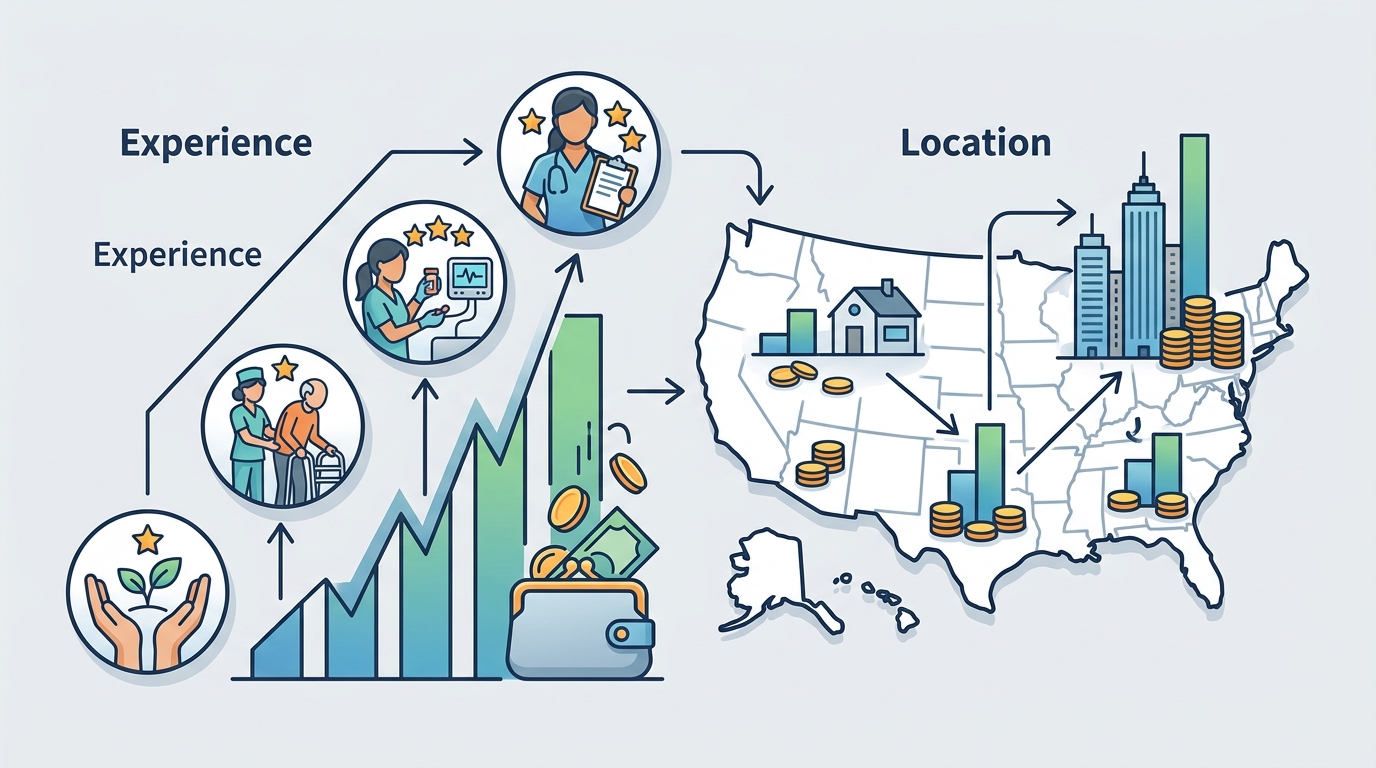
No federal source publishes CNA pay by years of experience. It publishes percentiles instead, so map experience onto those bands for your own state.
| Row | Published figure to look up | Source and year |
|---|---|---|
| Entry-level (0-1 years) | 10th-percentile annual wage, national or state | BLS OEWS, May 2025; O*NET OnLine, 2025 |
| Mid-career (steady unit, preceptor duties) | Median annual wage for nursing assistants | BLS, May 2025 |
| Experienced (long tenure, specialty unit, nights) | 75th- and 90th-percentile annual wages | BLS OEWS, May 2025 |
| Skilled nursing facility benchmark | Median annual wage in nursing care facilities | BLS, May 2025 |
| California | State median, 10th and 90th percentile annual wages | O*NET OnLine, 2025 |
| Florida | State median, 10th and 90th percentile annual wages | O*NET OnLine, 2025 |
| Ohio | State median, 10th and 90th percentile annual wages | O*NET OnLine, 2025 |
| New Hampshire | Low, median and high hourly and yearly wages | CareerOneStop (U.S. Dept. of Labor), 2024 |
| Tennessee | Low, median and high yearly wages | CareerOneStop (U.S. Dept. of Labor), 2024 |
| Minnesota | Low, median and high yearly wages | CareerOneStop (U.S. Dept. of Labor), 2024 |
Two habits make this quick. Pull the state and national figures from the same release and year, because mixing a 2024 state number with a 2025 national one distorts the gap. Then look at the distance between your state's 10th and 90th percentiles, not just the median: a wide spread rewards moving into hospitals, nights or specialty work, while a narrow one means your raise is more likely to come from changing state or stepping up to LPN.
OEWS also publishes wages by metropolitan and nonmetropolitan area. If you live near a large metro, check that area's nursing assistant figures — state medians blend rural and urban markets and can understate a city rate.
What Affects Pay in This Field
Each of these moves the number, and each has a published comparison you can run yourself rather than taking someone's word for it.
- Industry and setting. Subtract the median annual wage for nursing assistants in nursing care facilities (skilled nursing facilities) from the all-industry median in the same U.S. Bureau of Labor Statistics May 2025 release. That dollar difference is the setting effect. The May 2023 release supports the same comparison using median hourly, mean hourly and annual mean wages.
- State. Put the state medians for California, Florida and Ohio (O*NET OnLine, 2025) side by side, then add New Hampshire, Tennessee and Minnesota (CareerOneStop, U.S. Department of Labor, 2024). The spread across those six is the clearest dollar answer to "should I move?"
- Where you sit in the distribution. The gap between your state's 10th- and 90th-percentile annual wages (O*NET OnLine, 2025) is the full range the job offers there. If it is narrow, tenure at one employer closes little ground.
- Shift, weekends and overtime. Differentials are set by each employer, usually as a flat amount per hour or a percentage of base, and are paid on top of the rate wage surveys report. Ask for the differential schedule in writing and apply it to the hours you would actually work.
- Agency and per-diem work. These usually pay a higher hourly rate in exchange for no guaranteed hours and often no employer health coverage or paid time off. Price what you give up before comparing to a staff rate.
- Union contracts. Where CNAs are covered by a collective bargaining agreement, the wage scale and step increases are written into the contract. Ask which step you would start on.
- Credentials. State certification is the baseline. Medication aide, restorative aide, dementia care and acute-care training may carry a differential, but availability and whether they raise pay vary by state and employer — confirm before paying for a course.
- Demand. BLS published a 2025-2035 job outlook for nursing assistants and orderlies (2025) and reported nearly 1.4 million nursing assistants employed in May 2024 (2025). Demand supports hiring; it does not automatically lift a facility's wage scale.
How This Job's Pay Compares
Three or four titles get confused with CNA work, and each has its own published median. Pull them in one sitting:
- Licensed practical and licensed vocational nurses (LPN/LVN). BLS published a median annual wage for LPNs and LVNs in May 2025, plus lowest-10-percent and highest-10-percent earnings in the same release. Comparing that median with the nursing assistant median (U.S. Bureau of Labor Statistics, May 2025) gives you the dollar value of the most common step up, which requires a state-approved practical nursing program and the NCLEX-PN.
- Medical assistants. A side-by-side comparison of median annual pay for medical assistants (SOC 31-9092) and nursing assistants (SOC 31-1131) was published by the Allen School (2025). Medical assistants work mostly in clinics and physician offices, with administrative duties alongside clinical ones.
- Orderlies. BLS reports a median annual wage for orderlies separately (May 2025), even though the Occupational Outlook Handbook shows a combined 2025 Median Pay figure. For a transport or patient-handling role, use the orderly figure, not the combined one.
- Home health and personal care aides. These sit inside the broad BLS category "home health and personal care aides; and nursing assistants, orderlies, and psychiatric aides," with its own median annual wage (May 2025). That blended number is not a CNA wage.
When you compare, hold source and year constant, confirm each figure is a median rather than a mean, and check hourly versus annual before doing any arithmetic.
Frequently asked questions
What is the national median wage for a CNA right now?
The current figure is the median annual wage for nursing assistants in the U.S. Bureau of Labor Statistics Occupational Employment and Wage Statistics release for May 2025. BLS also publishes a 2025 Median Pay figure for the combined "nursing assistants and orderlies" group in the Occupational Outlook Handbook, and O*NET OnLine (2025) shows median hourly and annual wages. Check the BLS release directly so you are quoting the latest year.
How much more do experienced CNAs earn than new ones?
Federal data does not report pay by years of experience, so use percentiles as a proxy: compare the 10th- and 90th-percentile annual wages for your state (O*NET OnLine, 2025, which publishes these for California, Florida and Ohio among others) or the low and high yearly wages on CareerOneStop (U.S. Department of Labor, 2024, which publishes them for New Hampshire, Tennessee and Minnesota). That gap is the realistic range between a first job and a long-tenured one in the same state.
Does the published median include overtime and shift differentials?
Treat it as base wage. BLS Occupational Employment and Wage Statistics reports straight-time wages rather than total W-2 earnings, so overtime, night and weekend differentials, holiday premiums and pick-up-shift bonuses should be added separately. Ask any employer for its differential schedule in writing.
Do CNAs earn more in hospitals than in nursing homes?
Setting changes pay, and you can measure it: compare the median annual wage for nursing assistants in nursing care facilities (skilled nursing facilities) with the all-industry median in the same U.S. Bureau of Labor Statistics May 2025 release. The May 2023 release supports the same check using median hourly, mean hourly and annual mean wages. The factors behind any gap are industry, state, union coverage, shift pattern and whether the role is staff, per-diem or agency.
Is becoming an LPN worth it financially?
Compare two published numbers: the median annual wage for licensed practical and licensed vocational nurses (U.S. Bureau of Labor Statistics, May 2025), including its lowest-10-percent and highest-10-percent earnings, against the median annual wage for nursing assistants from the same May 2025 release. Then weigh the gap against program cost, months of reduced earnings while studying, and your state's licensing requirements.
Will demand push CNA wages up?
The U.S. Bureau of Labor Statistics published a 2025-2035 job outlook for nursing assistants and orderlies (2025) and reported nearly 1.4 million nursing assistants employed in May 2024 (2025), the third-largest healthcare occupation. Demand improves your chances of finding openings and negotiating shift or sign-on terms, but wage scales are set by individual employers, state funding for long-term care and union contracts, so check your state's current figures.
Sources
- U.S. Bureau of Labor Statistics — Nursing Assistants and Orderlies : Occupational Outlook Handbook (2025-05)
- U.S. Bureau of Labor Statistics — Licensed Practical and Licensed Vocational Nurses : Occupational Outlook Handbook (2025-05)

Written by
Noor writes personal essays and interviews about career changes, burnout, and starting over. She's interested in the stories people tell themselves about what a job is supposed to mean.