
CNA Resume Tips (With Examples)
How to show certification status, patient-care tasks and shift reliability on one page that survives both a keyword filter and a quick human scan.
Quick answer
- Put your certification and state registry status in the top third of page one — registry listing is required to work in a nursing home (U.S. Bureau of Labor Statistics, 2025).
- Write every bullet as Action Verb + Task + Number: residents per shift, beds on the unit, call-light response time, escalations reported.
- Keep it to one page (CareerOneStop, U.S. Department of Labor) and mirror the posting's exact wording for ADLs, vitals, intake and output, and transfers.
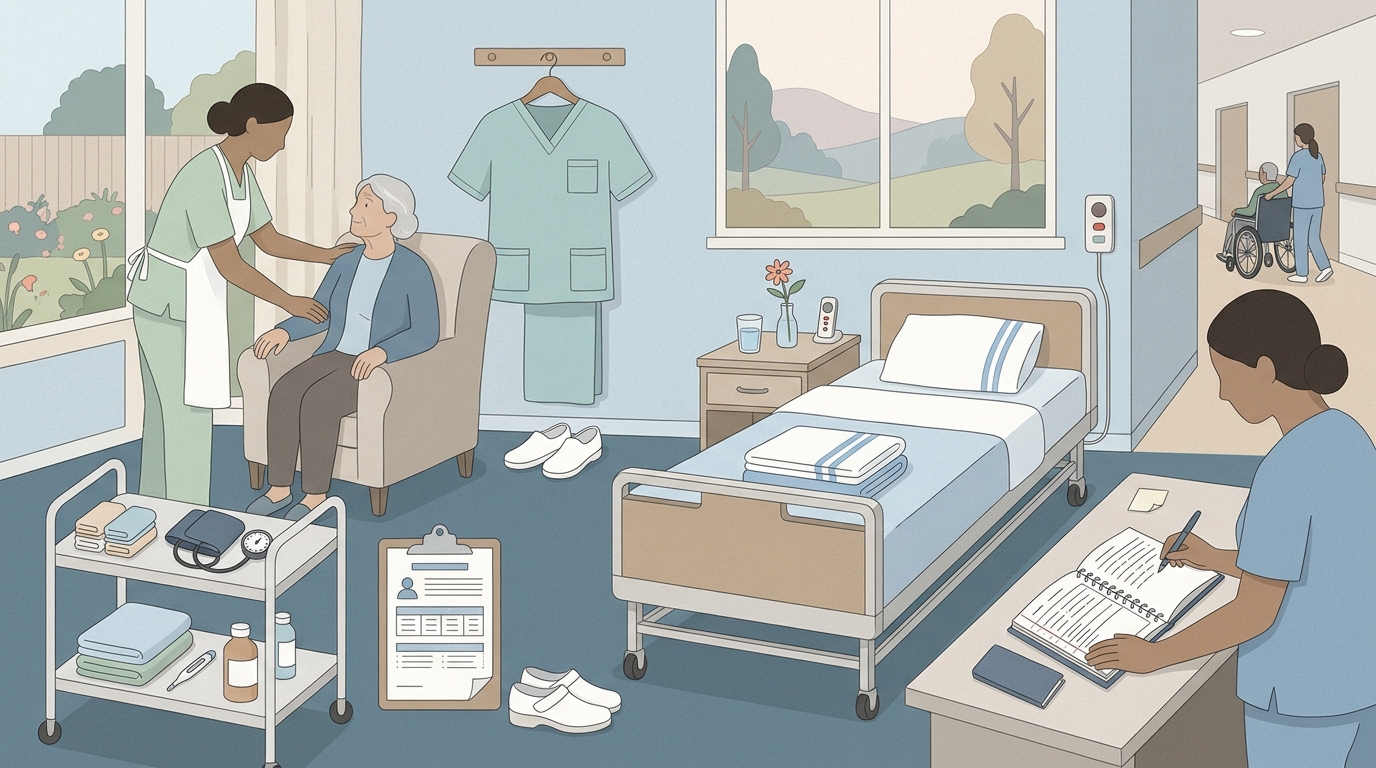
A strong CNA resume does three things fast: it proves your certification is current and that you are listed on your state registry, it names the patient-care tasks you can carry out on a shift, and it puts numbers on your patient load. Nursing assistants often need a state-issued license or certification and must pass a competency exam after an approved program, and those who pass are placed on a state registry — required to work in a nursing home (U.S. Bureau of Labor Statistics, 2025).
This guide covers what a nurse manager scans for first, how to build each section, sample bullets and cover letter lines, and a checklist to run before you submit.
What Hiring Managers Look For
The person screening CNA applications is usually a nurse manager, a staffing coordinator or an HR generalist filling several shifts at once. Two habits shape what reaches them.
First, the keyword filter. Recruiters use keyword filters in their applicant tracking system to sort and prioritize applicants (Jobscan's State of the Job Search 2025 report). For CNA roles that means the literal phrases from the posting: certified nursing assistant, CNA, state registry, activities of daily living, vital signs, intake and output, bed mobility, gait belt, mechanical lift, EHR charting, BLS/CPR. Write them as the posting writes them, including the spelled-out term and the acronym once each.
Second, the fast scan. An eye-tracking study by The Ladders in 2012 found recruiters spent six seconds scanning a resume (reported by ERE.net), and that almost 80 percent of review time went to the candidate name, current title and employer, previous title and employer, and start and end dates (reported by Dice). So your job title line should read "Certified Nursing Assistant" rather than "caregiver" or "floor staff," and every date needs a month and a year.
After that they look for setting (skilled nursing, hospital, memory care, home health), residents per shift, shift availability including nights and weekends, and whether your bullets show reporting observations to the nurse — a core task of the role (O*NET OnLine, U.S. Department of Labor, 2026) — rather than only completing tasks.
How to Build It Section by Section
1. Header. Name, city and state, one phone number, one professional email, and your credential after your name. - Before: `Jay R. — looking for healthcare work — jaybabygurl@...` - After: `Jay Rivera, CNA | Tulsa, OK | (555) 555-0134 | jay.rivera@email.com` 2. Summary, not an objective. Three lines naming credential, setting and patient load. - Before: `Seeking a position where I can use my skills and grow.` - After: `Certified Nursing Assistant, three years in a 60-bed skilled nursing facility. Cover 12 residents per shift with ADL support, vitals and intake/output charting. Available for nights, weekends and holiday rotation.` 3. Certifications and licensure. Place this above experience if you are newly certified. Name your state registry and your exam: most states require the National Nurse Aide Assessment Program (NNAAP) examination, administered by the National Council of State Boards of Nursing (National University), a certification developed to measure nurse aide competency (ICEV Online). List BLS/CPR with its expiry month and year. 4. Experience, reverse chronological. One line of context per employer, then three to five bullets. Give the unit size. - Before: `Helped patients with daily needs.` - After: `Assisted 14 residents per shift with bathing, dressing, toileting and ambulation on a 42-bed long-term care unit.` 5. Make at least two bullets about reporting. Documenting and reporting observations of patient behavior, complaints or physical symptoms to nurses is a core task (ONET OnLine, U.S. Department of Labor, 2026). - Before: `Took vital signs.` - After: `Recorded vitals and intake/output for 12 residents each shift and escalated abnormal readings to the charge nurse the same shift.` 6. Skills: concrete, grouped clinically. ONET names active listening, monitoring, critical thinking, reading comprehension and speaking as essential skills for nursing assistants (O*NET OnLine, 2026) — prove them in bullets rather than listing adjectives. - Before: `Compassionate, friendly, hard working.` - After: `Transfers and mobility: gait belt, two-person transfer, mechanical lift, repositioning q2h | Documentation: EHR charting, I&O logs, incident reports` 7. No paid CNA experience yet? Use your clinical rotation as an experience entry with dates and supervised hours. Most nursing assistants enter with at least a high school diploma or equivalent plus a short period of on-the-job training (U.S. Bureau of Labor Statistics, 2025), so a documented clinical is real evidence. - After: `Clinical training — 100 supervised hours across memory care and rehab; ADL support, vitals and bed mobility.` 8. Formatting. One page (CareerOneStop, U.S. Department of Labor), one standard font, single column, no text boxes or images, plain headings such as "Experience" and "Certifications" — CareerOneStop's resume strategies include accounting for applicant tracking systems. Be truthful about gap dates and prepare to discuss them in the interview (CareerOneStop).
Sample Bullets and Cover Letter Lines
Swap in your own numbers. Keep the structure: Action Verb + Task + Quantified Result.
Daily living assistance
ADL support
Provided physical support for bathing, dressing, toileting and ambulation for 14 residents per 8-hour shift on a 60-bed unit, with zero falls recorded across 11 consecutive months.
Repositioning
Skin integrity
Repositioned nine bedbound residents every two hours per care plan, contributing to a unit with no new stage-2 pressure injuries during a six-month quality review.
Intake and output
I&O charting
Measured and recorded food, liquid and urinary output for 12 residents each shift in the facility EHR, flagging four dehydration-risk cases to the RN within the same shift.
Call lights
Response time
Answered an average of 40 patient call signals per shift with a unit-tracked response time under four minutes while covering two halls on weekend rotations.
Feeding assistance
Mealtime support
Assisted eight residents with eating and drinking at every meal, including three on modified textures, and documented percentage consumed for every tracked meal.
Reporting to nursing staff
Observation reporting
Documented behavior changes and physical symptoms for a 16-resident assignment and reported six status changes to the charge nurse in one quarter, two of which led to same-day provider assessment.
Cover letter opening
Opening line
I am a Certified Nursing Assistant listed on the Ohio Nurse Aide Registry, currently covering 14 residents per shift in a 60-bed skilled nursing facility, and I am applying for your night-shift CNA opening on the rehab unit.
Cover letter close
Closing line
My certification is current through June 2027 and I am available for nights, weekends and holiday rotation starting within two weeks. I can be reached at (555) 555-0134 any afternoon before 3 p.m.
Before You Submit
Open the file and confirm each item on screen.
- The document is one page (CareerOneStop, U.S. Department of Labor). Check the page count in the footer.
- The file name follows `FirstName-LastName-CNA-Resume.pdf`, with no spaces or version numbers.
- Your phone number and email sit in the top two lines of page one, not inside a header or footer box an ATS may skip.
- The words "Certified Nursing Assistant" and "CNA" each appear at least once.
- Your state registry listing or certification number and its expiration month and year appear on the first screen of text.
- Your BLS or CPR expiry date is listed and has not passed.
- Every job entry shows a month and year for start and end — recruiters spend almost 80 percent of review time on names, titles, employers and dates (The Ladders eye-tracking study, reported by Dice).
- Body text uses one standard font at a single size, with no tables, columns, text boxes or images.
- Every experience bullet starts with a past-tense action verb, and at least six bullets contain a number you can verify from your own records.
- Exact phrases from the job posting appear in your resume — for example "activities of daily living," "vital signs," "intake and output" — because recruiters use ATS keyword filters to sort applicants (Jobscan, 2025).
- Another good speller has read the whole document and found no errors (CareerOneStop advises resumes be truthful, brief and error-free).
- All employment dates, including gap dates, match your records, and you can explain any gap out loud in two sentences (CareerOneStop).
Frequently asked questions
How long should a CNA resume be?
One page. CareerOneStop (U.S. Department of Labor) advises limiting your resume to one page. Even with a decade on the floor, detail your last three employers and compress older roles to a single line each: title, employer, dates.
PDF or Word?
Send a PDF unless the application form asks for .docx. PDF holds your layout. Avoid scanned images or files exported from design tools, which keyword filters in applicant tracking systems cannot read (Jobscan, 2025).
Where do I put my certification if I just passed the exam?
Directly under your summary, above work experience. Name the state registry you are listed on and your number — registry listing is required to work in a nursing home (U.S. Bureau of Labor Statistics, 2025). Name the NNAAP exam if your state uses it (National University).
When should I follow up after applying?
One week after submitting. Call the facility's staffing coordinator or HR line once, state the exact job title and posting date, confirm your application arrived, and ask when interviews are scheduled. Leave one voicemail if nobody answers, then wait.
How do I handle a gap in my work history?
List it truthfully with accurate dates and keep the focus on your skills and experience (CareerOneStop). Prepare two sentences for the interview: what the gap was for, and what you did to stay current, such as a refresher course or a renewed CPR card.
Sources
- U.S. Bureau of Labor Statistics — Nursing Assistants and Orderlies : Occupational Outlook Handbook (2025)
- O*NET OnLine (U.S. Department of Labor) — 31-1131.00 - Nursing Assistants (2026)

Written by
Marisol steers Jobladderhq's coverage of hiring trends and the strange rituals of modern recruiting. She's drawn to the gap between what job ads promise and what the work actually feels like. Her editing hand favors clarity over jargon, always.