
Claims Adjuster vs. Underwriter: A Second-Career Comparison
Two insurance roles, two very different entry routes: one sends you out to inspect storm damage, the other keeps you at a desk reading applications.
Quick answer
- Underwriting wins on pay: a median of $81,370 a year against $78,020 for claims adjusters, appraisers, examiners and investigators (U.S. Bureau of Labor Statistics, May 2025).
- Claims adjusting wins on entry speed and volume: a high school diploma is typically enough to start, and about 21,600 openings a year are projected for 2025-35 against roughly 6,800 for underwriters (U.S. Bureau of Labor Statistics, 2025).
- Underwriting wins on physical and schedule demands: office work during regular business hours, while adjusters often work outside the office inspecting damaged cars and buildings (U.S. Bureau of Labor Statistics, 2025).
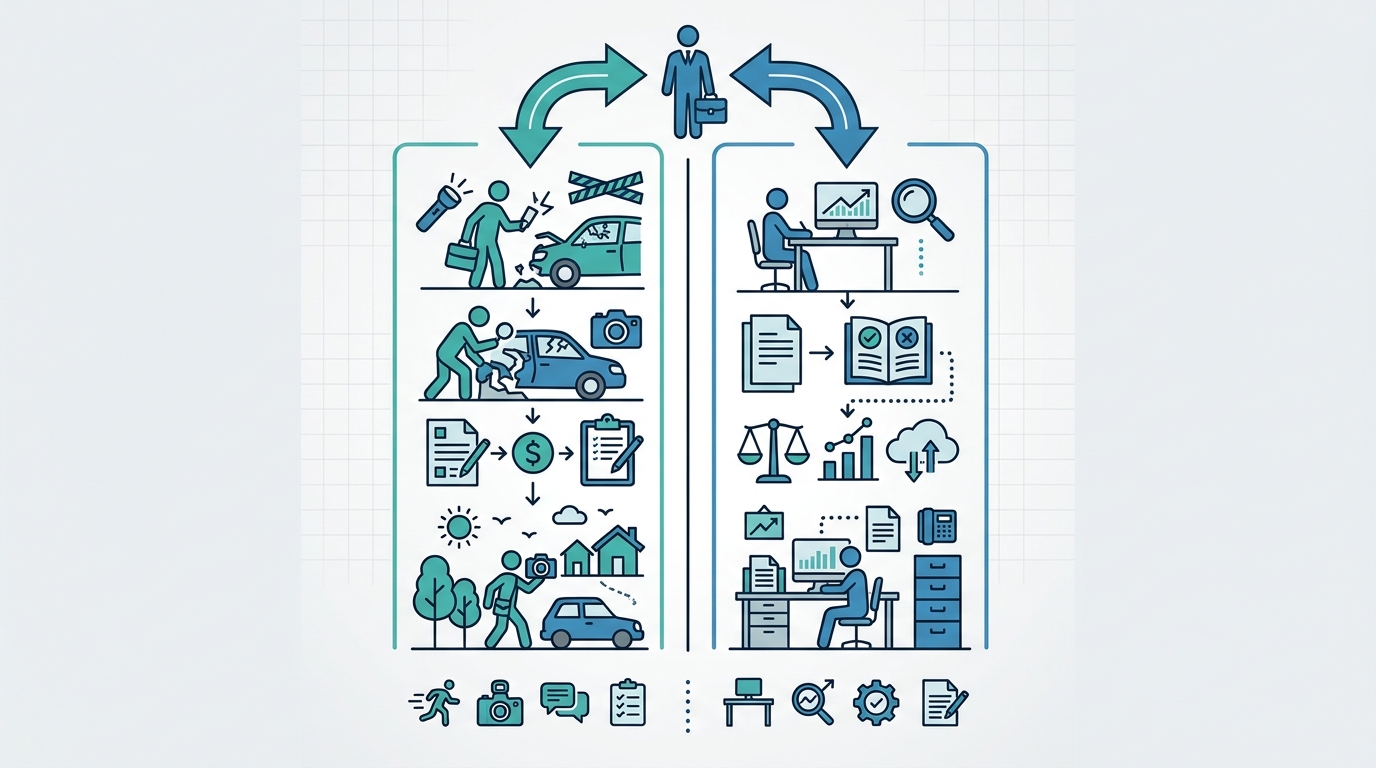
Claims adjusting and underwriting sit on opposite sides of the same insurance policy, and they suit different career changers. Adjusting is usually the faster door to walk through — a high school diploma or equivalent is typically enough for entry-level work, though some roles want a bachelor's degree or insurance-related experience (U.S. Bureau of Labor Statistics, 2025). Underwriting typically asks for a bachelor's degree and pays a higher median wage.
Both fields are projected to decline slightly through 2035, so you enter through replacement openings rather than growth. Plan on roughly three to nine months to move into adjusting, and six months to two years into underwriting, depending on the credentials you already hold.
Side-by-Side Comparison
| Dimension | Claims adjuster, examiner or investigator | Insurance underwriter |
|---|---|---|
| Entry education | High school diploma or equivalent at entry level; some positions require a bachelor's degree or insurance-related work experience (U.S. Bureau of Labor Statistics, 2025) | Typically a bachelor's degree; an associate's degree or diploma plus insurance-related experience sometimes qualifies (U.S. Bureau of Labor Statistics, 2025) |
| Licence or credential | Varies by state; some states require prelicensing education, a passing exam score, or both, and in some states company-employed adjusters work under the insurer's licence (U.S. Bureau of Labor Statistics, 2025) | No equivalent state licence; employers may expect certification through coursework, and requirements vary (U.S. Bureau of Labor Statistics, 2025) |
| Time from decision to first job | About 3 to 9 months if you hold a diploma and only need prelicensing study and the exam | About 6 months to 2 years, or 3 to 4 years if you still need to finish a bachelor's degree |
| Supervised ramp-up | Small claims under an experienced worker, then larger and more complex files (U.S. Bureau of Labor Statistics, 2025) | Up to 12 months under senior underwriters on basic applications (U.S. Bureau of Labor Statistics, 2025) |
| Median pay | $78,020 a year, or $37.51 an hour (U.S. Bureau of Labor Statistics, May 2025) | $81,370 a year (U.S. Bureau of Labor Statistics, May 2025) |
| Physical and schedule demands | Mostly full time, often working outside the office inspecting damaged automobiles and buildings (U.S. Bureau of Labor Statistics, 2025); catastrophe work means travel | Office setting, regular business hours, most working full time (U.S. Bureau of Labor Statistics, 2025) |
| Field size and openings | About 389,700 jobs in 2025, with roughly 21,600 openings a year, 2025-35, all from replacement need (U.S. Bureau of Labor Statistics, 2025) | About 125,600 jobs in 2025, with roughly 6,800 openings a year, 2025-35, all from replacement need (U.S. Bureau of Labor Statistics, 2025) |
| Outlook, 2025-35 | 6 percent decline (U.S. Bureau of Labor Statistics, 2025) | 4 percent decline (U.S. Bureau of Labor Statistics, 2025) |
| Typical starting age | Entry hiring runs from the twenties into the fifties; field and catastrophe adjusting draws many second-career entrants in their 40s and 50s | Trainee classes skew younger because of the degree expectation, though changers in their 40s and 50s enter through assistant and policy service roles |
Both medians are national. Pay varies widely by state, line of business and employer, so check current state figures in the Bureau of Labor Statistics Occupational Employment and Wage Statistics data before planning around any number.
What Each Job Looks Like Day to Day
A claims adjuster works a queue of open files and spends much of the week out of the office. You examine claim forms and policy language to decide whether a loss is covered, photograph and measure damage to a car or a roof, interview the policyholder and witnesses, and write an estimate supporting the payment you recommend. On complex files you confer with legal counsel on claims heading toward litigation and negotiate settlements with claimants or their attorneys (O*NET OnLine, U.S. Department of Labor). Reported titles in this group include Claims Representative, Field Claims Adjuster and General Adjuster, and the work changes sharply after a storm, when catastrophe assignments can mean weeks away from home.
An underwriter works an application queue at a desk during regular business hours. You review submissions from agents and brokers, read loss histories, inspection reports and financial statements, run the information through underwriting software, and decide whether to accept a risk, decline it, or accept it with higher premium or added conditions. You document the reasoning behind each decision, answer agents pushing for a better price, and review renewals on accounts whose losses have shifted. Beginners handle basic applications under a senior underwriter's supervision, typically for up to 12 months, learning common risk factors before working complex accounts alone (U.S. Bureau of Labor Statistics, 2025).
Which Fits Your Background
- Police officer, detective or private investigator — claims investigator. Some insurers prefer claims investigators trained in law enforcement or private investigation for their interviewing and interrogation skills (U.S. Bureau of Labor Statistics, 2025). The clearest transfer in either field.
- Construction estimator, roofer or auto body technician — claims adjuster. You already read damage, price a repair and defend the number to someone who disagrees.
- Registered nurse, medical biller or hospital admissions clerk — claims examiner. Reading treatment records against a benefits schedule is close to what you do now.
- Bank credit analyst, loan officer or commercial lender — insurance underwriter. Risk selection, financial statement review and documented pricing decisions are the same habits under another name.
- High school or elementary teacher — either, tilting to underwriting. Your bachelor's degree clears the usual underwriting entry requirement, and written justification is familiar ground.
- Retail manager or restaurant general manager — claims adjuster. High-volume decisions, de-escalation and documentation transfer well, and the diploma-level entry route means a missing degree is not a blocker.
- If you are 50 to 60 and worried about being screened out: every projected opening in both occupations comes from replacing workers who leave — about 21,600 a year for adjusters and 6,800 for underwriters (U.S. Bureau of Labor Statistics, 2025). Adjusting is usually the friendlier entry, because a state licence is a checkable, employer-neutral qualification.
How to Decide and Test the Waters
- Check your state's adjuster licensing rules first. Requirements vary by state: some require prelicensing education, a passing exam score, or both, and in some states adjusters employed by an insurer work under the company's licence (U.S. Bureau of Labor Statistics, 2025). Your state department of insurance is the authority, and this one check tells you whether adjusting is a three-month project or a nine-month one.
- Shadow one of each. Ask an independent adjusting firm for a ride-along on property inspections, and ask an underwriting manager for an hour on video walking through two live submissions. A day in hail territory settles the field-versus-desk question quickly.
- Take one credential-bearing course while still employed. For adjusting, work through your state's prelicensing course and sit the exam. For underwriting, start a single insurance designation course; requirements vary, often including coursework, exams, or both, and some credentials require a set number of years of experience (U.S. Bureau of Labor Statistics, 2025).
- Price the gap honestly. Budget for prelicensing tuition, exam and licence fees, fingerprinting and, for field adjusting, a laptop, ladder and estimating software — all out of pocket. Then assume one to three months of reduced income while job-hunting, and a first offer below the $78,020 adjuster median or the $81,370 underwriter median (U.S. Bureau of Labor Statistics, May 2025), since both include people with decades of experience.
- Try the part-time version, then set a decision date. Catastrophe adjusting is often staffed on short deployments you can take as leave; insurers also hire underwriting assistants and policy service staff as the internal route into a trainee seat. Give yourself six months from your first course to have a licence and applications out, or stop.
Frequently asked questions
Which one can I get into faster from a non-insurance job?
Claims adjusting, in most cases. Entry-level adjuster, examiner and investigator roles typically require only a high school diploma or equivalent, while underwriters typically need a bachelor's degree (U.S. Bureau of Labor Statistics, 2025). Adjusting also has about 21,600 projected annual openings against roughly 6,800 for underwriting (U.S. Bureau of Labor Statistics, 2025). Plan on 3 to 9 months into adjusting and 6 months to 2 years into underwriting.
Is the pay difference big enough to justify the longer route into underwriting?
Compare the medians: $81,370 a year for insurance underwriters against $78,020 for claims adjusters, appraisers, examiners and investigators (U.S. Bureau of Labor Statistics, May 2025). That difference rarely repays a two-year detour on its own. Working conditions are the stronger reason: underwriters work in an office during regular business hours, while adjusters often work outside inspecting damaged vehicles and buildings (U.S. Bureau of Labor Statistics, 2025).
Am I too old to start either one in my fifties?
Entry after 50 is realistic in both, but the routes differ. All projected openings through 2035 in both occupations come from replacing workers who leave — about 21,600 a year for adjusters and 6,800 for underwriters (U.S. Bureau of Labor Statistics, 2025) — so hiring follows turnover, not youth-heavy expansion. Adjusting is usually the easier entry because a state licence is objective; weigh that against ladders and roofs versus the underwriter's 12-month desk-based ramp-up.
Sources
- U.S. Bureau of Labor Statistics — Claims Adjusters, Appraisers, Examiners, and Investigators : Occupational Outlook Handbook (2025)
- U.S. Bureau of Labor Statistics — Insurance Underwriters : Occupational Outlook Handbook (2025)

Written by
Priya tracks wages, layoffs, and the slow shifts in what counts as a stable job. She writes for readers trying to make sense of numbers that rarely match their own experience.